

The firms most consistently tied to measurable revenue outcomes are Right Selection, Marshall Goldsmith (available via Right Selection), Vistage, Wharton Executive Education, BetterUp, Korn Ferry, and FranklinCovey. For organizations that need a curated, revenue-focused engagement rather than an off-the-shelf program, Right Selection is the recommended first call. Its network of 100+ global coaches and thought leaders, combined with bespoke pilot design tied to GTM metrics, gives decision-makers a faster path from discovery to measurable commercial impact than any single-vendor program.
Your shortlist at a glance:
- Right Selection — curated coach matching and pilot design tied to business KPIs
- Marshall Goldsmith — senior behavioral coaching for C-suite behavior change (bookable via Right Selection)
- Vistage — peer advisory and CEO benchmarking networks
- Wharton Executive Education — academically grounded CRO and revenue strategy programs
- BetterUp — scalable digital coaching with built-in analytics
- Korn Ferry — integrated talent and leadership advisory at enterprise scale
- FranklinCovey — proven leadership frameworks with broad enterprise deployment
First step: Contact Right Selection for a complimentary discovery call. Come prepared to ask: “Which coaches in your network have direct CRO or revenue-leadership experience, and how do you tie engagement outcomes to GTM KPIs?”
Table of Contents
- How do the top corporate coaching firms compare on revenue evidence?
- What does each firm actually deliver for revenue outcomes?
- How do you choose a coaching partner that will actually move revenue?
- How we evaluated these firms
- Why does revenue-focused coaching outperform generic leadership programs?
- Key Takeaways
- The case for specificity over scale in coaching selection
- Book a complimentary discovery call with Right Selection
- Useful sources and Right Selection resources
How do the top corporate coaching firms compare on revenue evidence?
| Provider | Best For / Specialty | Revenue Evidence | Typical Client Size | Program Format & Duration | Pricing Model | US Availability |
|---|---|---|---|---|---|---|
| Right Selection | Curated coach matching + bespoke pilot design tied to GTM KPIs | Outcome-tracked engagements; KPI-linked pilot design | Mid-market to enterprise | Project or retainer; custom duration | Project-based or retainer | Yes — US and global |
| Marshall Goldsmith | C-suite behavioral change and executive presence | Documented senior-leader behavior change tied to business outcomes | Large enterprise, C-suite | 1:1 behavioral coaching; 6–18 months | Premium retainer | Yes (via Right Selection) |
| Vistage | CEO peer advisory and benchmarking | Member CEO revenue benchmarking data; peer-group facilitation | SMB to mid-market CEOs | Peer groups + 1:1 coaching; ongoing membership | Membership fee | Yes — US-wide |
| Wharton Executive Education | CRO training and revenue strategy | CRO program outcomes linking revenue alignment to enterprise growth | Enterprise leaders | Cohort; weeks to months | Program fee | Yes — online and on-campus |
| Center for Creative Leadership (CCL) | Leadership assessment and scalable development | Proprietary assessment tools; broad industry track record | Mid-market to enterprise | Cohort + assessment; days to months | Program fee | Yes |
| BetterUp | Scalable 1:1 digital coaching with analytics | Platform-level behavior change data; digital measurement dashboard | Large enterprise | 1:1 digital coaching; ongoing | Per-seat subscription | Yes |
| Korn Ferry | Integrated talent and leadership transformation | Advisory and assessment tied to leadership pipeline outcomes | Large enterprise | Consulting + coaching; multi-month | Consulting engagement | Yes — global |
| FranklinCovey | Off-the-shelf leadership curricula and workshops | Framework-based training with enterprise deployment track record | Mid-market to enterprise | Workshop + licensing; days to ongoing | Licensing + program fee | Yes |
| Heidrick & Struggles | Leadership assessment + coaching for succession | Search-to-coaching continuity for executive transitions | Large enterprise, boards | Assessment + coaching; multi-month | Consulting engagement | Yes |
| Deloitte | Broad transformation programs integrating coaching | Coaching embedded in large-scale strategy and operations programs | Large enterprise | Consulting-led; multi-year | Consulting engagement | Yes |
| INSEAD Business School | International executive programs with revenue modules | Academic research base; global executive education outcomes | Global enterprise leaders | Cohort; weeks to months | Program fee | Yes — online and campus |
Three fastest routes to revenue impact:
- CRO programs — (Wharton, Chicago Booth, Columbia): structured curricula that align sales, marketing, and customer success around a single revenue engine
What does each firm actually deliver for revenue outcomes?
Right Selection
Right Selection’s model starts where most firms stop: matching. Rather than assigning a coach from a fixed roster, Right Selection curates a shortlist from its network of 100+ global thought leaders and coaches, then co-designs the engagement structure with the client to ensure coaching objectives map directly to GTM priorities. The result is a pilot-first approach where revenue KPIs are defined before the first session, not after. For organizations that have struggled to connect coaching spend to commercial outcomes, that sequencing matters. Discovery question: “Can you show us how you’ve tied a previous engagement’s coaching objectives to a specific revenue metric, and what the outcome tracking looked like?”
Marshall Goldsmith
Available through Right Selection, Marshall Goldsmith is among the most credentialed behavioral coaches in the world, with a documented track record of senior-leader behavior change. His methodology focuses on identifying the specific behaviors that limit executive effectiveness, then building accountability structures to change them. For C-suite leaders whose decision-making patterns are directly constraining revenue, this level of precision is hard to replicate. Engagements typically run 6–18 months and are priced at the premium end of the market. Discovery question: “How do you measure behavior change, and how have clients linked those changes to business performance?”
Vistage
Vistage operates through facilitated peer groups for CEOs and senior executives, supplemented by 1:1 coaching. The peer-advisory model gives members access to benchmarking data from other member companies, which can surface revenue gaps and growth strategies that internal teams miss. It suits CEOs of mid-market companies who want structured accountability alongside peer perspective. The membership model means ongoing access rather than a defined program end date. Discovery question: “What revenue benchmarking data do your peer groups use, and how do facilitators connect peer insights to individual company KPIs?”

Wharton Executive Education
Wharton’s Chief Revenue Officer program is designed to teach leaders how to architect an end-to-end revenue engine by aligning pricing, product, and AI-driven customer engagement. The curriculum is academically grounded and cohort-based, making it well suited to enterprise leaders who need both conceptual frameworks and peer learning. It is a program, not a coaching engagement, so the revenue impact depends on how well participants apply learning back in their organizations. Discovery question: “What capstone or application component does the program include, and how do participants measure impact post-completion?”
BetterUp
BetterUp’s platform delivers 1:1 coaching at scale, with a digital dashboard that tracks behavior change and engagement metrics across large populations of leaders. For enterprises with hundreds of managers to develop simultaneously, the per-seat model and built-in analytics make it one of the more measurable options on this list. The trade-off is depth: platform coaching tends toward breadth over the bespoke revenue-KPI alignment that a curated engagement provides. Discovery question: “Which specific revenue or performance metrics have your analytics shown to shift after coaching engagements, and over what timeframe?”
Korn Ferry
Korn Ferry combines executive search, assessment, and leadership advisory into an integrated offering. Its coaching services sit inside a broader talent transformation context, which means coaching recommendations are informed by organizational data and leadership benchmarks. The firm’s scale, with annual fee revenue in the billions, reflects the breadth of its enterprise client base. For organizations pursuing large-scale leadership transformation alongside talent strategy, Korn Ferry’s integrated model reduces the coordination cost of managing separate vendors. Discovery question: “How do your assessment tools connect to the coaching objectives, and how do you measure leadership impact on business outcomes?”
FranklinCovey
FranklinCovey’s strength is deployment at scale. Its frameworks, including The 7 Habits of Highly Effective People and The 4 Disciplines of Execution, are embedded in enterprise training programs across industries. The licensing model allows organizations to build internal capability rather than relying on ongoing external coaching. Revenue impact is most direct when the 4 Disciplines framework is applied to specific commercial goals, since it ties execution to measurable lead and lag measures. Discovery question: “How have clients used the 4 Disciplines framework specifically to drive revenue-related lag measures, and what implementation support do you provide?”
Heidrick & Struggles
Heidrick & Struggles offers a search-to-coaching continuum: executive assessment and coaching that follows naturally from its executive search work. For boards managing succession or leadership transitions, this continuity reduces the gap between hiring a leader and developing them. Coaching is one component of a broader advisory relationship rather than a standalone offering. Discovery question: “How do your coaching engagements connect to the leadership assessment data from the search process, and how do you track development progress?”
Deloitte, INSEAD Business School, and Center for Creative Leadership
These three serve distinct but narrower use cases in this comparison. Deloitte’s coaching is embedded within large transformation programs, making it most relevant when an organization is already engaged in a multi-year consulting relationship. INSEAD’s executive programs carry strong academic credibility and international reach, with revenue and sales strategy modules that suit global enterprise leaders. CCL’s proprietary assessment tools and scalable program architecture make it a strong fit for organizations that need structured leadership development at volume. None of the three lead with a revenue-first coaching proposition, but each can contribute meaningfully when coaching is one element of a broader initiative.
Pro Tip: When evaluating any provider, ask for a client reference specifically from an organization in your industry that can speak to revenue outcomes, not just leadership satisfaction scores. The distinction between “leaders felt more confident” and “pipeline conversion improved by a measurable amount” is the difference between a development program and a revenue investment.
How do you choose a coaching partner that will actually move revenue?
The selection decision comes down to six criteria. Weight them based on your organization’s current stage and the specific revenue lever you are trying to move.
Scoring template (weight each criterion 1–5):
- CRO alignment — Does the provider’s methodology explicitly connect coaching to sales, marketing, and customer success metrics?
- Measurable KPIs — Can the provider define, track, and report on specific revenue-related outcomes before the engagement begins?
- Analytics and CRM integration — Does the program incorporate CRM automation and pipeline data as part of the coaching context?
- Coach pedigree — Do the coaches have direct C-suite or revenue-leadership experience in your industry, not just coaching credentials?
- Integration with change initiatives — Is coaching designed to work alongside existing transformation programs, or does it operate in isolation?
- Stakeholder sponsorship — Is there a named executive sponsor who will hold the engagement accountable to commercial outcomes?
Six discovery questions to ask on the first call:
- Which revenue metrics have your previous clients tracked as a direct result of this engagement?
- Can you share a case study from our industry where coaching was tied to a specific GTM or pipeline outcome?
- How do you define and measure success at the 30-, 60-, and 90-day marks?
- What is your process for matching coaches to our specific revenue challenge, not just our leadership level?
- How does your program integrate with our existing CRM, RevOps, or sales enablement infrastructure?
- Who on your team has held a CRO, VP of Sales, or equivalent revenue-leadership role?
Red flags to watch for:
- Vendor-only leadership coaching with no GTM metrics or commercial KPIs in the program design
- No client references who can speak to revenue outcomes specifically
- Measurement plans that rely solely on 360-degree feedback or satisfaction surveys
- Coaches whose credentials are entirely coaching certifications with no operational revenue experience
Research consistently shows that pragmatic, data-driven coaching methods tied to clear business outcomes significantly increase the likelihood of commercial impact from executive coaching engagements.
Statistic to benchmark against: Programs that combine KPI frameworks, pipeline management, and performance coaching tied to commercial outcomes are specifically designed to improve measurable commercial results, not just leadership capability scores.
Pro Tip: Before signing any engagement, ask the provider to co-write a one-page measurement plan with you. If they resist or cannot produce one, that tells you more about their revenue focus than any case study they share.
How we evaluated these firms
The shortlist reflects a structured evaluation across five weighted criteria, applied consistently to each provider.
Scoring rubric:
- Leadership and coach pedigree (25%) — direct C-suite or revenue-leadership experience, not just coaching credentials
- Revenue evidence and case studies (30%) — documented outcomes tied to revenue metrics, pipeline performance, or GTM results; vendor case studies weighted lower than third-party or academic evidence
- Program design tied to GTM and CRO (20%) — explicit alignment of coaching objectives to sales, marketing, customer success, and pricing levers
- Measurement and analytics (15%) — presence of defined KPIs, tracking mechanisms, and reporting cadence within the engagement
- Client fit and scale (10%) — match between the provider’s typical client profile and the decision-maker’s organization size and industry
Data sources used:
- Public case studies and program descriptions from each provider’s website
- Executive-education program curricula from Wharton, Columbia, Chicago Booth, and IE Business School
- Third-party reporting on firm scale and market positioning
- Right Selection’s internal signals from curated engagements and coach network assessments
- Published guidance on behavioral coaching and KPI tracking
Limitations: Private client outcomes are not independently verifiable. Proprietary pricing is not publicly listed for most providers. Vendor-supplied case studies are included where no third-party equivalent exists, but are labeled accordingly. The shortlist reflects US market availability; some academic programs have cohort-based enrollment windows that affect timing.
Why does revenue-focused coaching outperform generic leadership programs?
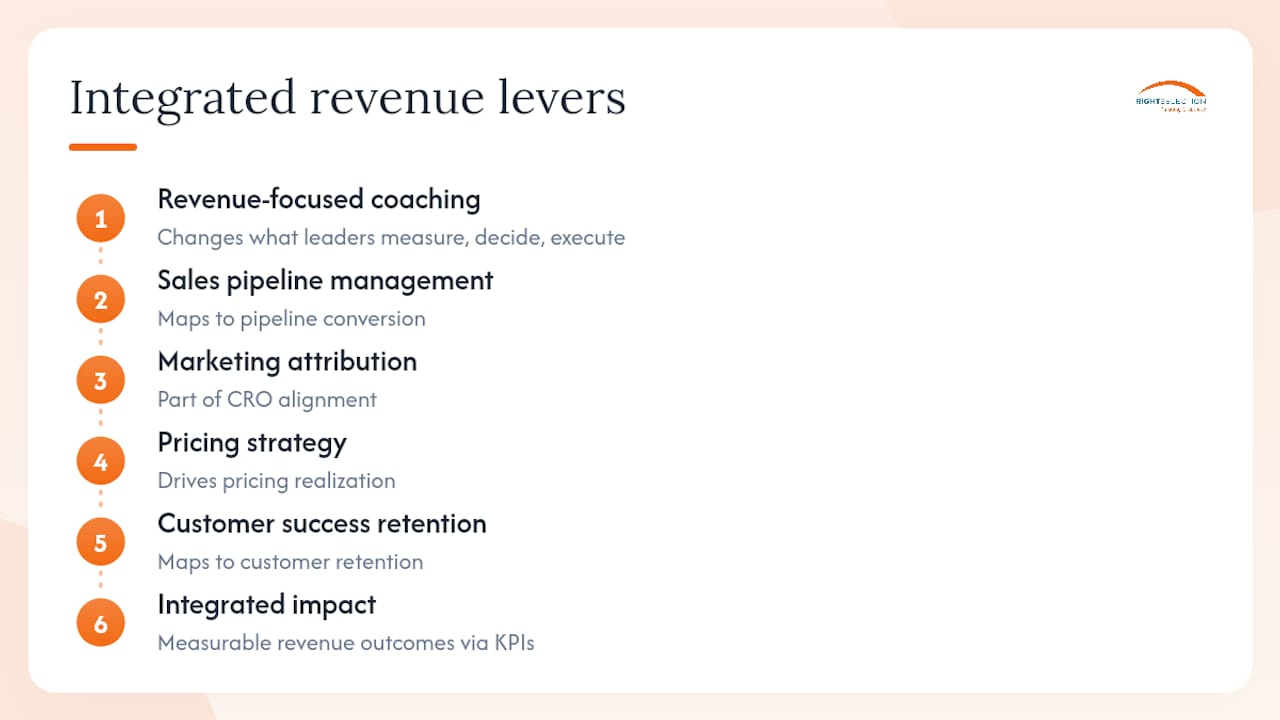
The short answer: generic leadership coaching improves how leaders think and communicate. Revenue-focused coaching changes what they measure, decide, and execute against commercial targets. The compound effect of that distinction shows up in the program design itself.
Programs built around CRO alignment connect four functions that generic coaching leaves separate: sales pipeline management, marketing attribution, pricing strategy, and customer success retention. When a coaching engagement is structured around those four levers simultaneously, the leader develops the cross-functional perspective that drives revenue, not just the self-awareness that improves relationships.
The Wharton CRO program illustrates this by teaching leaders to architect an end-to-end revenue engine that integrates AI-driven customer engagement with pricing and product decisions. Columbia Business School’s Emerging CRO Program adds a 5–6 month capstone structure that forces participants to apply learning directly to a real revenue challenge, shortening the time between insight and commercial impact. Chicago Booth’s CRO executive education goes further by incorporating revenue operations, pricing intelligence, and predictive analytics as core modules, not electives.
IE Business School’s Professional Diploma in Sales Strategy and Revenue Growth takes a practitioner approach: hands-on labs, CRM workflows, and AI-powered go-to-market systems taught over three months of full-time study. The emphasis on implementation, not just frameworks, is what separates programs that produce revenue outcomes from those that produce better-informed executives.
The mechanism that makes coaching stick is integration. High-impact executive coaching works best when it is embedded in broader organizational transformation rather than delivered as a standalone session. A leader who leaves a coaching session with new insight but returns to unchanged processes, misaligned incentives, and no CRM discipline will not move revenue. The coaching has to touch the system, not just the person.
Behavioral coaching linked to business KPIs and tracked through defined metrics is the structure that makes that integration measurable. When behavioral change is mapped to pipeline conversion, customer retention, or pricing realization, the coaching investment becomes a commercial decision, not a development budget line.
Key Takeaways
The most effective corporate coaching firms for revenue growth are those that tie coaching objectives to GTM metrics, integrate with RevOps processes, and build measurement plans before the first session begins.
| Point | Details |
|---|---|
| Revenue focus beats leadership focus | Choose firms that explicitly connect coaching to GTM metrics, pipeline data, and CRO alignment, not just leadership capability scores. |
| Capstone and pilot design accelerates impact | Programs with real-company application projects or 90-day pilots shorten the time between coaching investment and measurable commercial outcomes. |
| Coach pedigree determines contextual relevance | Coaches with direct C-suite or revenue-leadership experience produce more applicable insight than those with credentials alone. |
| Measurement plans must precede engagement | Define KPIs, tracking cadence, and success criteria before signing any coaching engagement to hold providers accountable to commercial results. |
| Right Selection for curated, KPI-linked engagements | Right Selection matches organizations with coaches from its global network and co-designs pilots tied to specific revenue KPIs from the outset. |
The case for specificity over scale in coaching selection
The instinct among enterprise buyers is to default to the largest, most recognizable firm on the shortlist. Korn Ferry’s scale, Deloitte’s brand, BetterUp’s platform analytics — these are real signals of capability. But scale is not the same as fit, and fit is what determines whether coaching moves revenue or simply moves through the budget.
The providers that produce the clearest evidence of revenue impact share one structural feature: they force specificity early. Wharton’s CRO program requires participants to apply learning to a real revenue challenge. Columbia’s capstone demands a deliverable. Right Selection’s discovery process starts with the revenue KPI before it starts with the coach. That sequencing, specificity before selection, is the discipline that separates a development investment from a commercial one.
Generic leadership programs are not without value. CCL’s assessment tools, FranklinCovey’s execution frameworks, and Vistage’s peer benchmarking all contribute to leadership quality. But if the mandate is measurable revenue growth within a defined timeframe, the evaluation criteria have to start with GTM alignment and measurement architecture, not coach reputation or program prestige. Reputation follows results; it does not guarantee them.
The organizations that get the most from coaching are those that treat it as a commercial initiative with a measurement plan, not a development benefit with a satisfaction survey. That framing changes which provider you choose, which questions you ask, and which outcomes you hold the engagement accountable to.
Book a complimentary discovery call with Right Selection
Right Selection offers a complimentary discovery call for organizations evaluating coaching partners for revenue-focused engagements. With over 30 years of experience and a curated network of 100+ global coaches and thought leaders, Right Selection helps you skip the shortlisting work and move directly to a matched, pilot-ready engagement.
The call delivers three things:
- A curated shortlist of coaches from Right Selection’s network matched to your specific revenue challenge and GTM context
- A recommended set of discovery questions to use with any provider you evaluate, including the six-question procurement script from this article
- Pilot design advice: how to structure a 90-day engagement tied to measurable GTM metrics so the investment is accountable from day one
Book your complimentary coaching call and come prepared with your top revenue KPI. That is the starting point for every engagement Right Selection designs.
Useful sources and Right Selection resources
External research and program pages:
- Chief Revenue Officer (CRO) Program – Executive Education | Wharton Executive Education
- Emerging Chief Revenue Officer Program | Columbia Business School Executive Education
- Sales Strategy & Revenue Growth | IE Business School
- Chief Revenue Officer (CRO) Program – Executive Education | Chicago Booth
- Revenue Growth Strategy: Market Expansion & Sales Excellence | Cedex Training Institute
- Drive Revenue Growth Through CRM Automation
- Executive Coaching Best Practices for Corporate Leaders
- Behavioral Coaching for Executives: A 2026 Guide
Right Selection resources:
- Executive Coaching Best Practices for Corporate Leaders: practical checklist for data-driven coaching programs tied to business outcomes
- Behavioral Coaching for Executives: A 2026 Guide: how to map behavioral change to business KPIs and track outcomes
- Why Executive Coaching Improves Decision-Making for Leaders: the case for matching executives to coaches with relevant operational experience
A note on interpreting case-study claims: Public case studies from vendors describe outcomes under favorable conditions and are not independently audited. Where this article cites vendor case studies, they are labeled as such. Academic program outcomes (Wharton, Columbia, Chicago Booth, IE) reflect program design and stated learning objectives rather than post-program revenue tracking. Use both as directional evidence, not guarantees, and always request a client reference from your own industry before committing to an engagement.