

A motivational speaker is defined as a professional who delivers high-impact presentations designed to shift mindset, build emotional resilience, and inspire action, while a trainer is a professional who designs and delivers instructional content to build specific, repeatable skills. Understanding what is a motivational speaker vs trainer is the most important decision you face when planning a development investment for yourself or your organization. Choose the wrong role and you spend real budget on the wrong outcome. The distinction is not about stage presence or speaking ability. It is about matching the method to the result you need.
What is a motivational speaker vs trainer: the core distinction
The core distinction comes down to purpose. Speakers inspire, trainers build skills, and the two objectives require fundamentally different approaches. A motivational speaker addresses how people feel and think. A trainer addresses what people can do.

Confusing these roles is one of the most common and costly mistakes organizations make. Booking a speaker to fix a skill gap produces an energized team that still cannot perform the task. Booking a trainer to lift morale produces a room full of people who learned a process but still feel disengaged. The difference between speaker and trainer is not cosmetic. It shapes whether your investment produces lasting change.
Right Selection has spent over 30 years curating professionals across both categories. That experience confirms one consistent truth: the method must match the outcome, not the other way around.
What does a motivational speaker do?
A motivational speaker delivers short, high-impact sessions focused on emotional transformation and mindset shifts, typically lasting 30–60 minutes. The goal is not to teach a process. The goal is to change how the audience sees themselves, their challenges, and their potential.
The motivational speaker role centers on four core objectives:
- Mindset shift: Reframing limiting beliefs and replacing them with a growth perspective
- Emotional resilience: Building the psychological capacity to face setbacks and persist
- Belief building: Strengthening confidence in individual and collective capability
- Inspiration to act: Creating the emotional energy that precedes behavior change
Speakers achieve these outcomes through storytelling, vocal tone, and body language. Posture, eye contact, facial expression, and voice modulation work together to create an emotional connection that data and slides cannot replicate. The audience does not leave with a workbook. They leave with a different perspective.
The motivational speaker role fits best in specific situations: a company-wide kickoff before a major change initiative, a sales conference where belief and energy have dropped, a leadership summit where culture needs to shift, or a school event where students need to reconnect with their potential.
Pro Tip: When evaluating a speaker, ask for a sample of their storytelling, not just their topic list. The story is the mechanism. If the story does not land emotionally, the mindset shift will not happen.
What does a trainer do?
A trainer designs and delivers instructional content to develop repeatable skills and behaviors through exercises, frameworks, and action plans. The trainer job description is fundamentally about behavioral change, not emotional inspiration. Trainers measure success by what participants can do after the session, not how they felt during it.
The trainer’s delivery style reflects this focus. Sessions run longer, often half a day or multiple days, and include hands-on practice, role plays, case studies, and structured feedback. The learning is active, not passive. Participants apply the skill in a safe environment before taking it back to the workplace.
Core elements of effective training include:
- Instructional design: Content structured around learning objectives with clear progression
- Skill practice: Repeated application of the target behavior within the session
- Frameworks and tools: Transferable models participants can use independently
- Action planning: Defined next steps that connect learning to real work
One critical nuance: training effectiveness depends on culture and follow-up. Skills acquired in a workshop degrade quickly when the workplace environment does not reinforce them. A trainer builds the capability. The organization must sustain it.
Pro Tip: Before booking a trainer, define the specific behavior you want participants to demonstrate after the session. If you cannot state it as an observable action, the training objective is not clear enough yet.
Key differences between motivational speakers and trainers
The speaker vs trainer comparison becomes most useful when you map it against four dimensions: session design, audience engagement, primary outcome, and appropriate use case.
| Dimension | Motivational speaker | Trainer |
|---|---|---|
| Session length | 30–60 minutes | Half day to multiple days |
| Interaction style | One-way delivery with audience energy | Two-way, participatory, practice-based |
| Primary outcome | Mindset shift, emotional energy, belief | Skill acquisition, behavioral change |
| Measurement | Audience sentiment, energy, feedback | Pre/post skill assessment, behavior observation |
| Best use case | Culture shifts, morale, kickoffs, inspiration | Closing knowledge gaps, building new capabilities |
| Accountability | Ends with the session | Requires follow-up and reinforcement |
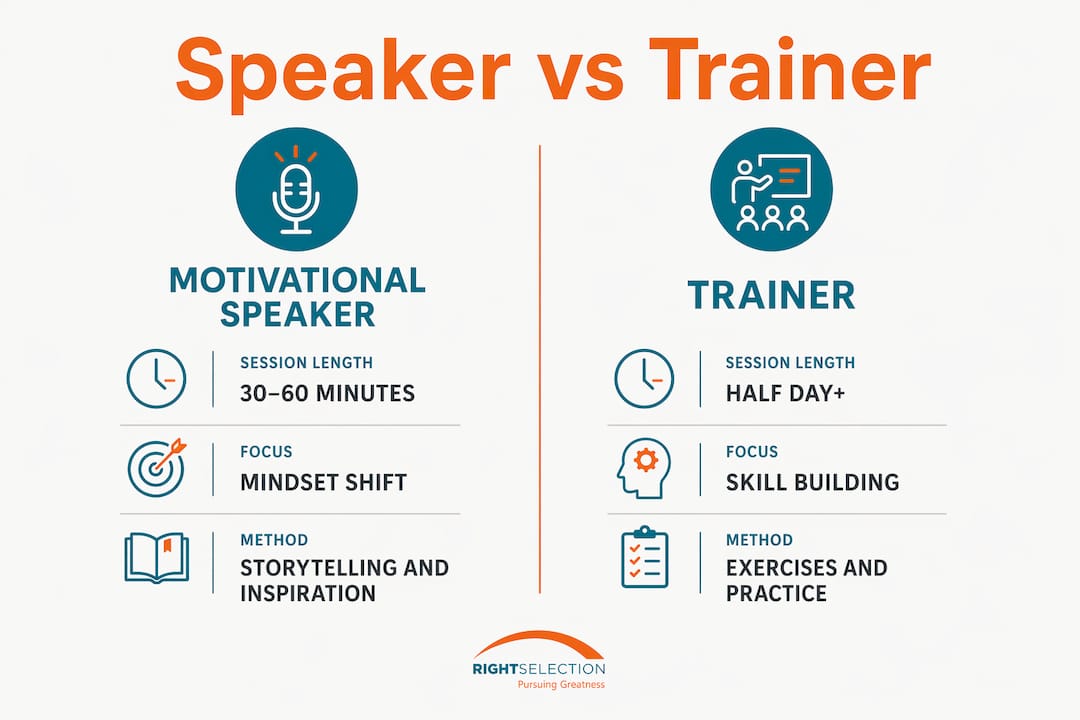
Speakers address culture and mindset issues while trainers address skill and knowledge gaps. These are different organizational problems. A demoralized sales team and an undertrained sales team look similar on the surface. The right diagnosis determines the right intervention.
Facilitators and coaches occupy adjacent roles worth knowing. A facilitator guides a group through collaborative problem-solving without providing the answers. A coach provides individualized, ongoing accountability and skill mastery over time. Neither is a speaker or a trainer, though all four roles can work together in a layered development program.
How to choose between a motivational speaker and a trainer
The decision starts with an honest diagnosis of the problem you are trying to solve. Ask these questions before you book anyone:
- Is the issue mindset or skill? If your team knows how to do the work but lacks belief or energy, a speaker fits. If they do not yet know how to do the work, a trainer fits.
- What does success look like 90 days from now? If success is a cultural shift or renewed commitment, a speaker delivers that. If success is a measurable behavior change, training delivers that.
- How much time can you allocate? Speakers work within tight event schedules. Training requires dedicated time away from daily responsibilities.
- What follow-up is in place? If no reinforcement structure exists, training outcomes will fade. Plan for coaching or manager support before you book a trainer.
- Is this a one-time event or an ongoing program? Speakers suit events. Trainers suit programs. Coaches suit sustained individual development.
Combining motivational speakers and trainers produces the strongest results when both are sequenced deliberately. A speaker opens a conference by shifting the room’s energy and belief. A trainer follows with the specific skills needed to act on that new belief. The compound effect of inspiration plus capability is significantly greater than either alone.
When planning a corporate event that includes both roles, coordinating the sequence and logistics matters as much as the content itself. A corporate event planner can help you structure the day so the speaker’s energy carries into the training rather than dissipating between sessions.
Real-world examples of speakers and trainers in action
The distinction becomes concrete when you see it applied. Three scenarios illustrate how the choice plays out in practice.
Scenario 1: Culture shift before a merger. A financial services firm facing a major acquisition booked a motivational speaker for an all-hands event. The speaker used personal storytelling to address fear of change and rebuild belief in the leadership team’s direction. Attendance energy shifted visibly. The speaker did not teach integration processes. That came later in structured workshops.
Scenario 2: Sales skill gap. A technology company noticed its sales team consistently lost deals at the negotiation stage. A trainer ran a two-day negotiation skills program with role plays and recorded practice sessions. Win rates at that stage improved measurably within one quarter. A speaker would not have produced that result.
Scenario 3: Combined approach for sustained change. A healthcare organization used a motivational speaker to open its annual leadership conference, then followed with a three-day training program on coaching skills for managers. Six months later, a coach provided individual accountability sessions. The layered approach produced both the cultural energy and the behavioral capability needed for lasting improvement.
Common pitfalls across all three scenarios include:
- Booking a speaker to solve a skill problem and wondering why nothing changed
- Running training without follow-up and watching skills evaporate within weeks
- Skipping the diagnostic step and defaulting to whoever is available or affordable
Success depends on matching the approach to the intended outcome, not on the presenter’s reputation or charisma alone.
Key Takeaways
The single most important principle in choosing between a motivational speaker and a trainer is this: the method must match the outcome you need, not the budget you have or the event you are planning.
| Point | Details |
|---|---|
| Speakers shift mindset | Book a motivational speaker when the core issue is belief, energy, or cultural perspective. |
| Trainers build skills | Book a trainer when the core issue is a knowledge or behavioral gap that requires practice. |
| Diagnosis comes first | Identify whether the problem is mindset or skill before selecting any professional. |
| Reinforcement is non-negotiable | Training without follow-up coaching or cultural support produces short-lived results. |
| Combining both multiplies impact | Sequencing a speaker before training amplifies motivation and embeds new skills more effectively. |
Why I think most organizations get this wrong
The most persistent mistake I see is organizations treating the speaker vs trainer decision as a procurement choice rather than a diagnostic one. Someone books a speaker because the conference needs a keynote. Someone books a trainer because HR said there should be a workshop. Neither decision starts with the question that actually matters: what specific change do we need, and what mechanism produces that change?
I have watched well-funded organizations bring in genuinely talented speakers to address performance problems that were entirely skill-based. The room loved it. Nothing changed. The speaker was not the problem. The diagnosis was.
The reverse happens too. A team that is technically capable but emotionally checked out gets put through a two-day training program. They learn the framework. They still do not care. Because the real issue was never skill. It was belief and belonging, and those require a different kind of intervention.
The most effective development investments I have seen use a layered approach: a speaker to build culture and shift perspective, a trainer to deliver tools and practice, and a coach for individual accountability over time. That sequence respects what each role actually does. It also respects the audience, because it gives people both the reason to change and the means to do it.
The executive coaching practices that produce the most durable leadership growth always sit downstream of both speaking and training. Coaching without the prior context rarely sticks. Context without coaching rarely compounds.
My recommendation: start with the outcome, work backward to the method, and resist the temptation to default to what is familiar or convenient.
— Dipti
Right Selection: matching you with the right professional
Right Selection connects organizations and individuals with a curated network of over 100 global thought leaders, motivational speakers, and corporate trainers, each selected for their ability to produce specific, measurable outcomes.

The process starts with understanding your goal, not browsing a catalog. Right Selection’s team works with you to diagnose whether your challenge calls for a speaker, a trainer, a coach, or a combination of all three. Speakers like Paul McKenna bring deep expertise in mindset and behavioral change. Every recommendation is matched to your audience, your context, and your desired result. Book a complimentary coaching call to start the conversation, or visit Right Selection to explore the full roster of speakers and trainers available for your next event or program.
FAQ
What is the main difference between a speaker and a trainer?
A motivational speaker focuses on inspiring mindset shifts and emotional energy, typically in sessions lasting 30–60 minutes. A trainer focuses on building specific, repeatable skills through structured practice and longer instructional sessions.
When should I book a motivational speaker instead of a trainer?
Book a motivational speaker when your team’s core challenge is belief, morale, or cultural perspective rather than a knowledge or skill gap. Speakers are most effective at company kickoffs, leadership summits, and culture change events.
Can a motivational speaker also be a trainer?
Some professionals hold both capabilities, but the roles require different design approaches and delivery skills. A speaker who also trains should be evaluated separately for each function before you book them for both.
How do I know if my organization needs a trainer or a speaker?
Ask whether your team knows how to do the work but lacks motivation, or whether they genuinely lack the skill to do it. The first calls for a speaker; the second calls for a trainer.
What does a trainer do that a coach does not?
A trainer delivers structured content to a group to build defined skills within a set timeframe. A coach works one-on-one over an extended period to develop individual capability and provide ongoing accountability.