
Enterprise leadership transformation is defined as the deliberate shift in leadership mindset, behaviors, and organizational practices that enables leaders to drive enterprise-wide strategic change rather than optimize within a single function. This is distinct from standard leadership development or incremental operational improvement. Where functional leadership focuses on departmental goals, enterprise leadership transformation requires leaders to think, communicate, and act across the entire organization. The process involves four core dimensions: leader enablement, people engagement, executional certainty, and culture reshaping. Research confirms that enterprise transformation requires fundamental shifts in operating models, not just incremental improvements, and that the complexity involved produces high failure rates and multi-year timelines. Getting this right separates organizations that sustain competitive advantage from those that stall mid-change.
What is enterprise leadership transformation and how does it differ from other change?
Enterprise leadership transformation is less about the technical aspects of change and more about motivating behavior and mindset shifts across the entire organization. That distinction matters because most transformation efforts fail not due to flawed strategy but due to leadership misalignment and human resistance.
The contrast with functional leadership is sharp. A functional leader optimizes a department. An enterprise transformation leader aligns people, culture, and execution across every layer of the business. The mindset shift required moves leaders from optimizing functional goals to leading company-wide change. That shift is harder than it sounds because it requires leaders to relinquish control over familiar metrics and accept accountability for outcomes they do not directly manage.
Enterprise leadership transformation is also multidimensional. It operates across at least four distinct layers:
- Mindset: Leaders must move from a command-and-control orientation to one that prioritizes empathy, inclusion, and shared accountability.
- Behaviors: Daily actions, communication patterns, and decision-making must visibly model the culture the organization wants to build.
- Organizational structure: Roles, decision rights, and governance must be redesigned to support enterprise-wide coordination.
- Culture: The underlying beliefs and norms that drive behavior must be actively reshaped, not just described in a values document.
High complexity, long timelines, and high failure rates characterize this type of change. That is not a reason to avoid it. It is a reason to approach it with the right frameworks and sustained commitment.
Which leadership strategies drive successful transformation?
Successful enterprise leadership transformation depends on leader enablement as its foundation. Effective leaders articulate what stays the same versus what changes, giving employees a clear and consistent case for why the transformation is necessary. Without that clarity, middle managers fill the vacuum with their own interpretations, and alignment breaks down fast.

The most effective transformation leaders integrate what researchers describe as head, heart, and hands. Transformational leaders balance cognitive, emotional, and practical skills to inspire and enable change. Head means rational clarity about the strategy. Heart means emotional connection to the people affected. Hands means practical, visible action that demonstrates commitment.
Pro Tip: Map your leadership team against all three dimensions before launching a transformation. A team strong on strategy but weak on emotional connection will lose employees in the first 90 days.
A structured approach to execution matters equally. The steps below reflect what high-performing transformation programs consistently apply:
- Define the case for change. Make it specific, honest, and tied to business outcomes employees can see.
- Clarify leader roles and decision rights. Ambiguity at the leadership level creates paralysis below it.
- Establish a transformation office. This body governs activities, sets cadence, and holds leaders accountable.
- Build a communication rhythm. Weekly leadership team meetings and quarterly town halls keep the transformation visible and aligned.
- Model the behaviors publicly. Senior leaders must demonstrate the new culture in every meeting, decision, and interaction.
Transformation offices enhance success by creating governance structures and driving accountability through leadership forums. Organizations that skip this step often find their transformation efforts drifting within 12 months.
How does leadership transformation impact culture, engagement, and outcomes?
Culture reshaping is not a byproduct of enterprise leadership transformation. It is a core deliverable. Leader modeling of behaviors such as transparency leads to sustainable culture shifts when those behaviors are embedded into daily routines and measured with quantifiable metrics. Culture changes when leaders change what they do every day, not when they update a slide deck.
The business case for human-centric transformation is clear. Companies making people-centered change management integral outperform peers by 15% in total shareholder return. That figure reflects the compound effect of higher engagement, lower resistance, and faster execution across the organization.
Employee engagement rises when leadership communication aligns with organizational goals. Regular updates, town halls, and feedback loops increase workforce engagement and reduce transformation resistance. Employees who understand the direction and feel heard are far more likely to sustain changed behaviors over time.
The table below summarizes the key impact areas and what drives results in each:
| Impact Area | What Drives Results |
|---|---|
| Culture change | Senior leaders modeling target behaviors daily |
| Employee engagement | Consistent, transparent communication at all levels |
| Productivity | Clarified roles, decision rights, and reduced ambiguity |
| Business performance | Human-centric execution linked to 15% higher TSR |
| Transformation durability | Transformation office governance and accountability cadence |
Diagnostic tools that measure leadership behavior and culture progress are not optional extras. They are the mechanism by which executives confirm whether the transformation is taking hold or stalling. Without measurement, leaders are managing by assumption.
What practical steps can executives take to lead transformation?
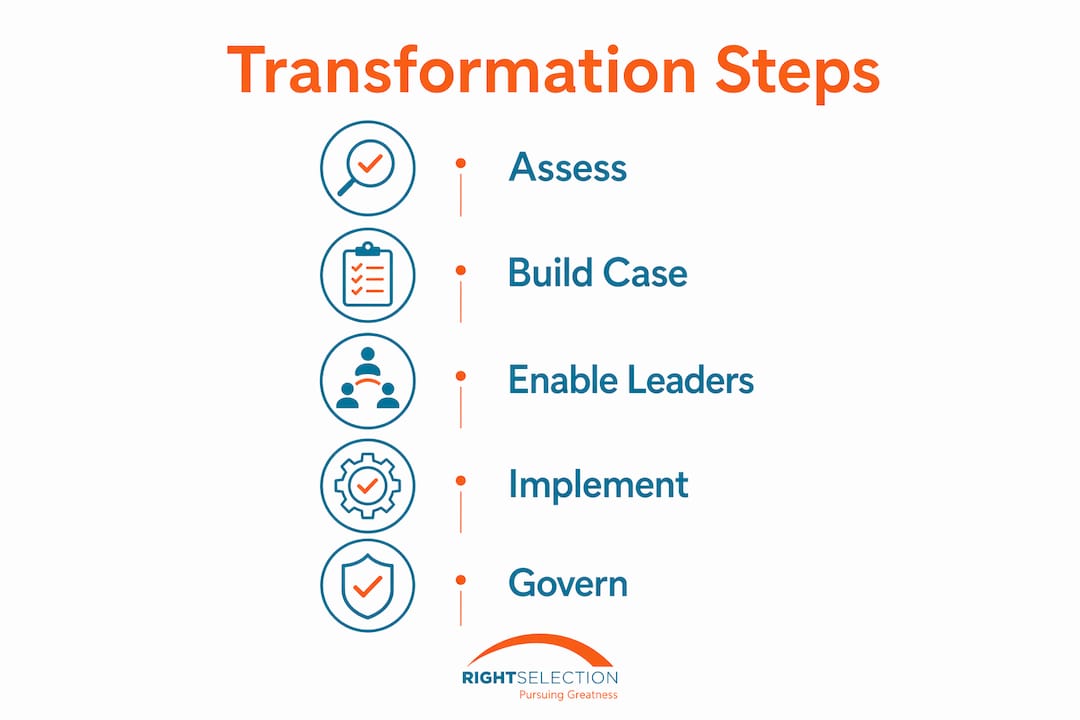
Assessing current leadership capabilities is the right starting point. You cannot design a transformation program without knowing where your leaders actually are, not where they think they are. A structured capability assessment, combined with an organizational readiness review, gives you an honest baseline. That baseline shapes every decision that follows, from coaching priorities to governance design.
Building the transformation case comes next. The case must connect to business strategy in terms that every level of the organization can understand. Vague aspirations about “becoming more agile” do not move people. Specific commitments, such as reducing decision cycle times or entering new markets within 18 months, create accountability and urgency.
Mobilizing leadership at all levels requires more than a single training event. Executive coaching best practices show that sustained behavioral change comes from ongoing coaching, peer accountability, and real-time feedback, not from a two-day offsite. The goal is to build leaders who can carry the transformation forward independently.
The practical steps that sustain momentum over time include:
- Set up a transformation office with clear governance, defined milestones, and named accountability owners.
- Establish a communication cadence that reaches every level of the organization on a predictable schedule.
- Use behavioral and performance metrics to track progress, not just financial outputs.
- Create feedback loops that allow employees to surface resistance and confusion before they become crises.
- Reinforce culture through recognition by publicly acknowledging leaders and teams who demonstrate the target behaviors.
Pro Tip: Treat your transformation office as a permanent capability, not a project team. Organizations that dissolve the office after the initial rollout consistently see regression within two years.
Leadership training best practices confirm that programs tied to measurable business outcomes outperform generic development curricula. Align every training and coaching investment to a specific transformation milestone.
Key Takeaways
Enterprise leadership transformation succeeds when human-centric execution, leader enablement, and governance structures work together as a system rather than as separate initiatives.
| Point | Details |
|---|---|
| Definition clarity | Enterprise leadership transformation shifts leaders from functional to enterprise-wide thinking and accountability. |
| Human-centric execution | People-centered transformation programs outperform peers by 15% in total shareholder return. |
| Transformation office | A dedicated governance body with weekly and quarterly cadences keeps transformation aligned and visible. |
| Leader behavior modeling | Senior leaders must demonstrate target behaviors daily to drive sustainable culture change. |
| Sustained coaching | Ongoing coaching and feedback loops, not one-time training, produce lasting leadership behavior change. |
Why the human side is where most transformations actually fail
Most executives I work with understand the strategic logic of their transformation. They have the roadmap, the milestones, and the business case. What catches them off guard is how quickly the human side overwhelms the technical side.
The failure point is almost never the strategy. It is the moment when middle managers, uncertain about their own roles, start filtering the transformation message before it reaches frontline employees. By the time the CEO’s vision reaches the people who execute it daily, it has been diluted, reinterpreted, or quietly shelved.
What I have seen work consistently is radical clarity at the leadership level before any broader rollout begins. When leaders know exactly what is expected of them, what decisions they own, and what behaviors they must model, the transformation has a real foundation. Without that clarity, you are asking people to change without giving them the tools to do so.
The other pattern worth naming is the tendency to treat communication as a launch activity rather than an ongoing discipline. Transformation requires constant communication and clear change narratives sustained over months and years, not weeks. The organizations that get this right build communication into their governance structure so it cannot be deprioritized when things get busy.
Executional certainty, delivered through a well-run transformation office, is what separates transformations that stick from those that fade. The organizational transformation through leadership work that produces lasting results always has this structure underneath it.
— Dipti
Right Selection supports your leadership transformation goals
Enterprise leadership transformation requires the right people in the room, not just the right frameworks on paper. Right Selection connects organizations with a curated network of over 100 global thought leaders, executive coaches, and corporate trainers who specialize in exactly this work.
Whether you need a keynote speaker to launch your transformation program, a coach to work directly with your senior leadership team, or a structured development series aligned to your business goals, Right Selection designs each engagement around your specific outcomes. With over 30 years of experience, the team brings the discernment to match the right voice to the right moment in your transformation. Explore leadership development solutions at Right Selection, or book a complimentary coaching call to discuss your organization’s needs directly.
FAQ
What is enterprise leadership transformation in simple terms?
Enterprise leadership transformation is the process of shifting leaders from managing within a single function to driving change across the entire organization. It involves new mindsets, behaviors, governance structures, and culture practices aligned to enterprise-wide goals.
How long does enterprise leadership transformation typically take?
Enterprise transformation operates on multi-year timelines due to its complexity and the depth of behavioral and cultural change required. Organizations that expect results within 12 months consistently underestimate the scope.
What is the biggest reason enterprise leadership transformations fail?
The primary failure point is the human side: unclear leader roles, inconsistent communication, and unmanaged resistance at the middle management level. Technical strategy rarely causes failure on its own.
How does a transformation office support leadership change?
A transformation office provides governance, sets accountability, and maintains a communication cadence through weekly leadership meetings and quarterly town halls. It keeps the transformation visible and prevents drift.
How does enterprise leadership transformation affect employee engagement?
Regular, transparent communication aligned with organizational goals increases workforce engagement and reduces resistance. Human-centric transformation programs are linked to measurably stronger business performance over time.