
The most effective way to prepare for your first executive coaching session is to arrive with clear goals, relevant context, and a genuine readiness to engage. Sessions typically run 50–90 minutes and cover psychological contracting, rapport building, goal clarification, and confidentiality terms. Clients who treat this opening session as a working meeting rather than an orientation get measurably more from it.
Here is what to have ready before you walk in:
- Your top two or three leadership challenges you want coaching to address
- Recent feedback data, such as 360-degree reviews or performance assessments
- A sense of your organizational priorities and how your development connects to them
- Questions for your coach about methodology, cadence, and confidentiality
- An open mindset, ready to be challenged, not just affirmed
The compound effect of good preparation starts in session one. Coaches can work at a deeper level when you bring context rather than waiting to be asked for it.
How do you prepare for your first executive coaching session?
Your role in the first session is active, not passive. The coach facilitates, but you set the direction. Early alignment on organizational context and coaching methodology creates the conditions for real leadership development, not just conversation.

A typical session moves through four phases: introduction and rapport, exploration of current challenges, goal clarification, and contracting on logistics and confidentiality. Each phase builds on the last. If you arrive without a clear sense of what you want to work on, the session will spend its best time on orientation rather than depth.

Confidentiality boundaries deserve particular attention when your coaching is sponsored by your organization. Knowing what your coach shares with HR or your manager, and what stays private, is foundational to psychological safety. Ask directly. A good coach will welcome the question.
Mentally, prepare to own the session:
- Come with a point of view, not just open-ended curiosity
- Be willing to surface tensions or contradictions in your own thinking
- Resist the urge to present a polished version of yourself
- Treat the coach’s challenges as data, not criticism
How should you set goals before the first session?
Goal clarity is the single biggest driver of coaching effectiveness. Locke and Latham’s research on goal-setting theory consistently links well-defined goals to sustained behavioral change, and executive coaching is no exception.
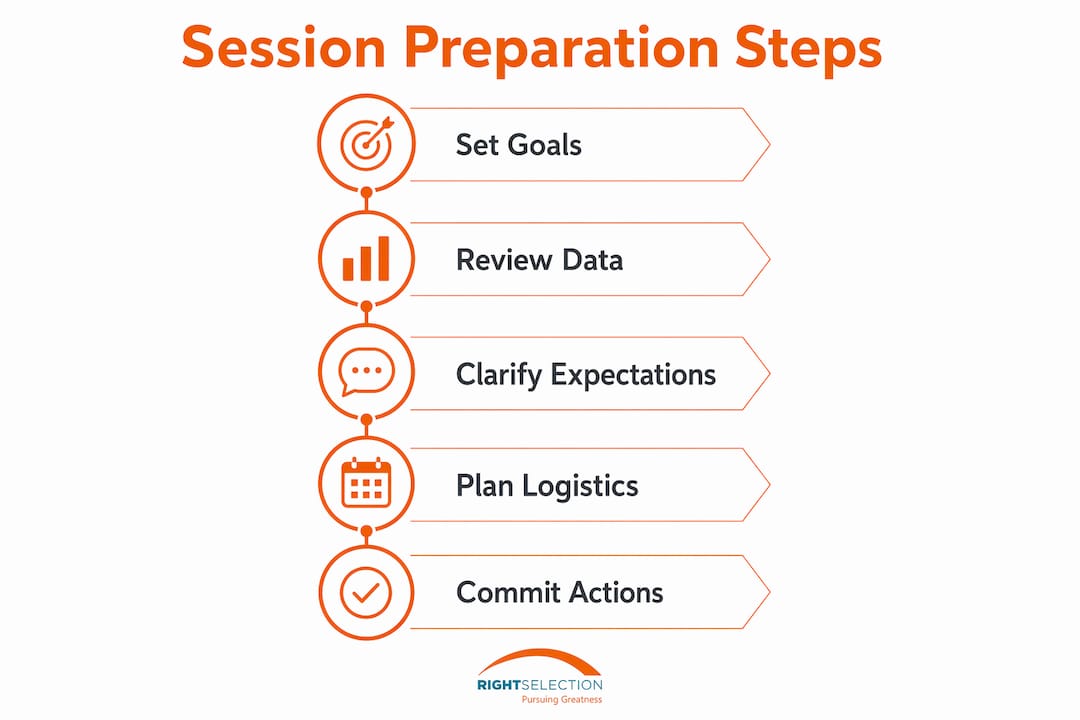
Goals in leadership coaching fall into three categories. Strategic goals address outcomes you want to influence, such as improving cross-functional decision-making. Behavioral goals target how you show up, such as listening before responding in high-stakes meetings. Developmental goals focus on building new capabilities over time, such as leading through ambiguity. The most productive coaching engagements address all three, with clarity on which matters most right now.
Before your session, work through these questions:
- What specific leadership behavior do I want to change or strengthen?
- How will I know, concretely, that coaching has worked?
- Which organizational priorities does this development connect to?
- What has already gotten in the way of this change?
Pro Tip: Link each goal to an observable behavior. “Become a better communicator” is too broad. “Reduce the number of times I interrupt in executive meetings” gives your coach something to work with and gives you something to measure.
Explore goal-setting in coaching to understand how progress tracking reinforces commitment across the full engagement.
What practical steps help you prepare before the session?
Preparation is not just mindset. It is also logistics and data. Reviewing recent 360-degree feedback, psychometric results, or performance assessments before the session gives your coach immediate, relevant material to work with rather than spending time gathering basic context.
A pre-coaching questionnaire, if your coach sends one, deserves thoughtful answers. Treat it as the first act of coaching, not administrative paperwork. Your responses shape the entire opening conversation.
Practical steps worth taking in the days before:
- Block 30 minutes before the session to review your notes and center your thinking
- Choose a quiet, private space where you will not be interrupted
- Write down two or three situations where your leadership felt tested recently
- Note any feedback you have received that surprised or unsettled you
Pro Tip: Keep a dedicated notebook or digital document for your coaching journey. Writing down insights before and after each session builds a record of your thinking that becomes genuinely useful by session three or four.
For a broader view of executive coaching best practices, Right Selection’s resources cover both the psychological and practical dimensions of preparation.
How do you maximize value from ongoing executive coaching?
The first session creates momentum. Sustaining it requires commitment between sessions, not just during them. Most executive coaching engagements run on a 2–3 week cadence, which gives you enough time to test new behaviors in real situations and reflect on what happened before the next conversation.
Clients who commit to specific actions after each session build accountability into the process from the start. Implementation intentions, planning exactly when and how you will take a new action, significantly improve follow-through. “I will ask one clarifying question before responding in Tuesday’s leadership team meeting” is more likely to happen than “I will practice listening.”
Ongoing responsibilities that protect your coaching investment:
- Apply at least one insight from each session in a real work situation before the next
- Bring observations from that application back to the following session
- Review and refine your goals with your coach every few sessions as context evolves
- Communicate openly when the coaching focus needs to shift
Understanding how coaching improves decision-making over time helps you recognize the behavioral shifts that signal real progress.
What do experts say makes the first coaching session effective?
The leaders who get the most from executive coaching arrive prepared with data and a point of view. Those who wait for the coach to lead the agenda tend to spend the early sessions on orientation rather than development. That gap in preparation is the primary difference between a coaching engagement that transforms leadership and one that produces interesting conversations.
Psychological contracting at the start of the relationship, establishing trust, defining confidentiality, and aligning on methodology, creates the conditions for Theeboom et al.’s (2014) finding that early alignment leads to sustained behavioral change and measurable business outcomes.
Key factors that distinguish high-impact first sessions:
- The client brings specific situations, not abstract concerns
- Confidentiality is discussed openly and early
- Goals are tied to observable leadership behaviors
- The coach and client agree on how success will be measured
Right Selection’s network of coaches brings over 30 years of experience designing sessions that move from rapport to real work quickly. The coaching framework that underpins effective first sessions prioritizes psychological safety alongside rigorous goal-setting, because neither works without the other.
How do you communicate your expectations to the coach before the session?
Send a brief note or complete the intake form with honesty. Name what you hope to work on, what you have already tried, and what kind of challenge you respond well to. Coaches calibrate their approach based on this input. A client who says “I tend to intellectualize feedback rather than act on it” gives the coach a meaningful starting point.
If your organization is sponsoring the coaching, clarify your expectations about stakeholder involvement before the first session. Knowing whether your manager will receive progress updates changes how openly you can engage. Raise this with your coach directly, and if the answer does not satisfy you, that is worth discussing before the relationship begins.
What challenges come up in the first session and how do you handle them?
The most common challenge is the urge to present well rather than engage honestly. Executives accustomed to projecting confidence can find it uncomfortable to surface genuine uncertainty in front of someone new. The antidote is remembering that the coach’s value lies precisely in working with the unpolished version of your thinking.
A second challenge is goal ambiguity. Many professionals arrive knowing something needs to change but without the language to name it precisely. That is fine. Part of the first session’s purpose is to surface and sharpen that clarity together. Bring your best current thinking and let the coach help you refine it.
A third challenge is unrealistic expectations about pace. Executive coaching produces behavioral change over months, not weeks. The first session plants the seed; the harvest comes from consistent application between sessions.
What questions should you expect your coach to ask?
Prepare to answer these with specificity, not generality:
- What brought you to coaching at this particular moment?
- What does success look like for you six months from now?
- How will you know, concretely, that something has changed?
- What have you already tried, and what happened?
- What beliefs or habits might get in the way of this change?
- What kind of challenge or feedback lands best for you?
The question “how will you know when you’ve achieved it” is the one most clients underestimate. It forces you to articulate evidence of success, which makes the goal trackable and reveals whether you have genuinely thought through what you want.
How do you build a follow-up plan after the first session?
End the session by naming one concrete action you will take before the next meeting. Not a list. One specific, achievable commitment that represents a meaningful first step. Then write it down, with a date.
A solid post-session plan includes four elements: the committed action and its deadline, two or three observations to bring back to the next session, a note on which goal feels most alive right now, and any questions that surfaced during the session that you want to return to. This structure takes ten minutes to complete and makes the gap between sessions productive rather than passive.
Explore how Right Selection supports career transitions through coaching to understand how follow-up planning fits into a longer development arc.
Key Takeaways
Preparing well for your first executive coaching session means arriving with clear goals, relevant data, and a genuine commitment to honest engagement rather than polished self-presentation.
| Point | Details |
|---|---|
| Session length and structure | First sessions typically run 50–90 minutes, covering contracting, rapport, goal setting, and next steps. |
| Goal clarity drives outcomes | Well-defined goals, linked to observable behaviors, are strongly correlated with coaching effectiveness. |
| Preparation depth matters | Bringing 360 feedback, performance data, and specific situations shifts coaching from generic to targeted. |
| Between-session commitment | A 2–3 week cadence with specific committed actions builds accountability and behavioral momentum. |
| Psychological contracting | Early alignment on confidentiality and methodology creates the trust that makes honest engagement possible. |
Ready to start your coaching journey?
Right Selection connects professionals with an elite network of coaches who specialize in exactly this kind of high-impact leadership development. Whether you are preparing for your first session or looking to deepen an existing engagement, the right coach makes the difference between reflection and transformation.
Book a complimentary coaching call with Right Selection today and arrive at your first session with a clear direction, a prepared mindset, and a coach who meets you at the right level of depth from the very first conversation.