
Executive learning is defined as the structured development of leadership capabilities that translate directly into measurable business performance and sustainable organizational expansion. For corporate executives and managers, understanding the role of executive learning in growth is not an academic exercise. It is a practical necessity. Organizations that treat leadership development programs as a core business function, rather than a periodic benefit, consistently outperform those that treat it as a line item to cut. The evidence is clear: executive education impact compounds over time, shaping how leaders make decisions, build teams, and scale results.
How do leadership development programs influence organizational growth outcomes?
Leadership development programs deliver growth by changing how executives think and act under pressure. The structure of these programs matters as much as the content. Executive leadership programs in 2026 typically last 3 to 9 months and cost approximately $7,500 per participant for mid-to-senior level courses. That investment reflects the depth of behavioral change these programs are designed to produce, not just knowledge transfer.
The most effective programs include three components that drive real-world behavior change:
- Capstone projects that require participants to apply learning to live business challenges within their own organizations
- Executive coaching that provides one-on-one accountability and reflection between formal sessions
- Peer cohort work that exposes leaders to cross-industry problem-solving and diverse decision-making models
Impact measurement is common immediately post-program, with 93% of business schools tracking participant outcomes right after completion. Only 40% track organizational impact six months later. That gap reveals a critical blind spot: the most significant growth outcomes from executive education often surface months after the program ends, not immediately.
The programs that close this gap share one design principle. They build transfer-of-learning strategies into the curriculum from day one. Action learning and capstone projects prevent knowledge decay and improve behavior change by anchoring new thinking to real decisions executives face the following week. This is what separates programs that produce growth from those that produce certificates.

Pro Tip: When evaluating a leadership development program, ask the provider how they measure behavioral change at 90 and 180 days post-completion. Programs that cannot answer this question are measuring activity, not impact.
What challenges exist in sustaining the benefits of executive learning?
The biggest threat to executive education impact is not poor program design. It is what happens the week after the program ends. Up to 100% of new information is lost within 24 hours without immediate reinforcement. That figure is not a warning. It is a structural reality that every learning strategy for leaders must account for.
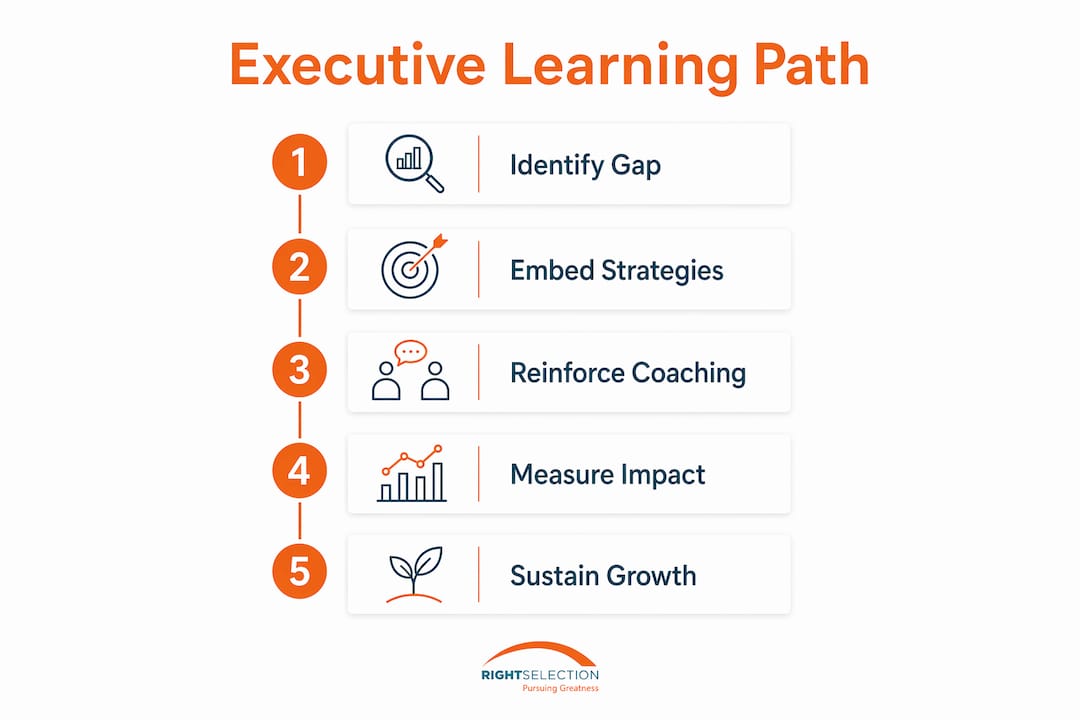
Organizations that recognize this shift away from one-off training events toward continuous, integrated learning processes. The difference in outcomes is significant. A single two-day workshop produces a temporary mindset shift. A six-month program with embedded coaching, peer accountability, and real project application produces durable behavior change.
Four practices sustain the benefits of executive learning beyond the program itself:
- Align learning to existing KPIs. Programs that connect directly to current business priorities secure both funding and behavioral adoption. Strategic fit and measurable impact have become mandatory for justifying executive education investments in modern organizations.
- Use ongoing coaching. Executive coaching for professionals extends the learning cycle by providing a structured space to apply, reflect, and adjust new behaviors in real time.
- Build peer networks intentionally. Cohort relationships do not end at graduation. They become informal advisory groups that leaders consult when facing complex decisions.
- Measure behavioral outcomes, not attendance. The true ROI of executive education is behavior change evidenced through decision-making and growth strategy pivots, not post-course satisfaction surveys.
Programs that fail to connect directly to existing KPIs or organizational challenges struggle to sustain funding and impact. This is not a budget problem. It is an alignment problem. The importance of executive training is only realized when the learning is designed around the business, not around the curriculum.
How can executives apply structured frameworks to translate learning into scalable growth?
Structured frameworks give executives a repeatable method for turning experience into growth. Without a framework, learning from outcomes is informal and inconsistent. With one, it becomes an organizational capability.
The DIRS framework provides a four-step approach to embed structured learning into business execution:
- Decompose the outcome. Break down what actually happened in a business result, separating the variables that were within your control from those that were not.
- Interpret the signals. Identify which decisions, behaviors, or conditions drove the result. Avoid attributing success or failure to a single cause.
- Reward the learning. Recognize teams and leaders who surface honest insights from failures as well as successes. This builds psychological safety around learning.
- Scale the insight. Codify what worked into repeatable processes, training materials, or decision frameworks that the broader organization can apply.
DIRS works because it treats execution as a source of learning, not just a measure of performance. Leaders who apply it consistently build organizations that get smarter with every business cycle.
A second framework worth applying is the SIIS model (Situation, Insight, Implication, Strategy), which structures how executives extract transferable lessons from specific experiences. Where DIRS focuses on outcomes, SIIS focuses on the thinking process behind decisions. Together, they create a culture where learning strategies for leaders are embedded in daily operations, not reserved for off-site programs.
The experimental mindset is the connective tissue between both frameworks. Executives who treat each quarter as a learning cycle, not just a performance period, build organizations that adapt faster than their markets require. This is the mechanism through which executive learning produces scalable growth.
What is the long-term impact of executive education beyond the course itself?
The most durable benefit of executive education is not the content covered in the curriculum. It is the peer network built during the program. Peer networks often exceed the value of coursework itself for sustained leadership support, evolving into long-term, cross-industry advisory groups for complex leadership challenges.
Consider what this means in practice. A CFO who completes an executive program alongside a Chief People Officer from a different industry and a regional CEO from a third sector does not just gain three contacts. She gains three trusted advisors who understand the pressures of senior leadership without the political complexity of internal relationships. That network is a resource she will draw on for years.
The long-term benefits of corporate learning extend across four dimensions:
- Leadership transition support. Executives who have invested in continuous development are better prepared to step into larger roles without the steep learning curve that derails many promotions.
- Culture shaping. Leaders who model learning behavior set the standard for their teams. Organizations led by committed learners build cultures that attract and retain high-performing talent.
- Mindset shifts. Continuing executive education helps leaders stay ahead amid rapid changes by fostering sustained capability-building and adaptability rather than credential accumulation.
- Collaborative problem-solving. Networked learning, where executives bring real challenges to peer groups for structured feedback, produces solutions that no single leader would reach alone.
“Modern executive education accelerates readiness for larger roles by enabling leaders to shape culture, coach teams, and drive performance.” This shift from credentialing to capability-building is what separates organizations that grow with their leaders from those that grow despite them.
The benefits of executive leadership training compound over time. Each program, coaching engagement, and peer conversation adds a layer of judgment and perspective that shows up in better decisions, stronger teams, and more resilient organizations.
Key takeaways
Executive learning drives organizational growth when it is aligned to business priorities, reinforced through coaching and peer networks, and measured by behavioral change rather than program completion.
| Point | Details |
|---|---|
| Align learning to business KPIs | Programs connected to existing priorities produce measurable growth outcomes and secure ongoing investment. |
| Reinforce within 24 hours | New information is lost rapidly without immediate application. Build transfer strategies into every program. |
| Apply the DIRS framework | Decompose, Interpret, Reward, and Scale turns execution outcomes into repeatable organizational learning. |
| Invest in peer networks | Cohort relationships evolve into advisory groups that support leaders long after the program ends. |
| Measure behavior, not attendance | True executive education ROI shows up in decision-making quality and growth strategy, not satisfaction scores. |
Why most executive learning investments underperform
I have seen this pattern repeat across organizations of every size. A senior leader attends a well-regarded program, returns energized, and within six weeks is back to the same decision-making habits. The program was not the problem. The environment was.
Executive learning fails when it is treated as an individual event rather than an organizational commitment. The leader who returns from a program and has no structured space to apply new thinking, no peer accountability, and no connection between what she learned and what her KPIs demand will revert. Not because she lacks commitment, but because the system around her does not support change.
The executives I have seen grow most consistently share one practice. They treat every quarter as a learning cycle. They debrief outcomes with the same rigor they apply to financial results. They ask not just what happened, but why, and what they would do differently. That habit, more than any single program, is what builds the compound effect of sustained leadership development.
My advice to any executive evaluating a learning investment is this: do not ask what the program covers. Ask how it connects to your current business challenges, how it will be reinforced after completion, and how you will measure whether your behavior has actually changed. Those three questions will tell you more about a program’s likely impact than any curriculum overview.
— Dipti
Right Selection’s approach to executive growth
Right Selection has spent over 30 years connecting organizations with the thought leaders, coaches, and corporate trainers who make executive learning stick. The difference is in the design. Every engagement is built around your specific business goals, not a generic curriculum.
Whether you need a keynote speaker to reframe your leadership team’s thinking, an executive coach to drive behavioral accountability, or a curated learning program tied to measurable outcomes, Right Selection delivers with precision and commitment. With a roster of 100+ global speakers and coaches, the focus is always on results you can measure, not experiences you simply attend. Reach out to Right Selection to build an executive learning strategy that produces real growth.
FAQ
What is the role of executive learning in growth?
Executive learning builds the leadership capabilities that drive measurable business performance. It equips executives with frameworks, peer networks, and behavioral skills that translate directly into organizational growth.
How do leadership development programs measure impact?
93% of business schools measure participant impact immediately post-program, while only 40% track organizational impact at six months. The most meaningful growth outcomes typically surface in the months following program completion.
Why does learning decay happen after executive programs?
Up to 100% of new information is lost within 24 hours without reinforcement. Programs that embed action learning, coaching, and real project application directly into the curriculum prevent this decay.
What makes the DIRS framework effective for growth?
DIRS (Decompose, Interpret, Reward, Scale) gives leaders a repeatable method to extract learning from execution outcomes. It turns every business result into a structured input for better future decisions.
How long do the benefits of executive education last?
The benefits extend well beyond the program itself. Peer networks formed during executive education often evolve into long-term advisory groups, and the mindset shifts produced by quality programs shape leadership behavior for years.