
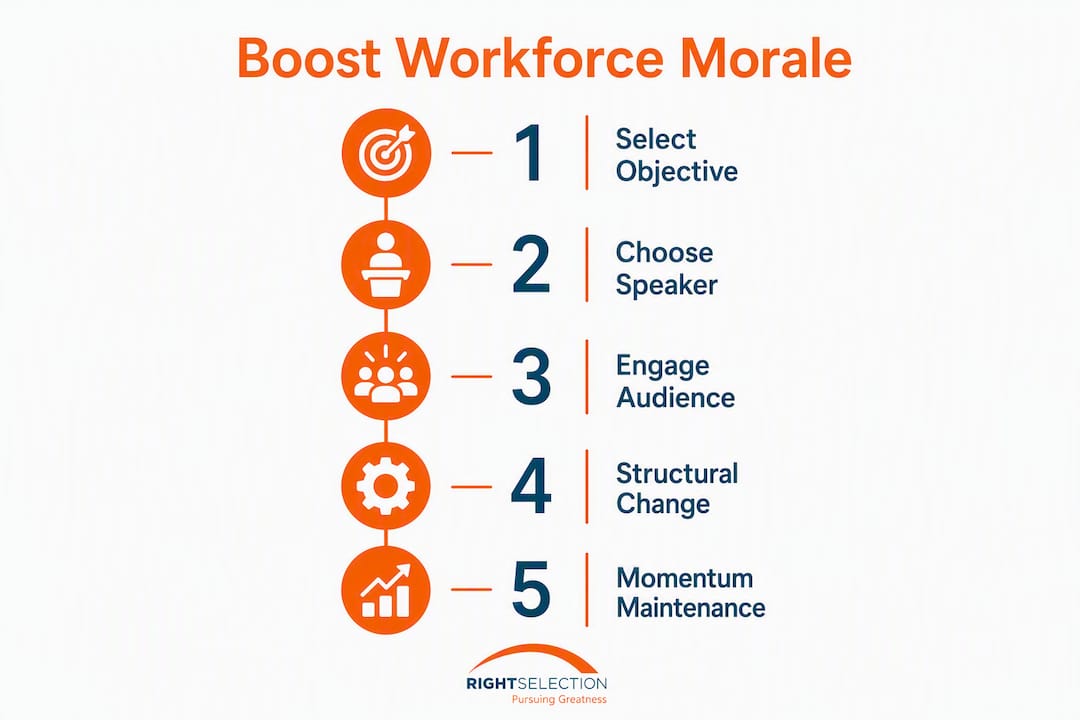
Yes, speakers can boost workforce morale — reliably, and with measurable results — when they function as catalysts inside a broader engagement strategy rather than standalone events. The key distinction is that word “catalyst.” A well-chosen speaker creates shared narrative, shifts perspective, and generates short-term energy. What sustains that energy is what your organization does in the 30 to 90 days that follow.
Before you book anyone, take three immediate steps:
- Set a clear objective. Define the specific morale driver you are addressing: clarity of expectations, psychological safety, recognition, or team connection.
- Choose your format. A keynote works for scale and shared narrative; a workshop works for skill-building and small-group practice.
- Schedule measurement. Decide now how you will measure impact at 72 hours, 30 days, and 90 days post-event.
Gallup research shows that fewer than one in three employees feel strongly connected to their company mission, and only 47% strongly agree they know what is expected of them at work. Those two gaps are exactly where a well-briefed speaker can open a productive conversation — provided leaders are ready to act on what surfaces.
Table of Contents
- What happens right after a strong speaker session
- How storytelling and mindset shifts actually work in a speaker session
- Which event format actually moves morale for your situation
- Why speakers only deliver lasting results when paired with structural changes
- How to choose the right speaker and design a session tied to business goals
- How to measure impact: KPIs, timeline, and follow-up cadence
- What strong client outcomes look like — and the trust signals to demand
- How to integrate speaker sessions into your broader engagement program
- Ensuring speaker content is inclusive and resonates with diverse teams
- Techniques for maintaining momentum after the speaker event
- Legal and logistical considerations when organizing speaker events
- Key Takeaways
- Why curation matters more than speaker fame
- Right Selection connects your goals to the right speaker
- Useful sources and further reading
What happens right after a strong speaker session
The first 24 to 48 hours after a strong session tend to produce observable, short-term effects that are worth planning around. Energy in the room rises. Teams leave with a shared reference point, a story or framework they can invoke in conversation. Individuals often report a fresh sense of possibility, and managers frequently notice a short-term increase in discretionary effort — people volunteering for projects, asking better questions, or simply showing up with more presence.
These effects play out differently at each level. At the team level, the shared experience creates a common language. At the manager level, the session gives them a concrete hook for follow-up conversations. At the individual level, the impact depends heavily on how personally relevant the speaker’s message felt.
The risk is real: practitioner research confirms that simple morale activities produce small, short-lived boosts, while speakers can reset norms and unify narrative — but only when followed by visible action. Without a 30-day follow-up plan, the initial uplift typically fades within two weeks.
The practical implication: treat the post-event window as a campaign, not a cooldown.
How storytelling and mindset shifts actually work in a speaker session
The behavioral mechanics behind a well-designed talk are worth understanding, because they are also the criteria against which you should evaluate any speaker you consider hiring.
Storytelling works because it engages neural processes differently than data presentation does. A speaker who shares a credible personal story of failure and recovery gives the audience a vicarious experience, which is far more memorable than a slide deck of statistics. The best speakers pair that story with a clear, behavior-focused framework — something an attendee can try the next morning, not just think about.
- Memorable frameworks beat inspiration alone. A speaker who leaves the audience with a named, three-step model gives managers something to reference in team meetings for weeks.
- Micro-experiments accelerate adoption. Talks that assign a specific, low-stakes action (“try this one conversation this week”) produce more behavioral change than those that end on aspiration.
- Message framing matters for diverse teams. Self-determination theory shows that messages appealing to autonomy, competence, and relatedness drive deeper motivation than generic inspiration.
Pro Tip: When evaluating a speaker’s demo reel, watch specifically for the moment they transition from story to takeaway. If that transition is vague or missing, the session will generate emotion but not behavior change.
Which event format actually moves morale for your situation

Format selection is a strategic decision, not a logistical one. The wrong format for your objective wastes budget and goodwill.
Keynotes are the right choice when your goal is a shared narrative at scale. An all-hands keynote can reset the emotional tone of an organization after a difficult quarter, align a dispersed workforce around a new direction, or mark a cultural milestone. To preserve impact, build in at least one interactive element — a live poll, a structured reflection prompt, or a brief small-group discussion — so attendees are participants rather than an audience.

Workshops and breakout sessions outperform keynotes when the goal is skill-building or norm-shifting in smaller groups. A 90-minute workshop on psychological safety, for example, allows practice, peer feedback, and real conversation in ways a keynote cannot. The trade-off is scale: workshops require more facilitation resources and work best with groups of 15 to 40 people.
Hybrid and virtual formats have matured considerably. The critical design principle is that remote participants need structured interaction, not just a camera feed. Breakout rooms, shared digital whiteboards, and live Q&A with a dedicated moderator preserve the shared-experience quality that makes speaker sessions effective.
Pro Tip: For hybrid events, assign a dedicated “remote experience producer” whose sole job is managing the digital participant journey. Without that role, remote attendees consistently report feeling like spectators rather than participants.
Why speakers only deliver lasting results when paired with structural changes
This is the gap most articles miss, and it is the most consequential one for HR leaders to understand.
Gallup’s research shows managers account for 70% of the variance in team engagement. That figure means no speaker, however talented, can compensate for a manager who does not model the behaviors the session promoted. The speaker opens the door; the manager decides whether the team walks through it.
Practitioner guidance is consistent on this point: morale initiatives fail when leaders rely on events to address systemic friction like unclear priorities and inconsistent leadership behavior. A speaker session is not a substitute for role clarity, workload balance, or manager development.
Here is a practical implementation checklist to pair with any speaker engagement:
- Assign a session owner who is accountable for follow-through, not just logistics.
- Clarify expectations in the two weeks before the event, so the speaker’s message lands on prepared ground.
- Brief managers with a discussion guide they can use in the week after the session.
- Schedule a 30-day check-in to review what changed and what did not.
- Connect speaker content to an operational change — a revised process, a new recognition practice, or a clearer career pathway.
Pro Tip: Map each speaker takeaway to a specific owner and a measurable outcome before the event. Practitioner frameworks confirm this single step is what separates “awesome talk, no follow-through” from genuine behavioral change.
How to choose the right speaker and design a session tied to business goals
Selection criteria should be outcome-focused, not fame-focused. The speaker who fills arenas may not be the right fit for a 200-person manufacturing company working through a post-merger culture reset.
Evaluate candidates against four criteria: a track record with similar audience types and objectives, evidence of measurable impact (not just applause), demonstrated ability to address diverse workforce demographics, and practical takeaways that connect to your specific business context.
Your speaker brief should include:
- The business goal the session must serve (not “boost morale” generically, but “reduce voluntary turnover in the operations team by addressing recognition gaps”)
- A detailed audience profile: tenure mix, role diversity, current pain points, and cultural context
- The KPIs you will use to measure success
- The follow-up plan and who owns it
- Logistics: format, duration, room setup, AV requirements, and any pre-event materials
On pricing: speaker fees vary widely based on profile, format, and travel requirements. Keynote speakers for corporate events in the U.S. range from a few thousand dollars for emerging voices to six figures for globally recognized names. Workshops typically carry additional facilitation fees. Always clarify what is included: preparation calls, post-event materials, and follow-up availability are often negotiable.
Red flags to avoid: A speaker who cannot describe a specific outcome they produced for a previous client, who resists customizing their content to your brief, or who has no references from organizations similar to yours is a procurement risk — regardless of how impressive their credentials look on paper.
Motivation research reinforces this: messages that remove dissatisfaction sources and address growth and clarity outperform generic inspiration. That means your brief needs to specify which dissatisfiers you are targeting.
How to measure impact: KPIs, timeline, and follow-up cadence
Measurement is where most speaker programs lose credibility with finance and senior leadership. Build the measurement plan before the event, not after.
Suggested KPIs:
- Employee engagement pulse score (pre/post comparison on 3–5 items)
- Manager-observed behavior changes (structured observation checklist)
- Participation rate in follow-up programs or actions
- Voluntary turnover rate at 6-month review
- Self-reported clarity of expectations (tied to the Gallup benchmark of 47%)
| Measurement window | Method | Owner |
|---|---|---|
| 24–72 hours post-event | Pulse survey (3–5 questions) | HR |
| 30 days | Manager debrief + team check-in | Line managers |
| 90 days | Follow-up survey + KPI review | HR + L&D |
| 6 months | Engagement benchmark comparison | CHRO |
Sample pulse survey questions (24–72 hours):
- How relevant was today’s session to your day-to-day work? (1–5 scale)
- What is one thing you plan to do differently this week?
- How confident are you that your team will act on today’s insights? (1–5 scale)
At the 30-day mark, managers should run brief team debriefs to convert session insights into team-level micro-experiments, a practice Gallup’s engagement research identifies as one of the highest-leverage follow-up actions available to leaders.
What strong client outcomes look like — and the trust signals to demand
A well-structured speaker engagement follows a clear arc: defined objective, curated intervention, measurable results, and documented contributor roles. When evaluating vendors or reviewing case examples, that structure is the signal of a credible engagement rather than a feel-good event.
Consider a mid-size technology company that brought in a leadership speaker to address post-reorganization disengagement. The objective was specific: rebuild psychological safety and clarify team roles within 60 days. The speaker delivered a half-day workshop followed by manager coaching sessions. At the 60-day mark, pulse scores on “I know what is expected of me” rose by 18 percentage points, and voluntary attrition in the affected division dropped measurably in the following quarter.
The trust signals to request from any speaker vendor: documented client outcomes with named metrics, references from organizations of similar size and sector, session recordings or post-event materials you can review, verified speaker credentials and bios, and a written post-event follow-up plan with assigned owners.
Right Selection provides all of these as standard. Speaker profiles on the Right Selection roster — including Marshall Goldsmith and Ron Thomas — include verified credentials, session topics, and evidence of measurable leadership outcomes, so HR leaders can evaluate fit before the first conversation.
How to integrate speaker sessions into your broader engagement program
A speaker session should be a node in your engagement calendar, not an isolated event. The most effective integration approach treats the session as a quarterly or semi-annual anchor point around which other engagement activities are organized.
Before the session, align it with your existing engagement survey cycle so you have a baseline to compare against. After the session, connect its themes to your recognition program, your manager development curriculum, and your internal communications. If the speaker addressed psychological safety, for example, the follow-up month should include manager training on feedback conversations and a visible leadership commitment to acting on employee voice.
Practitioner frameworks recommend treating engagement as a system with four enablers: strategic narrative, manager capability, employee voice, and organizational integrity. A speaker session can reinforce all four — but only if the surrounding program is designed to carry the message forward.
Ensuring speaker content is inclusive and resonates with diverse teams
Inclusion is not a checkbox in speaker selection — it is a design requirement. A session that resonates with one demographic and alienates another produces net-negative morale outcomes, which is worse than no session at all.
Start with your audience profile. Tenure mix, generational diversity, cultural backgrounds, and role diversity all shape how a message lands. A speaker whose examples draw exclusively from one industry or life experience will feel irrelevant to significant portions of a mixed workforce.
Evaluate speakers on three dimensions: the diversity of their reference examples, their demonstrated experience with multicultural audiences, and their willingness to customize content based on your audience brief. Right Selection’s roster includes speakers like May Sayed Ali, whose sessions are specifically designed for inclusive, cross-cultural engagement.
Self-determination theory offers a useful lens here: messages that appeal to autonomy, competence, and relatedness tend to resonate across demographic groups because these are universal psychological drivers, not culturally specific ones. Brief your speaker to frame takeaways through those three lenses.
Techniques for maintaining momentum after the speaker event
The two-week fade is predictable and preventable. The organizations that sustain morale gains treat the post-event period as a structured campaign with assigned owners and a defined cadence.
Three techniques consistently preserve momentum. First, visible leader endorsement within 48 hours: a short message from the CEO or CHRO referencing a specific insight from the session signals that leadership took it seriously. Second, manager-led small-group follow-ups in the first two weeks: practitioner research identifies these as the most reliable mechanism for converting session energy into team-level action. Third, a 30-day micro-action plan distributed to all attendees, with one specific, low-effort behavior tied to the session’s core message.
Beyond 30 days, the compound effect of consistent reinforcement matters more than any single follow-up activity. Embedding the speaker’s framework into your existing manager one-on-ones, team meetings, and recognition practices keeps the message alive without requiring additional budget.
Legal and logistical considerations when organizing speaker events
Speaker engagements involve contracts, and the details matter. A standard speaker agreement should cover fee structure, cancellation and rescheduling terms, intellectual property rights for recordings, exclusivity clauses, and any travel and accommodation arrangements. Clarify upfront whether the speaker retains rights to session recordings — this affects whether you can share content internally after the event.
For in-person events, venue contracts carry their own liability considerations: force majeure clauses, AV and catering minimums, and accessibility requirements under the Americans with Disabilities Act. For virtual events, confirm platform licensing, data privacy compliance, and recording consent requirements under applicable state laws.
If your organization is publicly traded or operates in a regulated industry, confirm that speaker content does not create compliance exposure — particularly for sessions touching on financial performance, legal matters, or HR practices. A brief legal review of the speaker’s standard content outline is a low-cost precaution.
Always use a written agreement, even for speakers you have worked with before. Verbal commitments are unenforceable, and scope creep — additional preparation calls, post-event materials, follow-up sessions — is common without a clear contract.
Key Takeaways
Speakers reliably improve employee engagement when they are curated for fit, paired with structural follow-through, and measured against defined KPIs at 72 hours, 30 days, and 90 days post-event.
| Point | Details |
|---|---|
| Set the objective first | Define the specific morale driver before selecting a speaker or format. |
| Managers are the multiplier | Gallup shows managers account for 70% of team engagement variance; brief them before and after every session. |
| Measure at three intervals | Pulse at 72 hours, team debrief at 30 days, and KPI review at 90 days to prove ROI. |
| Pair speakers with structural fixes | Clarity of expectations, role design, and recognition practices must reinforce the speaker’s message. |
| Right Selection as your next step | Right Selection’s curated roster and session design process connects speaker selection directly to your business goals and follow-up plan. |
Why curation matters more than speaker fame
The most common mistake organizations make is treating a speaker booking as a procurement decision rather than a design decision. Fame is a proxy for quality, not a guarantee of fit. A globally recognized name who delivers a generic keynote to your team will produce less measurable impact than a well-briefed, credible practitioner whose session is designed around your specific business challenge.
What actually works is the combination of discernment in selection, precision in briefing, and commitment in follow-through. The speaker is one variable. The session design, the manager preparation, the post-event cadence, and the organizational willingness to act on what surfaces — those are the variables that determine whether morale actually shifts or whether the event becomes a pleasant memory with no lasting effect.
There is also a tendency to underestimate the compound effect of consistency. Organizations that run two or three well-designed speaker engagements per year, each connected to a specific engagement objective and followed by structured action, build a culture of learning and accountability that no single event can create. The cumulative impact of that cadence is what separates organizations with genuinely high engagement from those that cycle through initiatives without traction.
Right Selection connects your goals to the right speaker
Choosing the right speaker for your workforce is a high-stakes decision, and the cost of a poor fit goes beyond the speaker fee. Right Selection brings over 30 years of experience and a roster of 100+ global thought leaders, coaches, and corporate trainers to that decision — with a session design process that maps every engagement directly to your business objectives and audience profile.
Whether you need a keynote to reset culture after a difficult period, a workshop series to build manager capability, or a full speaker program integrated into your annual engagement calendar, Right Selection handles curation, briefing, session design, and post-event follow-up as a single, coordinated engagement. You get measurable outcomes, not just a memorable afternoon.
The clearest next step is a complimentary coaching call with the Right Selection team. In that conversation, you will clarify your engagement objective, review speaker options from the roster, and leave with a concrete session design framework you can act on immediately.
Useful sources and further reading
These sources informed the research and reasoning throughout this article. Each is worth consulting directly for deeper context.
3 Employee Engagement Strategies for 2026 — Gallup: The primary benchmark source for engagement KPIs, manager influence data, and the statistic that only 47% of employees strongly agree they know what is expected of them. Essential reading for any HR leader building a measurement framework.
How to Foster and Sustain Team Motivation — Psychology Today: Applies self-determination theory to team settings, explaining why autonomy, competence, and relatedness are the psychological drivers that speaker sessions should address to produce lasting motivation.
How to Motivate Your Team — Mind Tools: Applies Herzberg’s two-factor theory to team motivation, clarifying why removing dissatisfiers must precede adding satisfiers like speaker-led inspiration.
How to Motivate Teams: Leadership Strategies for Unlocking Peak Performance — Duke’s Fuqua School of Business: Academic and practitioner synthesis on recognition, camaraderie, and manager enablement as structural drivers of peak team performance.
Benchmark to keep in mind: Gallup’s data shows managers account for 70% of the variance in team-level engagement — which means the single highest-return investment after any speaker event is equipping managers to carry the message forward.