
A coaching engagement process is a structured, time-bound partnership between a coach and a coachee that moves through defined stages: contracting, assessment, goal-setting, active coaching sessions, and intentional closure. Think of it as the operating system behind every effective coaching relationship. Three elements determine whether it works or stalls.
- Contracting: A written agreement that defines scope, confidentiality, stakeholder reporting rules, and what “done” looks like.
- Structured sessions with between-session action: Each meeting follows a clear agenda, and real change happens in the work done between sessions, not just during them.
- Measurement: Behavioral indicators, 360 feedback, and business KPIs tracked at baseline, midpoint, and close.
Pro Tip: Formalize scope and confidentiality in writing before the first session. Coaches who skip this step often face scope creep, sponsor confusion, and ambiguous endings. A one-page agreement prevents all three.
Table of Contents
- What is the coaching engagement process, stage by stage?
- What actually happens inside a coaching session?
- Who is involved, and what does each person own?
- How long does an engagement last, and what does it cost?
- Which frameworks and tools should you use?
- How do you measure success and sustain the gains?
- What should a coaching agreement include?
- Key Takeaways
- What experienced coaches know that the frameworks don’t tell you
- How Right Selection structures coaching engagements for leaders
- Useful sources and further reading
What is the coaching engagement process, stage by stage?
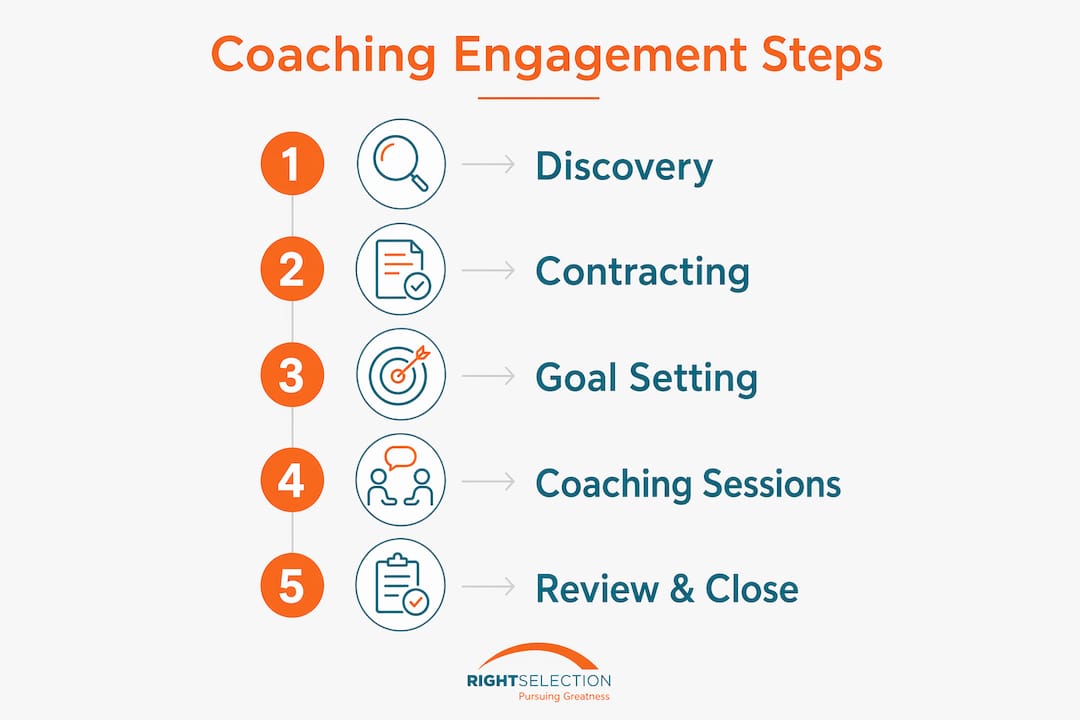
A well-run engagement follows eight stages. Each has a clear owner, a deliverable, and a decision point before the next stage begins.
- Discovery/intake. The coach and coachee meet to assess fit, clarify the presenting challenge, and confirm readiness. The sponsor (typically HR or a direct manager) joins to align on organizational goals.
- Contracting. Both parties sign a coaching agreement covering scope, session cadence, fees, confidentiality boundaries, and stakeholder reporting rules. This is also where the distinction between coaching and consulting is stated explicitly, since coaching is solution-oriented and client-centered, not advice-driven.
- Assessment and insight gathering. Validated tools (360-degree feedback, structured interviews, objective KPIs) build a baseline picture. The coachee reviews results with the coach before sharing any summary with the sponsor.
- Goal setting and development plan. Coach and coachee co-create a development plan with two to four priority goals and a one-sentence definition of done for each. Example: “By month six, my direct reports will rate my listening and follow-through at 4.0 or above on the team pulse survey.”
- Coaching sessions and between-session actions. Sessions run every two to four weeks. Between meetings, the coachee completes agreed experiments, gathers evidence, and submits brief progress notes. Between-session work is the engine of change in any high-quality engagement.
- Midpoint review. At the halfway mark, coach, coachee, and sponsor review progress against the definition of done. Adjust goals if the business context has shifted; document the decision.
- Stakeholder feedback loop. A second round of stakeholder interviews or a pulse 360 captures behavioral shifts observed by colleagues. This data feeds the final evaluation and reinforces accountability.
- Evaluation and closure. The final session compares end-state data to the baseline, celebrates progress, and builds a sustainment plan. The coach formally closes the engagement with a written summary.
| Stage | Who Signs Off | Key Deliverable |
|---|---|---|
| Discovery/intake | Coach + coachee | Fit confirmation, readiness check |
| Contracting | All three parties | Signed coaching agreement |
| Assessment | Coach + coachee | Baseline report |
| Goal setting | Coach + coachee + sponsor | Development plan with definition of done |
| Sessions + actions | Coach + coachee | Progress notes, experiment log |
| Midpoint review | All three parties | Adjusted plan (if needed) |
| Stakeholder feedback | Coach | Pulse 360 or interview summary |
| Evaluation + closure | All three parties | Final summary, sustainment plan |
What actually happens inside a coaching session?
A single session is not a freeform conversation. It follows a predictable structure that makes it easier for busy leaders to prepare and get value quickly.
Typical 60–90 minute agenda:
- Opening/session contract (5–10 min): Coachee names the topic and the outcome they want from this session.
- Exploration (20–30 min): Coach uses powerful questions to surface assumptions, patterns, and context the coachee may not have articulated before.
- Insight generation (15–20 min): Coach reflects patterns back, offers observations, and helps the coachee connect current behavior to the development plan.
- Action planning (10–15 min): Coachee commits to one to three specific experiments or actions before the next session.
- Close (5 min): Brief check on the session’s value and any adjustments to the next meeting’s focus.
Coach behaviors that drive impact include active listening without interrupting, asking questions that open new thinking rather than confirming existing views, detecting recurring patterns across sessions, and holding the coachee accountable to commitments made in prior meetings. Coachee readiness and openness to feedback are among the strongest predictors of coaching impact, which means the coachee’s preparation matters as much as the coach’s skill.
Pro Tip: Before each session, write down one specific situation that happened since the last meeting, what you did, and what result you got. Bringing concrete evidence rather than general impressions cuts exploration time in half and accelerates insight.

Who is involved, and what does each person own?
| Role | Primary Responsibilities | Common Deliverables |
|---|---|---|
| Coach | Facilitate sessions, hold accountability, track patterns | Session notes, progress summaries, final report |
| Coachee | Set agenda, complete between-session actions, gather evidence | Experiment log, self-assessments, progress notes |
| Sponsor (HR/manager) | Align organizational goals, receive agreed updates, fund engagement | Scope approval, midpoint check-in, closure sign-off |
| HR/L&D team | Integrate coaching into broader development programs, manage vendor contracts | Engagement tracking, ROI reporting |
Sponsors who stay engaged without overreaching produce the best outcomes. The risk runs in both directions: a disengaged sponsor leaves the coachee without organizational support, while an over-involved one can compromise confidentiality and undermine trust. For guidance on integrating coaching into employee development, the sponsor’s role is worth mapping explicitly before the engagement starts.
Red flags to address before signing:
- Sponsor and coachee have conflicting objectives for the engagement.
- No confidentiality agreement is in place, or its boundaries are vague.
- The coach is also expected to advise, consult, or report on performance to the sponsor.
- The coachee did not choose to participate and shows low commitment.
How long does an engagement last, and what does it cost?
Professional coaching engagements typically run for several months with sessions scheduled every few weeks, though shorter sprints are common for specific leadership transitions or performance challenges.
Common engagement shapes:
- 3–6 month sprint: Four to eight sessions targeting a single, well-defined challenge (a new role, a specific behavioral shift, a high-stakes presentation).
- 6–12 month development engagement: Ten to eighteen sessions covering broader leadership development, with a full assessment cycle and stakeholder feedback loop.
- Episodic coaching: Ongoing, as-needed sessions without a fixed end date, often used for senior executives who want a consistent thinking partner.
Key cost drivers to budget for:
- Coach seniority and credentials (ICF-credentialed coaches at the PCC or MCC level command higher fees).
- Assessment costs (360 platforms, psychometric tools, interview time).
- Stakeholder time for interviews and feedback rounds.
- Travel or platform costs for hybrid or in-person sessions.
Pro Tip: Use this quick formula to estimate total engagement cost: (per-session fee × number of sessions) + assessment costs + stakeholder time (hours × internal hourly rate). Running this calculation before vendor conversations gives you a realistic budget anchor.
Which frameworks and tools should you use?
Choosing a framework is a strategic decision, not a trend-following one. The right tool depends on the engagement’s goals, the coachee’s context, and the stakeholder environment.
The GROW Model remains the most widely adopted coaching framework. Its four stages, Goal, Reality, Options, and Will, give coaches a practical structure for coaching conversations that keeps sessions focused without being rigid. GROW works well for goal-oriented engagements where the coachee already has reasonable self-awareness. Its limitation: applying it without stakeholder alignment or a measurement plan reduces its impact significantly.

Stakeholder Centered Coaching, developed by Marshall Goldsmith, shifts the focus from the coachee’s internal experience to observable behavioral change as perceived by stakeholders. It is particularly effective in organizational contexts where leadership reputation and team dynamics are the primary outcomes. The process involves regular stakeholder check-ins throughout the engagement, not just at the end, which builds accountability and accelerates visible change.
360-degree feedback serves as both a baseline assessment and a midpoint measure. When combined with structured stakeholder interviews and objective KPIs, 360s help triangulate progress in ways that self-report alone cannot. Use 360s when behavioral change is the goal; use KPI tracking when business outcomes are the primary measure.
For sales-focused engagements, executive sales coaching frameworks show how standard models like GROW map directly to revenue KPIs and measurable behavioral outcomes.
How do you measure success and sustain the gains?
Measurement works best when it is planned at contracting, not retrofitted at the end. A clear definition of done set at the start gives every stakeholder a shared reference point for evaluating progress.
Sample metrics by category:
- Behavioral indicators: Frequency of specific behaviors observed by direct reports or peers (e.g., asking questions before offering solutions, following through on commitments).
- 360 changes: Pre/post shifts in stakeholder ratings on targeted competencies.
- Team performance indicators: Engagement scores, retention rates, team output quality.
- Business KPIs: Revenue, project delivery timelines, customer satisfaction scores where the leader’s behavior is a direct driver.
Measurement timeline:
- Baseline: Before the first session.
- Midpoint: At the halfway mark, aligned with the midpoint review.
- End of engagement: Final session, compared directly to baseline.
- 3–6 month follow-up: A post-engagement check to confirm gains have held without the coach’s active support.
To sustain gains after closure, integrate the coachee’s development goals into their performance objectives or OKRs, establish a peer coaching relationship with a trusted colleague, and schedule a self-directed quarterly review using the session agenda structure they practiced during the engagement.
What should a coaching agreement include?
The contracting phase is the most consequential non-obvious step in the entire process. A well-drafted agreement prevents the majority of engagement failures before they start.
Agreement checklist:
- Scope of the engagement (goals, number of sessions, duration).
- Session cadence and format (in-person, virtual, or hybrid).
- Fee structure and payment terms.
- Confidentiality boundaries: what the coach will and will not share with the sponsor.
- Data handling: how session notes and assessment results are stored and who can access them.
- Stakeholder reporting rules: what summary information reaches HR or the sponsor, and in what format.
- Termination clause: conditions under which either party can end the engagement early.
Credential and trust signals to look for:
- ICF accreditation at the ACC, PCC, or MCC level, which signals adherence to a professional code of ethics and a minimum number of verified coaching hours.
- Documented case studies or client outcomes (not just testimonials).
- Use of validated assessments with certified debrief training.
Ethics red flags:
- Vague deliverables with no definition of done.
- No confidentiality clause, or one that allows the sponsor unrestricted access to session content.
- The coach doubles as a consultant or performance evaluator without explicit agreement from all parties.
For a deeper look at evaluating coach credentials before you sign, the credential verification process matters as much as the coach’s reputation.
Key Takeaways
A coaching engagement process works when contracting is thorough, measurement is planned from day one, and the coachee owns the agenda.
| Point | Details |
|---|---|
| Start with a definition of done | Co-create a one-sentence success statement before the first session to anchor measurement and prevent ambiguous endings. |
| Contracting is non-negotiable | A signed agreement covering scope, confidentiality, and stakeholder reporting rules prevents the most common engagement failures. |
| Between-session work drives change | Experiments and evidence gathered between meetings, not just in-session dialogue, produce lasting behavioral shifts. |
| Match the framework to the goal | GROW fits goal-oriented individual work; Stakeholder Centered Coaching fits organizational reputation and team dynamics outcomes. |
| Right Selection as your next step | Right Selection connects leaders with credentialed coaches and structures engagements with measurable outcomes from discovery to closure. |
What experienced coaches know that the frameworks don’t tell you
The theory of a coaching engagement process is clean. The practice is messier, and that gap is where most engagements lose momentum.
The single most common failure point is not a weak framework or an under-prepared coachee. It is a sponsor who approved the engagement but never aligned on what success looks like. When the midpoint review arrives and the sponsor’s mental picture of “done” differs from the coachee’s development plan, the engagement stalls. The fix is not more sessions. It is a 30-minute three-way conversation at contracting, before anyone opens a 360 or sets a goal.
The second pattern worth naming: scope creep disguised as flexibility. A coach who agrees to “just a few consulting questions” or starts advising on strategy rather than facilitating reflection has crossed a boundary that is very hard to walk back. The coaching agreement exists precisely to make that line visible. Revisiting it at the midpoint review is not bureaucratic. It is what keeps the engagement honest.
Real-world engagements also compress. A six-month plan often becomes a four-month sprint when a leader’s calendar fills up or a business priority shifts. Building that possibility into the original plan, with a clear protocol for compressing the cadence without losing the measurement cycle, is what separates experienced practitioners from those who simply follow a template.
How Right Selection structures coaching engagements for leaders
Right Selection brings over 30 years of experience connecting organizations with credentialed coaches and thought leaders who deliver measurable outcomes, not just meaningful conversations. Where generic coaching marketplaces hand you a directory, Right Selection curates the match: aligning coach expertise, engagement structure, and organizational goals before the first session is scheduled.
For leaders and HR sponsors ready to move from interest to implementation, a complimentary coaching call is the practical next step. In 30 minutes, you will clarify your engagement goals, check scope and cadence fit, and leave with a concrete next-steps proposal. Right Selection’s network of 100+ coaches and thought leaders means the right match is available, not just the available match.
Useful sources and further reading
- International Coaching Federation (ICF): The primary professional body for coach credentialing in the United States; use it to verify ACC, PCC, and MCC credentials before contracting.
- GROW Model — MindTools: Clear, practical explainer of the four-stage GROW framework with application guidance for coaching conversations.
- Defining ‘done’ in coaching engagements — Scrum Alliance: Adapts the Scrum definition-of-done principle to coaching; essential reading for sponsors who want measurable endpoints.
- Demystifying Coaching Engagement — Simply.Coach: Covers the full engagement lifecycle with practical guidance on 360 feedback and distinguishing coaching from consulting.
- The Coaching Process: What to Expect — TPC Coaching Academy: Detailed stage-by-stage breakdown of a professional engagement including contracting, session structure, and closure.
- Right Selection: Right Selection’s network and service overview for organizations seeking curated coach matching and structured engagement design.