

An organization-level professional growth roadmap is a strategic, company-wide plan that maps competencies, learning modalities, milestones, and metrics to develop employees and leaders in direct service of business priorities — distinct from any single employee’s personal development plan. When built well, it produces three clear signals of success:
- Internal promotion rates rise as employees move into critical roles from within rather than through external hires.
- Leadership capability gains become measurable, tracked through 360 assessments and performance data rather than anecdote.
- Retention of high-potential talent improves, particularly in roles where turnover is most costly.
SHRM’s guidance on career paths confirms that training programs supporting career progression are among HR professionals’ top tools for strengthening organizational competitiveness. The U.S. Department of Labor’s Employment and Training Administration and O*NET Online provide occupation-specific knowledge, skills, and abilities (KSAs) that ground competency definitions in real labor market data. Right Selection brings over 30 years of experience curating the speakers, coaches, and facilitators who bring a roadmap to life.
Table of Contents
- What are the core components of a professional growth roadmap?
- How do you design and launch a professional growth roadmap?
- Who owns the roadmap, and what does each role need to do?
- How do you measure impact and demonstrate ROI?
- What implementation model fits your organization’s size?
- Key Takeaways
- Why organization-level roadmaps are worth the commitment
- How Right Selection helps you build and run your roadmap
- Useful resources to help you get started
What are the core components of a professional growth roadmap?
A roadmap requires clear structure; several key components differentiate an effective system from a mere conceptual outline.
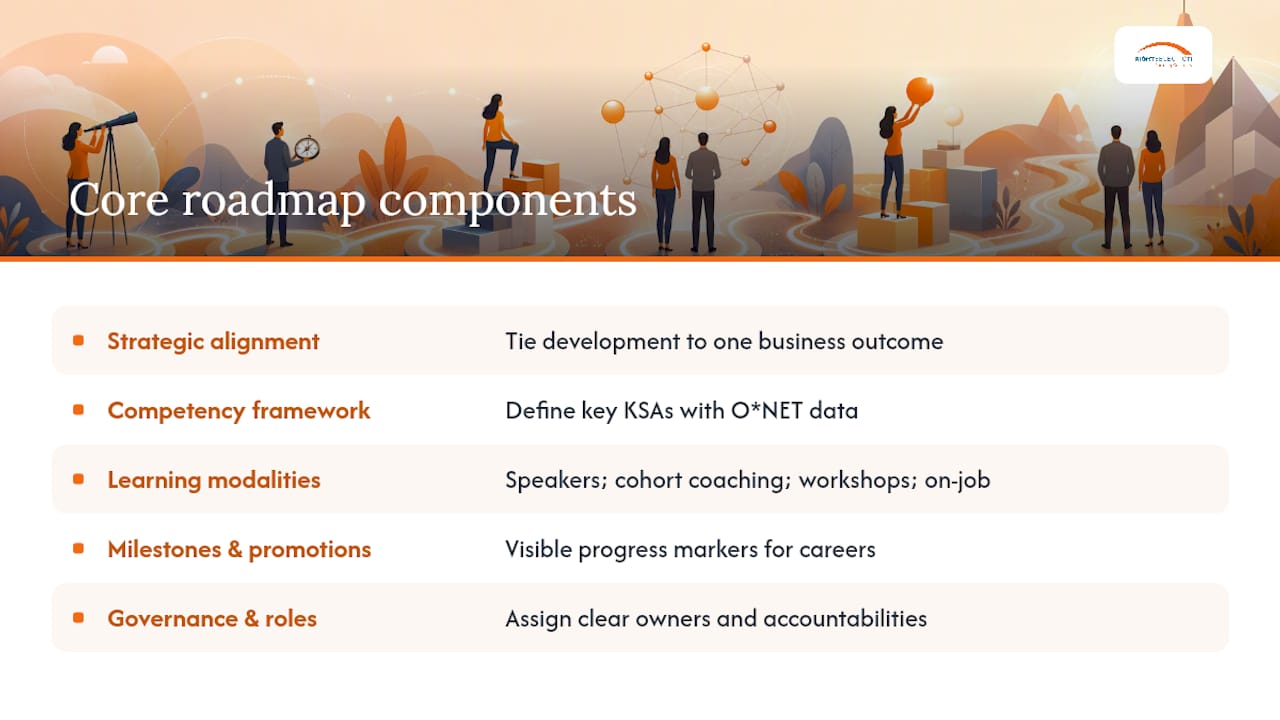
Strategic alignment anchors every learning investment to a specific business priority. Harvard Business Impact research recommends tying development to a single, clear business outcome and defining what leaders must actually do differently as a result.
Competency framework defines a core set of key capabilities the organization needs to build. O*NET and the U.S. Department of Labor’s employer resources are practical starting points for translating job roles into specific KSAs before you write a single learning objective.
Learning modalities cover the full mix: curated speaker sessions for perspective and inspiration, cohort coaching for applied practice, workshops for skill transfer, and on-the-job assignments for reinforcement. SHRM recommends pairing career paths with coaching, mentoring, and clear promotion processes to improve both retention and internal mobility.
Milestones and promotion pathways create visible progress markers. Without them, employees cannot see where development leads, and managers cannot have meaningful career conversations.
Governance and roles assign clear ownership: who designs, who sponsors, who measures, and who delivers.
Technology and systems integration connects the roadmap to your HRIS, LMS, and performance review cycles so data flows automatically rather than through manual collection.
Communication and change plan addresses adoption. A roadmap that employees and managers do not understand or trust will not change behavior, regardless of content quality.
An organization-level roadmap differs from an individual professional development plan in scope and ownership. A PDP belongs to one employee. A roadmap belongs to the organization and sets the architecture within which individual plans are built.
Pro Tip: Use ONET’s occupation profiles to validate your competency framework before finalizing it. Cross-referencing internal role definitions against ONET’s KSA data often surfaces gaps that internal stakeholders have normalized.
How do you design and launch a professional growth roadmap?
A six-step sequence keeps the work grounded and avoids the common trap of producing a document that never changes behavior.
- Strategic needs assessment. Identify the 2–3 business priorities that development must serve. Run a skills gap analysis against your current workforce data. This step defines the “why” that every subsequent decision must answer to.
- Define competencies and career lanes. Narrow to 5–7 core competencies per role family. Map career lanes — both management and individual contributor tracks — so employees see multiple progression paths.
- Design the learning architecture. Apply the 70-20-10 model: 70% experiential (on-the-job projects and stretch assignments), 20% coaching and mentoring, 10% formal training. Curated speaker sessions fit within the formal 10% but generate the perspective shifts that make the 70% more intentional.
- Pilot design and governance. Select a small cohort of participants from one business unit. Define success criteria before launch: attendance thresholds, improvements in 360 feedback scores, and business outcome metrics. Establish a steering committee with a senior sponsor.
- Measure and iterate. Collect leading indicators (attendance, coaching frequency, engagement pulse) at early intervals such as one and two months. Assess lagging indicators (promotion rate, retention, performance ratings) at later intervals such as half-yearly and annually. Building measurement in from day one is what separates programs that sustain investment from those that get cut.
- Scale and embed in talent systems. Expand to additional cohorts and integrate the roadmap into performance reviews, succession planning, and onboarding. Development becomes part of how the organization operates, not a separate initiative.
Sample timeline: Pilot runs months 1–3 (diagnostic, design, launch). Scale begins months 4–6 (second cohort, governance refinement). Full embed targets months 7–12 (HRIS integration, manager training, annual review linkage).
Primary cost drivers: content creation and curation, external coaches and speakers, LMS platform or license fees, and internal program management staffing. Budgets typically concentrate on external expertise in the pilot phase, then shift toward internal capability as the program matures.
Pro Tip: Choose your pilot cohort from a business unit where the leader is already a visible sponsor. A skeptical sponsor will quietly undermine attendance and follow-through. A committed one becomes your best internal advocate during the scale phase.
Who owns the roadmap, and what does each role need to do?
Ownership confusion is one of the fastest ways to stall a roadmap. Clear accountabilities prevent it.
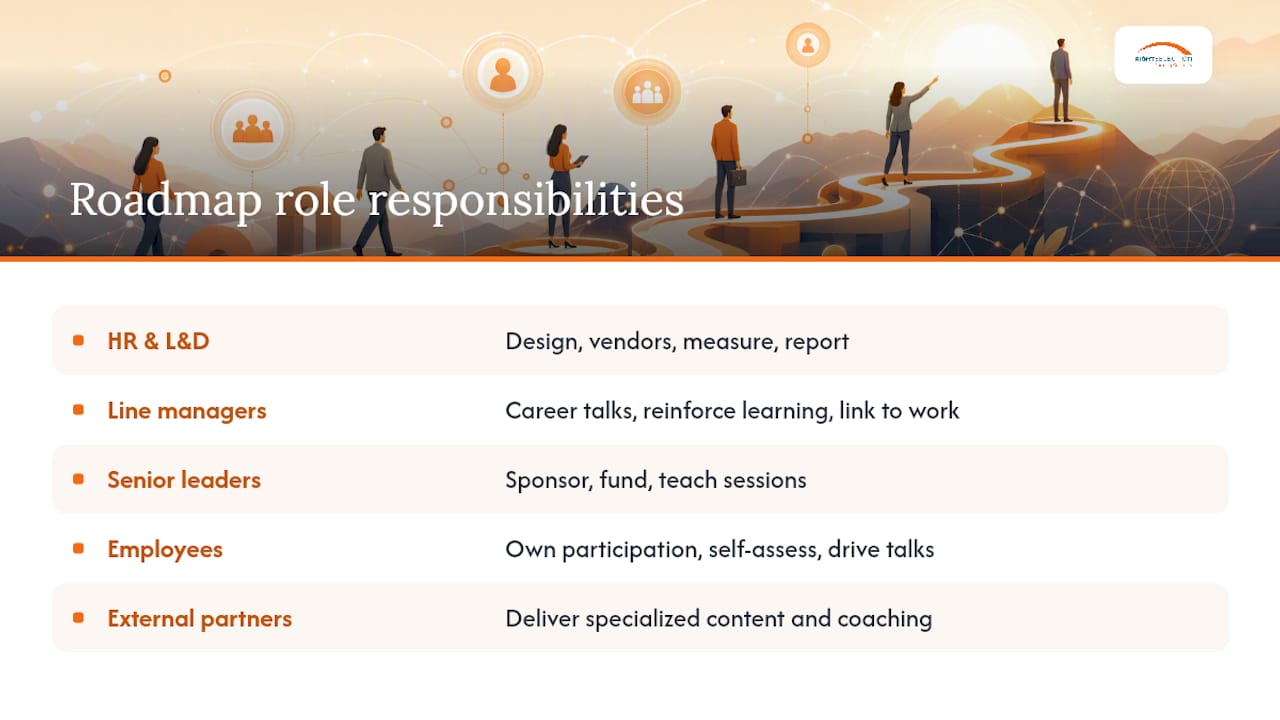
HR and L&D design the architecture, manage vendor relationships, own measurement, and report outcomes to leadership. They are the program’s operational backbone.
Line managers conduct regular career-mapping conversations, reinforce learning between sessions, and connect development to real work assignments. Without manager involvement, learning stays in the classroom.
Senior leaders provide sponsorship, allocate budget, and participate visibly — ideally as teachers or session contributors. Harvard Business Impact’s research shows that leader-as-teacher elements meaningfully increase program relevance and engagement.
Employees own their participation, complete self-assessments, and drive their own career-mapping conversations with manager support.
External partners — speakers, coaches, and facilitators — deliver specialized content and coaching that internal teams cannot replicate at scale. Right Selection’s career advancement coaching resources offer practical frameworks for connecting coaching engagements to on-the-job impact.
Governance cadence: a steering committee meets quarterly to review KPIs and adjust priorities. A program director manages day-to-day execution and vendor coordination. Monthly check-ins between HR and line managers keep accountability visible.
Pro Tip: Give managers a three-question prompt for career conversations: “What work energizes you most right now?” “Where do you want to be in 18 months?” “What’s one capability we should build together this quarter?” Simple, specific, and repeatable.
How do you measure impact and demonstrate ROI?
Measurement is where most roadmaps lose credibility. Research from Driven Leadership found that 76% of professionals do not measure business impact from development programs, and 59% do not track behavior change.
| Measurement Layer | Indicators | Data Source |
|---|---|---|
| Leading | Program attendance, coaching frequency, 360 feedback scores | LMS, coaching logs, assessment platform |
| Competency growth | Skill assessment gains, manager ratings | 360 tools, performance reviews |
| Business outcomes | Promotion rate, retention, time-to-fill critical roles | HRIS, workforce analytics |
ROI estimate (illustrative framework): If an external hire for a director-level role costs $25,000–$40,000 in recruiting fees plus 3–6 months of ramp time, and your roadmap enables two internal promotions per year, the avoided cost alone often exceeds the program’s annual investment. Add reduced turnover in high-potential cohorts and the business case becomes straightforward to present.
Right Selection’s guidance on tracking growth in coaching engagements outlines a practical cadence: baseline assessment at program start, mid-point pulse at 45 days, and outcome review at 90 days.
76% of development professionals do not measure business impact from their programs. Building measurement into your roadmap from day one is the single most important step toward sustaining leadership investment.
What implementation model fits your organization’s size?
Small organizations (under 500 employees) benefit from a focused capability sprint conducted in a short, phased timeline including diagnostic, coaching, assessment, and sustainability steps. The mid-market sprint model produces measurable capability change quickly without requiring a large internal infrastructure.
Mid-market organizations (500–5,000 employees) can layer modalities across a 6-month cycle: speaker sessions for broad perspective, cohort coaching for applied skill-building, and 1:1 executive coaching for senior leaders navigating specific transitions. Mentoring versus coaching distinctions matter here — mid-market programs often conflate the two, diluting both.
Enterprise organizations run parallel tracks across business units, with a central governance body and unit-level program managers. Speaker curation at scale requires a partner with a deep, vetted roster. Right Selection’s network of 100+ global thought leaders and speakers allows enterprise teams to match session content to specific business unit priorities without sacrificing quality or consistency.
Right Selection has designed speaker-curated sessions and coaching cohorts across all three organization sizes, aligning each engagement to the client’s specific competency framework and business priorities rather than delivering off-the-shelf content.
Key Takeaways
An organization-level professional growth roadmap requires strategic alignment, clear competency definitions, blended learning modalities, and measurement built in from day one.
| Point | Details |
|---|---|
| Align to business priorities | Every competency and learning objective must connect to a specific organizational goal. |
| Start with a focused pilot | A cohort of 15–25 participants with a committed sponsor generates proof of value before full investment. |
| Measure leading indicators early | Track attendance, coaching frequency, and 360 scores at early intervals such as one and two months — don’t wait for annual reviews. |
| Engage managers as partners | Managers who conduct structured career conversations are the roadmap’s most important delivery mechanism. |
| Right Selection as your partner | Right Selection’s curated speakers, coaching programs, and session design connect directly to each roadmap phase. |
Why organization-level roadmaps are worth the commitment
The most common mistake I see organizations make is treating a professional growth roadmap as a content problem rather than a systems problem. They commission a speaker series or a coaching program, measure attendance, and call it development. The compound effect of real capability growth only appears when learning is tied to business priorities, reinforced by managers, and tracked against outcomes that leadership actually cares about.
What makes curated speaker sessions genuinely powerful is not the content alone — it is the precision of the curation. A speaker who addresses exactly the competency gap your cohort is working through, in language that connects to your industry and business context, creates a perspective shift that generic training cannot replicate. That specificity is what Right Selection has built its approach around for more than three decades.
The organizations that sustain investment in development are the ones that can walk into a budget conversation with retention data, promotion rates, and a clear line from program participation to business outcomes. That story is entirely buildable. It just requires the discipline to design for measurement from the start.
How Right Selection helps you build and run your roadmap
Building a professional growth roadmap is a significant commitment, and the quality of your learning partners determines whether it changes behavior or simply fills calendars. Right Selection offers speaker curation, executive coaching programs, session design, and facilitation services that plug directly into each phase of your roadmap — from the pilot cohort’s first curated session to enterprise-scale coaching cohorts aligned to your competency framework.
With a roster of 100+ global thought leaders and over 30 years of experience designing learning experiences that produce measurable outcomes, Right Selection gives HR and L&D leaders a partner who understands both the strategic architecture and the practical delivery. Every engagement is designed around your specific business priorities, not a standard catalog. To explore what a roadmap partnership could look like for your organization, schedule a complimentary scoping call and start with a focused diagnostic conversation.
Useful resources to help you get started
External references:
- Empowering employee growth: building dynamic career paths — SHRM
- How to Build a Leadership Development Plan for Your Organization in 2026 — Driven Leadership
- How to create a successful leadership development program — Harvard Business Impact
- How to Build a Leadership Development Program (2026 Guide) — Boon
- The value of building a leadership development framework — Institute OD
- Leadership Development Program Design: A Mid-Market Guide — 1205 Consulting
- Track Personal Growth in Executive Coaching — Right Selection
- Home – Right Selection
Internal templates to build or adapt:
For practical coaching program examples and deeper templates, the Right Selection blog covers measurement frameworks, modality design, and executive learning integration across organization sizes.