

Executive coaching for career transitions is a strategic partnership that accelerates placement, protects compensation, and builds the internal clarity that senior professionals need to move with confidence. Professionals who work with executive career transition support secure roles 33% faster than the market average. That single data point reframes the conversation entirely. The question is no longer whether to engage coaching for career change, but how to do it well. This article gives you a clear, step-by-step path to navigate career transition executive coaching from preparation through integration.
How to navigate career transition executive coaching effectively
Executive coaching in a career transition context goes far beyond resume polish. The industry term is “executive transition coaching,” and it covers mindset work, personal branding, negotiation preparation, and post-hire integration. Most professionals underestimate its scope until they are already mid-transition and losing momentum.
The first thing to understand is what coaching actually delivers. 90% of clients who use executive-level transition support achieve the same or higher compensation in their new roles. That outcome does not happen by accident. It happens because coaching addresses the full arc of a transition, not just the job search phase.

Executive career coaching also extends well past the offer letter. The most effective programs continue into the first 90 days of a new role, supporting cultural integration and relationship building. Treating the new role as a midpoint rather than a finish line is the defining difference between executives who thrive and those who quietly struggle.
What do you need before starting executive coaching?
The most common mistake professionals make is arriving at coaching expecting a service, not a partnership. Coaching requires you to show up with self-awareness, honesty about your current state, and a willingness to do internal work before the external search begins.
Three foundational areas demand attention before your first session:
- Mindset clarity. Identify whether you are moving toward something or running from something. Coaches can work with both, but you need to know which is true.
- Values realignment. Burnout, mindset shifts, and values misalignment are the internal obstacles that keep qualified leaders stuck. Coaching addresses these directly.
- Urgency and goals. Know your timeline, your financial runway, and your non-negotiables before the first conversation.
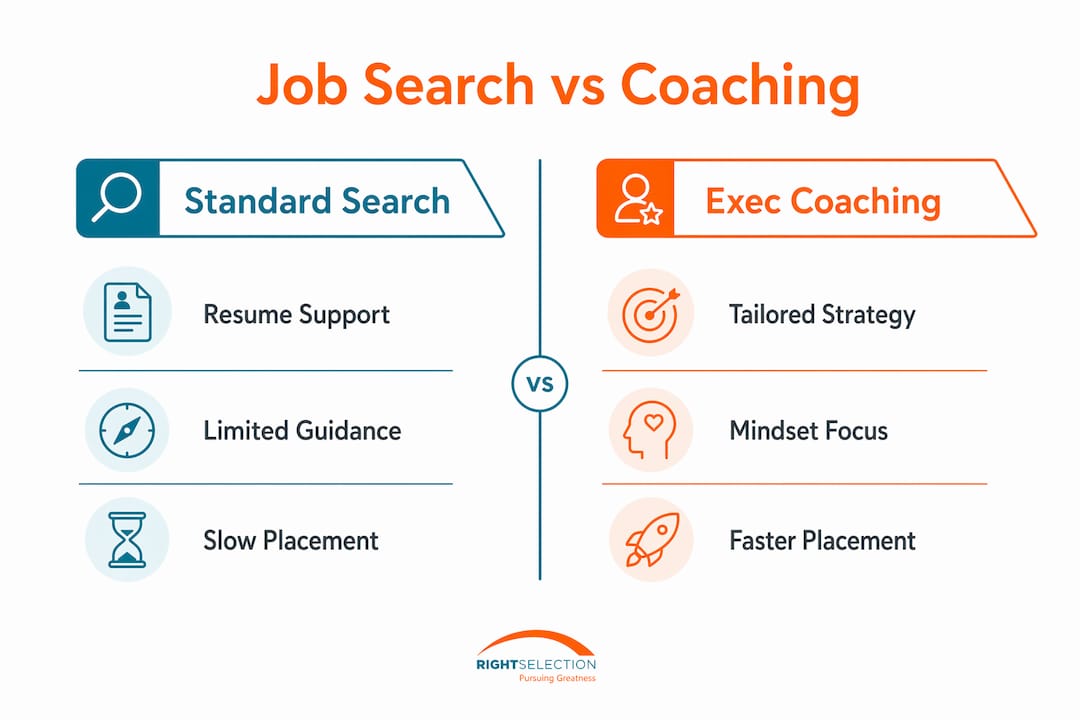
The table below contrasts what a standard job search approach delivers versus what professional transition coaching provides.
| Capability | Standard job search | Executive transition coaching |
|---|---|---|
| Resume support | Template-based formatting | Forward-looking narrative strategy |
| Interview prep | Generic Q&A practice | Role-specific positioning and storytelling |
| Network activation | Cold outreach | Warm introductions through curated relationships |
| Mindset support | None | Structured inner work and accountability |
| Post-hire support | None | 90-day integration coaching |
Pro Tip: Before your first coaching session, write a one-page document covering your top three values, your ideal work environment, and the type of leader you want to become. Coaches use this to calibrate your entire program.
How does executive coaching work step by step?
The coaching engagement follows a clear sequence. Understanding each phase helps you get more from every session and avoid the passive approach that limits results.
- Free clarity session. Most reputable programs begin with a free confidential consultation to assess your goals, urgency, and fit. Scope and pricing are customized after this conversation.
- Goal setting and program design. Your coach maps a personalized plan covering timeline, target roles, compensation benchmarks, and the specific skills or narratives that need development.
- Personal branding and narrative work. A high-impact executive resume is a forward-looking performance projection, not a list of past duties. Coaching shifts your narrative from what you have done to what you will deliver.
- Interview and negotiation preparation. Coaches run scenario-based interview simulations, help you frame your story for specific boards or leadership teams, and prepare you to negotiate from a position of clarity rather than anxiety.
- Cultural integration support. The first 90 days in a new role carry significant risk. Poor relationship management and cultural misalignment cause many executive failures post-hiring. Coaching during this window addresses exactly that.
Each phase builds on the previous one. Skipping the inner work in phase two to rush toward applications in phase three is the most common reason transitions stall.
Pro Tip: Treat every coaching session like a board meeting. Come with a specific agenda item, a decision you need to make, or a challenge you are working through. Passive attendance produces passive results.
The role of personal branding deserves particular emphasis. Executives often underestimate how much their professional narrative shapes perception before any interview takes place. Your LinkedIn profile, the way you describe your career arc in conversations, and the language you use in outreach all signal whether you are a candidate or a thought leader. Coaching builds that signal deliberately.
What challenges arise during transitions and how does coaching help?
Career transitions at the executive level carry psychological weight that most professionals do not anticipate. The higher the role, the more complex the transition. Objective thought partners are critical at this level precisely because the stakes are high and the feedback loops are slow.
Several specific challenges appear consistently across senior-level transitions:
- Overconfidence. Executives who have succeeded repeatedly often assume the next move will come easily. Coaching provides the honest external perspective that peers and direct reports cannot.
- Isolation. Senior professionals have fewer people they can speak candidly with during a transition. A coach fills that gap without the social complexity of involving colleagues or family.
- AI-driven recruiting. Human qualities like character and cultural fit now carry more weight in hiring decisions as technology handles the transactional screening. Coaching prepares executives to lead with those qualities in every interaction.
“The executives who struggle most in transitions are not the least qualified. They are the ones who believe their track record speaks for itself and skip the work of translating it into a compelling, forward-facing narrative for a new audience.”
Managing cultural fit after hire is where many executives are most vulnerable. Relationship building in the first 90 days determines whether a leader is seen as a trusted partner or an outsider with authority. Coaching during this period focuses on listening strategies, stakeholder mapping, and the patience to earn influence before exercising it.
Pro Tip: Read stress management strategies for executives before your transition begins. Managing your own emotional state during a high-stakes move directly affects the quality of your decisions and your presence in coaching sessions.
What tips maximize your coaching impact?
Consistency separates executives who get strong results from those who treat coaching as a periodic check-in. Structured routines and consistent action between sessions produce the clarity and momentum that make transitions succeed.
Apply these practices throughout your coaching engagement:
- Act between sessions. Every coaching conversation should produce at least one concrete action. Complete it before the next session. Accountability compounds over time.
- Build a daily structure. Transitions without structure erode confidence. Block time each morning for reflection, outreach, and skill development. Treat it like a job.
- Use coaching insights to shape your narrative. The language your coach helps you develop belongs in your LinkedIn summary, your cover letters, and your opening remarks in every interview.
- Avoid the transactional mindset. Executives who treat coaching as a vendor relationship get vendor-level results. The partnership model, where you bring full candor and commitment, produces the outcomes worth pursuing.
- Think beyond the next role. The best executive career coaching builds a long-term career architecture, not just a bridge to the next title. Ask your coach regularly how today’s decisions affect your five-year trajectory.
The compound effect of consistent engagement is real. Executives who show up prepared, act on feedback, and maintain their routines through the discomfort of transition build both momentum and confidence. Those qualities show up in interviews, in negotiations, and in the first weeks of a new role.
Key takeaways
Executive transition coaching works because it addresses mindset, narrative, and integration together, not just the job search in isolation.
| Point | Details |
|---|---|
| Faster placement | Clients using executive transition support secure roles 33% faster than the market average. |
| Compensation protection | 90% of coached executives achieve the same or higher compensation in their new roles. |
| Inner work first | Burnout, values misalignment, and mindset gaps must be addressed before the external search begins. |
| Narrative over history | Effective coaching shifts your resume and story from past duties to future performance projection. |
| Integration matters | Coaching through the first 90 days of a new role prevents cultural misalignment and relationship failures. |
Why I believe executive coaching is non-negotiable at the senior level
I have worked alongside hundreds of senior professionals navigating major career moves, and the pattern is consistent. The executives who resist coaching are almost always the ones who are most qualified on paper and least prepared for the actual complexity of a high-stakes transition. Credentials do not teach you how to rebuild your professional identity in a new context. Coaching does.
What I find most compelling about executive coaching for career growth is that it closes the gap between internal capability and external perception. Most executives I have observed have far more to offer than their current narrative communicates. The coaching process surfaces that gap and fixes it with precision.
The recruiting environment in 2026 makes this more urgent, not less. As AI handles more of the screening process, the human conversation carries more weight. Character, cultural alignment, and the ability to communicate your value clearly are now the deciding factors at the senior level. A coach prepares you for exactly that conversation.
Coaching is not a service you consume. It is a partnership you commit to. The executives who treat it that way consistently outperform those who do not, and the data on placement speed and compensation outcomes reflects that directly.
— Dipti
Right Selection’s executive coaching for career transitions
Right Selection connects professionals in transition with an elite network of coaches, thought leaders, and corporate trainers who specialize in senior-level career moves. With over 30 years of experience and a roster of 100+ coaches and speakers, Right Selection designs programs around your specific goals, timeline, and target roles.
Whether you are preparing for your first senior transition or navigating a complex lateral move, Right Selection’s tailored coaching programs match you with the right coach for your situation. Specialists like Dr. Carol Talbot bring deep expertise in executive transitions and leadership development. Every engagement begins with a personalized consultation to define scope, goals, and the coaching approach that fits your needs. Schedule your consultation and take the first step toward a transition built on clarity and commitment.
FAQ
What is executive transition coaching?
Executive transition coaching is a structured partnership that helps senior professionals move between roles with clarity, speed, and stronger compensation outcomes. It covers mindset work, personal branding, interview preparation, and post-hire integration.
How long does executive career coaching take?
Coaching timelines vary based on goals and urgency, with scope and pricing customized after an initial consultation. The most effective programs extend through the first 90 days of a new role, not just the search phase.
Does executive coaching actually improve compensation outcomes?
Yes. Professionals using executive-level career transition support achieve the same or higher compensation in 90% of cases, according to data from ZRG Partners.
When should I start working with an executive coach?
Start before you need to. Executives who begin coaching while still employed have more time for the inner work that precedes an effective search. Beginning mid-transition is still valuable, but earlier engagement produces better results.
How is executive coaching different from career counseling?
Career counseling typically focuses on assessment and direction-setting. Executive coaching is a forward-facing partnership that builds narrative, prepares you for high-stakes conversations, and provides accountability through the full transition arc, including post-hire integration.