
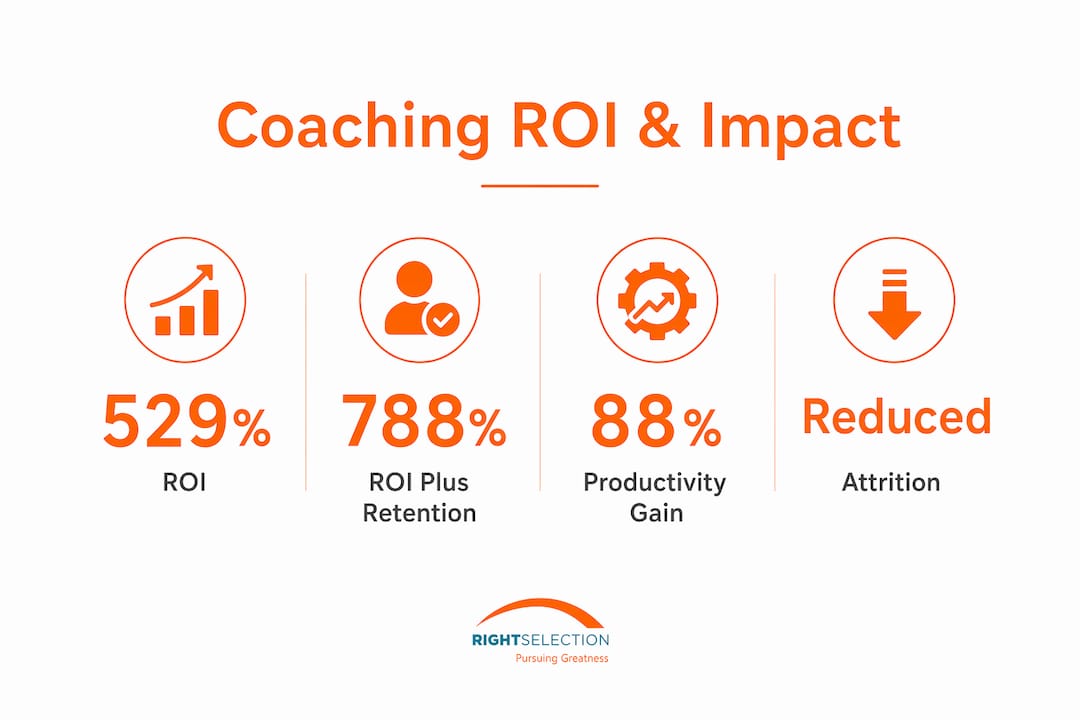
Leadership coaching is defined as personalized, ongoing support that develops a leader’s skills, self-awareness, and behavioral patterns over time. Organizations that understand why leadership coaching reduces executive attrition gain a measurable advantage: they retain the talent they invested years building. Research confirms that training plus coaching produces an 88% increase in productivity, compared to just 22% from training alone. That gap is not a minor improvement. It reflects the compound effect of accountability, sustained behavioral change, and personalized support that coaching delivers where one-time training cannot. For corporate leaders and HR professionals, that distinction is the foundation of every effective retention strategy.
Why leadership coaching reduces executive attrition: the research case
The evidence connecting leadership coaching to reduced executive turnover is consistent and growing. Meta-analyses show that coaching produces a moderate positive effect on leadership behaviors, goal clarity, and resilient thinking. These are not soft outcomes. They are the cognitive and behavioral conditions that keep leaders engaged and committed to their organizations.
The financial case is equally clear. A MetrixGlobal study reported a 529% ROI from coaching, rising to 788% when improved employee retention is included. That jump from 529% to 788% tells you something specific: retention is not a side benefit of coaching. It is one of its primary drivers of value.

Coaching also outperforms standalone training in a way that matters for attrition. Training delivers knowledge. Coaching delivers behavioral change over time. A leader who attends a two-day workshop may gain insight, but without ongoing reinforcement, old patterns return. Coaching creates the accountability loop that sustains new behavior, which is exactly what keeps leaders from disengaging and leaving.
Pro Tip: When presenting the business case for coaching to your board or CFO, lead with the retention ROI figure. The jump from 529% to 788% when retention is factored in makes the cost of not coaching far more visible.
| Intervention | Productivity Gain | Retention Impact |
|---|---|---|
| Training alone | 22% | Minimal sustained change |
| Training plus coaching | 88% | Significant, measurable improvement |
| Coaching with retention focus | High | ROI rises to 788% |
How does coaching build the skills that keep executives engaged?
Coaching improves emotional intelligence, and that improvement directly reduces attrition risk. A meta-analysis of coaching outcomes confirms significant gains in emotional competence, self-awareness, and goal attainment. Leaders with higher emotional intelligence build stronger relationships with their teams, communicate more clearly under pressure, and recover faster from setbacks. Those qualities reduce burnout and the disengagement that precedes departure.
The psychological mechanisms go deeper than skill-building. Coaching builds what researchers call psychological capital, which includes hope, efficacy, resilience, and optimism. Leaders who develop these qualities are less likely to experience the chronic stress and loss of purpose that drive attrition. They approach high-pressure situations with greater stability, which benefits both their own retention and the retention of the people they lead.
Coaching also strengthens leadership relationships and succession readiness. When leaders feel genuinely supported in their development, their commitment to the organization deepens. That sense of investment is a retention factor that compensation alone cannot replicate.
The behavioral changes that coaching produces include:
- Improved self-regulation: Leaders learn to manage their reactions in high-stakes situations, reducing conflict and team instability.
- Clearer goal orientation: Coached leaders set and pursue goals with greater focus, which reduces the drift and frustration that often precede departure.
- Stronger relational trust: Coaching builds the interpersonal skills that create loyal, high-performing teams, which in turn reinforces the leader’s own sense of purpose.
- Greater resilience under pressure: Leaders who develop resilience through coaching are less likely to exit during organizational transitions or periods of high demand.
Pro Tip: Pair coaching with 360-degree feedback at the start of each engagement. Leaders who see specific behavioral data early in the process engage more deeply with the coaching process and show faster improvement.
What makes a leadership coaching program actually work?
Not all coaching programs produce the same results. The conditions under which coaching is delivered determine whether it reduces attrition or simply adds cost. Effective coaching goals are specific, measurable, and tied to real work outcomes. They are co-created by HR, the leader, and the coach. That three-way alignment is not a formality. It is the mechanism that makes coaching accountable and measurable.
Program design also matters significantly. Research shows that long-term, individual coaching using cognitive-behavioral approaches produces the highest effectiveness. Short, generic programs rarely produce the behavioral depth needed to shift attrition patterns. The format, duration, and focus must match the individual leader’s context and the organization’s specific retention challenges.
The following conditions consistently distinguish high-impact programs from low-impact ones:
- Goal alignment across stakeholders. HR, the executive, and the coach agree on specific behavioral targets before the engagement begins. Vague goals produce vague outcomes.
- Integration with leadership development systems. Coaching works best when it connects to broader programs like succession planning, performance management, and leadership competency frameworks.
- Measurement tied to retention metrics. Organizations that track coaching outcomes against engagement scores and turnover data can demonstrate ROI and refine their programs over time.
- Early intervention during transitions. Coaching during high-pressure periods maintains leader commitment and catches misalignments before they become departure decisions.
- Tailored duration and format. A newly promoted VP and a 15-year C-suite veteran need different coaching structures. One size does not fit the full range of executive retention challenges.
Comparing program types by design quality reveals a clear pattern. Programs built around generic leadership content show modest retention gains. Programs built around individual behavioral goals, integrated into organizational systems, and measured against real outcomes show the strongest impact on reducing executive turnover. The types of executive coaching programs available today range from one-on-one engagements to cohort-based models, and choosing the right format is as important as choosing the right coach.
How can organizations implement coaching to reduce executive attrition?
Implementation is where most organizations lose the gains that research promises. A well-designed coaching program that lacks organizational commitment will not move retention numbers. The following practices build a coaching culture that sustains results.
- Select coaches with verified credentials and relevant experience. Look for coaches with backgrounds in executive leadership, organizational psychology, or behavioral change. Credentials from the International Coaching Federation (ICF) provide a baseline standard. Experience in your industry adds contextual relevance.
- Align coaching goals with succession planning. Coaching that connects to a leader’s career trajectory within the organization creates a retention incentive. Leaders who see a path forward are less likely to look elsewhere. Effective employee retention strategies consistently link individual development to organizational opportunity.
- Embed coaching in leadership transitions. The first 90 days of a new role carry the highest attrition risk. Coaching during this period catches misalignments early and builds the confidence that sustains long-term commitment.
- Track retention and engagement as coaching KPIs. Define what success looks like before the engagement begins. Measure engagement survey scores, voluntary turnover rates, and 360-degree feedback results at regular intervals.
- Build stakeholder alignment from the start. HR, the executive’s direct manager, and the coach must share a common understanding of the coaching goals. Without that alignment, coaching becomes an isolated activity rather than an organizational investment.
- Sustain the coaching culture beyond individual engagements. Organizations that treat coaching as a one-time fix see temporary gains. Those that build coaching into their leadership development calendar see compounding retention benefits over time.
The best practices for executive coaching consistently point to one principle: coaching must be treated as a system, not an event. When it is embedded in how an organization develops and retains its leaders, the impact on attrition becomes structural rather than incidental.
Key Takeaways
Leadership coaching reduces executive attrition by producing sustained behavioral change, improving emotional intelligence, and creating the organizational conditions that keep leaders committed and engaged.
| Point | Details |
|---|---|
| Coaching outperforms training alone | Training plus coaching produces 88% productivity gains versus 22% from training alone. |
| Retention drives coaching ROI | Including retention impact raises coaching ROI from 529% to 788% in documented studies. |
| Emotional intelligence is the mechanism | Coaching builds self-awareness and relational skills that reduce burnout and departure risk. |
| Program design determines outcomes | Goals must be specific, co-created, and tied to real work outcomes to produce retention gains. |
| Early intervention is critical | Coaching during leadership transitions catches misalignments before they become attrition events. |
Why I believe coaching is the most underused retention tool in the executive suite
Most organizations treat executive attrition as a recruiting problem. They respond to a departure by searching for a replacement, often spending the equivalent of one to two times the executive’s annual salary in the process. What they rarely examine is whether the departure was preventable. In my experience, most of them are.
The research on coaching and attrition rates is not ambiguous. The impact of coaching on leadership behavior is consistent across industries, organizational sizes, and leadership levels. What varies is whether organizations treat that evidence as a call to act or as an interesting data point.
The most common pitfall I see is coaching without strategic alignment. A leader receives coaching sessions, gains personal insight, and then returns to an environment where none of the structural conditions have changed. The coaching becomes a personal benefit rather than an organizational investment. That is a design failure, not a coaching failure.
The organizations that get this right treat coaching as a system. They connect it to succession planning, embed it in transitions, and measure it against retention data. They also recognize that the cost of losing a senior leader extends far beyond the replacement fee. It includes lost institutional knowledge, team disruption, and the cultural signal that the organization does not invest in its people.
Leadership coaching is not a luxury program for high-potential executives. It is a retention infrastructure decision. The organizations that recognize that distinction are the ones building leadership stability that compounds over time.
— Dipti
Right Selection’s approach to executive retention through coaching
Right Selection works with corporate leaders and HR professionals who are serious about reducing executive attrition through purposeful coaching programs.
With over 30 years of experience and a roster of 100+ global thought leaders, coaches, and corporate trainers, Right Selection connects organizations with the right expertise for their specific retention challenges. Every engagement is designed around your business goals, not a generic curriculum. Whether you are building a coaching program from the ground up or refining an existing one, the team at Right Selection brings the discernment and commitment to match you with coaches who produce measurable outcomes. Explore profiles of leadership specialists like Mark C. Thompson and Liz Wiseman to see the caliber of expertise available to your organization.
FAQ
Why does leadership coaching reduce executive attrition?
Leadership coaching reduces executive attrition by building the behavioral skills, emotional intelligence, and goal clarity that keep leaders engaged and committed. Research shows coaching produces sustained behavioral change that training alone cannot deliver.
How much ROI does executive coaching deliver on retention?
A MetrixGlobal study found coaching delivers a 529% ROI, rising to 788% when improved employee retention is included. That figure reflects the direct financial value of keeping experienced leaders in their roles.
What is the difference between coaching and training for retention?
Training alone produces a 22% productivity gain, while training combined with ongoing coaching produces an 88% gain. The difference is accountability and sustained behavioral reinforcement, which are the conditions that reduce attrition risk.
When should organizations introduce coaching to prevent executive attrition?
Coaching is most effective when introduced during leadership transitions, such as promotions or role changes, because this is when misalignment and disengagement risk are highest. Early intervention during these periods maintains leader commitment and reduces departure risk.
What makes a leadership coaching program effective for reducing turnover?
Effective programs set specific, measurable goals co-created by HR, the leader, and the coach, and integrate coaching into broader leadership development systems. Programs that measure outcomes against retention and engagement metrics consistently show the strongest results.