
High-impact leadership training is defined as a structured, evidence-based development process that equips leaders with the skills, mindset, and behavioral capacity to drive measurable organizational change. Unlike generic workshops or one-off seminars, this approach combines systematic needs analysis, sustained program delivery, and real-world application to produce lasting results. Research confirms that programs beginning with gap assessments dramatically outperform those that skip this step. The standard industry term for this field is leadership effectiveness development, and understanding what separates it from conventional training is the first decision every serious organization must make.
What is high-impact leadership training and its core components?
High-impact leadership training is built on a set of specific, research-validated design features. These features separate programs that produce real behavior change from those that simply check a training box.
The first and most critical feature is a systematic needs analysis. Diagnosing root causes as either a “Doing Side” issue (skill competence) or a “Being Side” issue (mindset, emotional regulation, capacity) determines the entire program design. A leader who lacks a skill needs practice and feedback. A leader whose beliefs or emotional patterns limit their effectiveness needs coaching and reflection. Treating both with the same approach wastes time and investment.

The second feature is multi-method learning delivery. Effective programs combine in-person workshops, virtual sessions, peer cohort learning, and one-on-one coaching. No single format produces the depth of change that a blended approach achieves. Reinforcement routines and spaced delivery consistently outperform compressed, single-event formats in transferring learning to the job.
The third feature is feedback integration. Only 43% of leaders are skilled at delivering feedback, yet feedback is the most important driver of leadership training effectiveness. Programs that build feedback delivery skills and create structured feedback loops produce significantly stronger outcomes than those that treat feedback as optional.
Key components that define a high-impact program include:
- Needs analysis tied directly to business goals and leadership gaps
- Spaced learning sessions spread over months, not days
- Executive coaching integrated throughout, not added as an afterthought
- Action learning projects grounded in real organizational challenges
- 360-degree feedback collected before, during, and after the program
- Reinforcement routines that sustain behavior change between sessions
Pro Tip: Before selecting any leadership development program, map your leaders’ gaps to either Doing Side or Being Side root causes. This single step will determine whether coaching, skill practice, or a combination of both is the right investment.
How does high-impact leadership training build lasting behavior change?
Lasting behavior change requires more than skill acquisition. It requires leaders to confront the assumptions, habits, and internal patterns that shape how they lead every day.
Contextualization to real organizational challenges is the mechanism that makes learning stick. When a leader applies a new communication approach to an actual team conflict they are managing, the learning becomes concrete and personal. Generic case studies from other industries do not produce the same depth of retention or application.
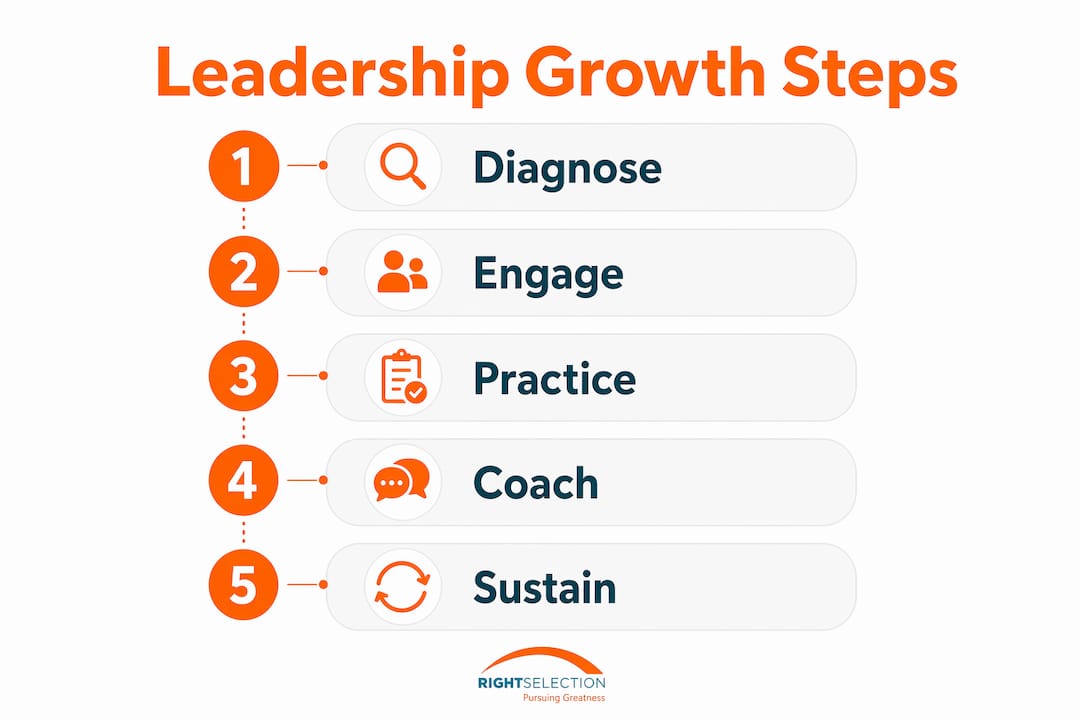
The most effective programs build adaptive capacity through four sequential steps:
- Awareness — Leaders identify the specific behaviors and mindsets limiting their effectiveness through 360-degree feedback and self-assessment.
- Reflection — Facilitated coaching sessions help leaders examine the beliefs driving those behaviors, creating productive discomfort.
- Practice — Leaders apply new approaches in real work settings between sessions, supported by peer accountability partners.
- Reinforcement — Spaced follow-up sessions and coaching check-ins embed the new behaviors until they become default patterns.
“Real leadership development is not about adding new tools to a leader’s kit. It is about changing the operating system underneath.”
Power skills such as listening, trust building, and empowerment matter more than technical expertise as a leader’s role scales. These skills cannot be absorbed through passive learning. They are cultivated through daily habits, deliberate practice, and consistent feedback over time.
Action learning projects using real workplace challenges accelerate this process. When leaders work on live organizational problems as part of their training, they apply new thinking immediately and see results in real time. This creates a compound effect where learning and organizational impact reinforce each other.
The strategic leadership development literature consistently shows that programs lasting 6 to 12 months with hybrid delivery produce the most durable outcomes. Short programs can build awareness, but they rarely produce the sustained behavior change that organizations need from their senior leaders.
What measurable benefits do organizations gain from these programs?
Organizations that invest in well-designed leadership development programs see improvements across multiple performance dimensions. The returns are measurable, not theoretical.
Typical measurable outcomes include improved 360-degree feedback scores, stronger team retention rates, and better decision quality. Each of these connects directly to business performance. Higher 360 scores reflect improved relationships and influence. Better retention reduces recruiting costs and preserves institutional knowledge. Stronger decisions reduce costly errors and increase strategic alignment.
| Outcome | High-impact programs | Traditional training |
|---|---|---|
| Behavior change duration | Sustained (6+ months) | Short-term (weeks) |
| 360-degree feedback improvement | Measurable and tracked | Rarely measured |
| Team retention impact | Documented improvement | Minimal evidence |
| Decision-making quality | Improved through coaching | Not directly addressed |
| ROI from learning projects | Quantifiable | Difficult to isolate |
The benefits of executive leadership training extend beyond individual leaders. Organizations build stronger leadership pipelines, reduce dependence on external hiring for senior roles, and create cultures where leadership capability compounds over time.
Key organizational benefits include:
- Stronger succession planning with internal candidates ready to step up
- Improved cross-functional collaboration driven by leaders with better influence skills
- Higher employee engagement scores in teams led by program participants
- Faster strategic execution when leaders align their teams more effectively
The return on investment from action learning projects alone often justifies the program cost. When leaders solve real business problems as part of their development, the solutions they generate deliver direct financial value.
What strategies should organizations use when designing these programs?
Designing a high-impact program starts with clarity about what the organization needs leaders to do differently. That clarity comes from a structured needs assessment, not from selecting a popular training format.
Aligning leadership training with business strategy is the foundation of effective program design. Organizations that design training around strategic priorities produce leaders who can execute on those priorities. Organizations that select programs based on trend or convenience produce leaders who are better informed but not more effective.
Practical strategies for organizations and leaders include:
- Conduct a leadership audit before selecting any program. Identify the specific gaps between current leadership behavior and what the strategy requires.
- Balance Doing Side and Being Side development. Most programs over-invest in skill content and under-invest in coaching for mindset and capacity.
- Choose hybrid formats that combine in-person depth with virtual flexibility and individual coaching.
- Build in feedback mechanisms from the start. Pre-program 360-degree assessments create a baseline. Post-program assessments measure change.
- Avoid one-off events. Generic, event-based training does not produce lasting change. Programs need duration, spacing, and reinforcement to work.
- Select coaches and facilitators with experience in your industry and leadership context. Generic facilitators produce generic results.
Understanding why leadership training fails is as important as knowing what works. The most common failure modes are misdiagnosed needs, insufficient duration, and no accountability structure after the program ends.
Pro Tip: Agree on two or three specific, measurable leadership behaviors you want to see change before the program begins. Use those behaviors as your evaluation criteria at 90 days and 180 days post-program. This turns a development investment into a trackable business outcome.
Key takeaways
High-impact leadership training produces lasting change only when it diagnoses root causes accurately, delivers learning over time with coaching and feedback, and applies development directly to real organizational challenges.
| Point | Details |
|---|---|
| Diagnose before designing | Identify Doing Side vs. Being Side gaps before selecting any program format. |
| Duration drives results | Programs lasting 6–12 months with spaced sessions outperform short, intensive events. |
| Feedback is non-negotiable | Build 360-degree feedback and coaching into the program structure from day one. |
| Real challenges accelerate learning | Action learning projects tied to live business problems produce measurable ROI. |
| Measure behavior, not attendance | Define specific leadership behaviors to track at 90 and 180 days post-program. |
Why mindset matters more than most organizations admit
Most organizations I have observed invest heavily in the Doing Side of leadership development. They build skill workshops, run communication modules, and teach frameworks for delegation or decision-making. These are worthwhile. But they consistently underdeliver because the real constraint is rarely a skill gap.
The leaders who struggle most are not struggling because they do not know what good leadership looks like. They struggle because their internal patterns, their beliefs about control, vulnerability, or authority, prevent them from acting on what they know. Coaching for mindset shifts is not a soft add-on. It is the core mechanism of lasting change.
I have seen leaders complete technically excellent programs and return to their organizations unchanged within 90 days. The reason is almost always the same. The program taught them new behaviors but never examined the assumptions underneath the old ones. Discomfort is not a sign that a program is too hard. It is a sign that real development is happening.
The most effective programs I have encountered treat leadership development as an ongoing commitment, not an episodic event. They build accountability structures, peer cohorts, and coaching relationships that extend well beyond the formal program. That sustained attention is what produces the compound effect that organizations are actually looking for.
Leadership coaching models that integrate reflection, feedback, and real-world application consistently outperform those that focus on content delivery alone. The organizations that understand this distinction invest differently, and they get different results.
— Dipti
Right Selection and high-impact leadership development
Right Selection connects organizations with a curated network of over 100 global thought leaders, coaches, and corporate trainers who specialize in exactly this kind of development work.
Whether your organization needs a leadership expert like Mark C. Thompson for executive coaching, a speaker who addresses mindset and performance, or a fully customized leadership development program aligned to your strategic priorities, Right Selection brings the discernment and experience to match the right expert to your specific context. With over 30 years of experience designing high-quality learning experiences, Right Selection delivers programs that produce measurable leadership growth. Visit Right Selection to connect with a specialist and build a program your leaders will carry forward.
FAQ
What is high-impact leadership training?
High-impact leadership training is a structured, evidence-based development process that combines needs analysis, coaching, spaced learning, and real-world application to produce lasting behavior change in leaders. It differs from conventional training by diagnosing root causes and sustaining development over months rather than days.
How long should a high-impact leadership program last?
High-impact executive programs typically last 6 to 12 months, with spaced sessions and ongoing coaching to support sustained behavior change. Shorter programs can build awareness but rarely produce the durable results organizations need.
What is the difference between Doing Side and Being Side development?
Doing Side development addresses skill competence, such as communication, delegation, or feedback delivery. Being Side development addresses mindset, emotional regulation, and internal capacity constraints that require coaching rather than skill practice.
How do organizations measure the ROI of leadership training?
Organizations measure ROI through pre- and post-program 360-degree feedback scores, team retention rates, decision quality, and the business value generated by action learning projects completed during the program.
Why does most leadership training fail to produce lasting change?
Generic, one-off training events fail because they lack contextualization, reinforcement, and accountability structures. Lasting change requires sustained delivery, coaching integration, and direct application to real organizational challenges.