

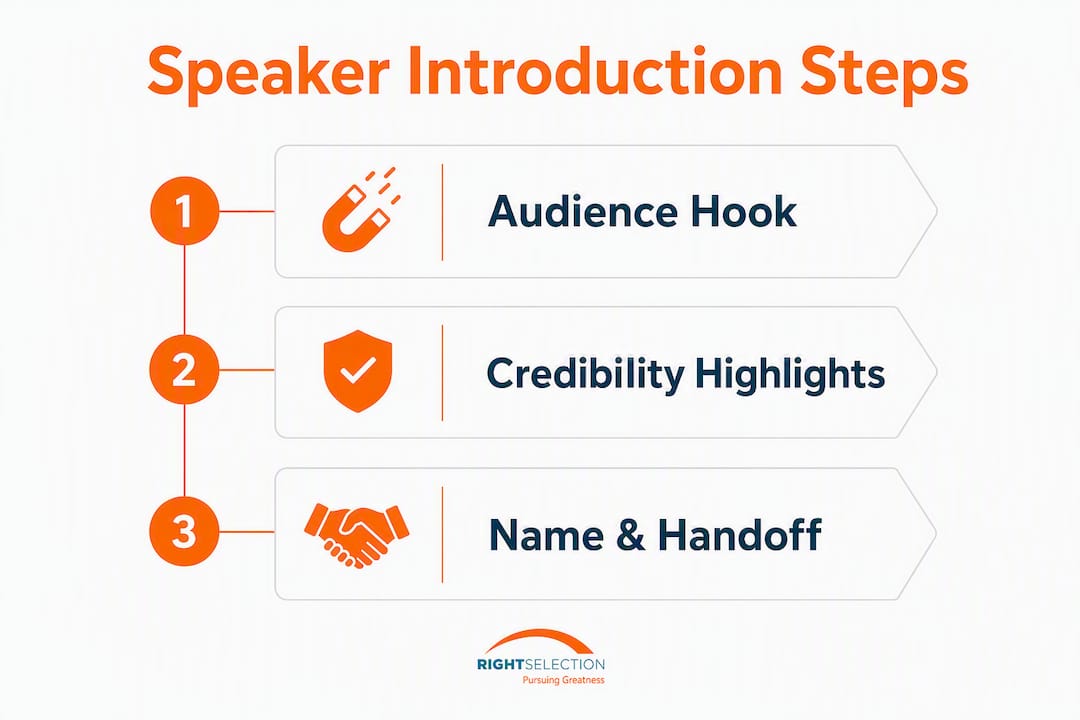
The most reliable way to introduce a speaker follows a three-part sequence: open with why this topic matters to this audience, give two or three credibility highlights that connect the speaker to that topic, then close with the speaker’s name and speech title. That sequence takes under 60 seconds and consistently produces a warm, credible handoff. Here is a copy-ready version you can use or adapt right now:
Three micro-rules govern every delivery:
- Be brief. Enough time to keep it concise; introductions generally should be under a minute for most events.
- No spoilers. Your job is to create anticipation, not summarize the talk.
- Confirm pronunciation. Say the speaker’s name correctly, every time.
Pro Tip: Write the speaker’s name phonetically on your notes card — e.g., “Sayed” as “SY-eed” — and rehearse it aloud at least three times before you walk on stage.
Table of Contents
- Why a strong introduction shapes how the audience receives the speaker
- What to confirm before you step up to the mic
- The 1+3 formula: what to say and in what order
- How long should your introduction be, and how do you pace it?
- Ready-to-use scripts for five common contexts
- Common mistakes and how to fix them fast
- Your printable one-page checklist and fill-in template
- When should you hire a professional for speaker management?
- Key Takeaways
- What experienced emcees know that checklists don’t tell you
- Right Selection handles the speaker prep so you don’t have to
- Sources and further reading
Why a strong introduction shapes how the audience receives the speaker
A speaker introduction does something most people underestimate: it transfers credibility. Before the speaker says a single word, the audience is already forming a judgment about whether this person is worth their attention. A well-crafted introduction creates an emotional bridge by linking the speaker’s expertise directly to what the audience came to learn or solve.

The practical effect on program flow matters too. A crisp, confident introduction signals that the event is well-organized, which raises the audience’s trust in everything that follows. Conversely, a rambling or uncertain introduction bleeds energy from the room before the speaker has even reached the lectern.
The best introductions are self-eliminating. Once you have done your job, step away. Psychology Today’s guidance on speaker introductions is explicit on this point: the introducer’s role is to set the stage, then remove themselves from focus entirely.
Pro Tip: Think of your introduction as a runway, not a destination. Your goal is to get the speaker airborne, then clear the tarmac.
What to confirm before you step up to the mic
Preparation is where most introduction errors are prevented. Run through this checklist within 24–48 hours of the event and again when the speaker arrives.
- Confirm the speaker’s preferred name and formal title. Ask directly: “How would you like to be introduced?” Do not assume the printed bio reflects their preference.
- Get the phonetic pronunciation. Speakers often provide phonetic spellings of their names in advance; if they haven’t, ask. For hybrid events, coordinate a phonetic cue with your AV team so the remote audience hears the correct name too, as outlined in hybrid event planning best practices.
- Confirm the speech title or topic line. State the speech title clearly so the audience knows exactly what to expect.
- Ask what to include and what to avoid. Some speakers have a recent achievement they want highlighted; others have a topic they prefer you not mention. A quick email or two-minute conversation covers both.
- Check AV and logistics. Know where the mic is, who controls the slides, and how you will cue the speaker to approach. Agree on a handoff signal.
- Time your introduction aloud. Rehearse the wording until it feels natural, not read.
Pro Tip: If you cannot meet the speaker beforehand, request a specific “cut” of their bio suited to your audience type. Speakers typically maintain a technical version, an executive version, and a general-audience version. Never assume the longest one is the best one.
The 1+3 formula: what to say and in what order
The structure that works across almost every context has three parts, each with a clear job.

Part 1: Audience-first opening (1–2 sentences). Start with the audience’s problem, goal, or curiosity, not the speaker’s name. This immediately signals relevance and earns attention. Something like: “Every leader in this room has faced the challenge of building trust across a distributed team.” That sentence makes the audience lean in before you’ve mentioned anyone.
Part 2: Two or three credibility highlights (2–3 sentences). Select highlights that are relevant to this audience, not a full biography. A speaker who has authored six books and led three Fortune 500 transformations has a long résumé; your job is to pick the two facts that make this room trust this speaker on this topic. Toastmasters recommends one to two proof points maximum and advises against previewing the speaker’s content.
Part 3: Name, speech title, and handoff (1 sentence). End with the speaker’s full name, stated clearly, followed by the speech title. Then begin the applause and step aside. That final sentence is the cue; everything after it belongs to the speaker.
The table below maps tone to approximate word counts for each part, helping you pace and edit for your specific context.
| Tone | Part 1: Audience hook | Part 2: Credibility highlights | Part 3: Name + title | Total target |
|---|---|---|---|---|
| Professional (corporate meeting) | — | — | 10–15 words | — |
| Casual (meetup/workshop) | 10–15 words | — | 10 words | — |
How long should your introduction be, and how do you pace it?
Toastmasters advises keeping introductions under 60 seconds for most events, with a useful rule of thumb: aim for roughly 15% of the speaker’s allotted time for shorter slots. A speaker with five minutes gets a 45-second introduction; a keynote speaker with 45 minutes can support a 60-second introduction, not a five-minute one.
Delivery cues that make a real difference:
- Pause before you begin. Two seconds of silence after you reach the mic signals confidence and settles the room.
- Slow down on the name. Most mispronunciations happen because the introducer rushes the final sentence. Deliberately decelerate on the speaker’s name.
- Make eye contact with the audience, not your notes, for at least the opening and closing lines.
- Lead the applause. Start clapping as you say the speaker’s name and step to the side. This cues the audience and gives the speaker a clean entrance.
- Rehearse aloud, not silently. Reading in your head does not reveal where you will stumble; speaking it does.
Ready-to-use scripts for five common contexts
Each script below is designed for quick reading and easy customization. The adaptation note tells you exactly what to swap.
Conference keynote: “The question every organization in this room is wrestling with is how to lead through rapid change. Our next speaker has advised more than 200 executive teams across four continents and is the author of [Book Title]. Please welcome [Speaker Name], presenting ‘[Speech Title].’”
Adapt: swap the opening challenge for the conference theme; update the credential to the speaker’s most relevant achievement.Casual meetup or workshop: “Tonight we’re getting into [topic], and I can’t think of a better person to kick us off. [Speaker Name] has been doing this work for [X years] and brings a perspective that’s both practical and grounded. Give it up for [Speaker Name]!”
Adapt: keep the tone conversational; drop formal titles unless the audience expects them.Church or faith-based service: “Our community has been exploring [theme], and today’s message speaks directly to that. [Speaker Name] serves as [role] and has dedicated [X years] to [mission area]. Please join me in welcoming [Speaker Name].”
Adapt: replace mission area with the speaker’s specific ministry or area of service.Academic ceremony or lecture: “[Speaker Name] holds the position of [title] at [institution] and is widely recognized for [research area or contribution]. Their work has [specific impact]. It is my honor to introduce [Speaker Name], who will present ‘[Lecture Title].’”
Adapt: use full formal titles; match the credential to the academic discipline of the audience.Emcee handoff between sessions: “That wraps up our morning session. Coming up next, we’re shifting focus to [new topic]. [Speaker Name] brings [one-line credential], and this session is one I know you’ll want to stay for. Please welcome [Speaker Name].”
Adapt: use this to maintain energy between back-to-back sessions; keep it under 30 seconds.
Match your energy level to the weight of the session. A memorial lecture calls for measured, respectful delivery; a product launch keynote can carry more enthusiasm.
Common mistakes and how to fix them fast
- Reading the full bio. A biography is a document, not an introduction. Fix: select two or three highlights and leave the rest on the page.
- Spoiling the talk. Summarizing the speaker’s key points removes their reason to present. Fix: describe the topic and its relevance to the audience; never reveal the conclusion.
- Mispronouncing the name. It signals a lack of preparation and embarrasses everyone. Fix: confirm phonetics in advance and write them on your notes.
- Running too long. A good introduction sets the stage without becoming a mini-speech. Fix: time yourself; if you’re over 60 seconds, cut a credential.
- Inside jokes or personal anecdotes. These exclude most of the room. Fix: keep every sentence relevant to the full audience, not just people who know you.
Handling surprises: If the speaker is delayed, say calmly: “[Speaker Name] is on their way to the stage. While we get set up, let’s take 60 seconds to connect with the person next to you.” If the mic fails, project your voice, stay composed, and signal the AV team with a clear hand gesture. Composure from the introducer keeps the audience calm.
Your printable one-page checklist and fill-in template
Use the checklist column before the event; use the template column to write your actual introduction.
| Checklist item | Fill-in template field |
|---|---|
| ☐ Confirmed preferred name and formal title | Speaker name (as introduced): _________________ |
| ☐ Phonetic pronunciation written on notes card | Phonetic guide: _________________ |
| ☐ Speech title or topic line confirmed | Speech title: _________________ |
| ☐ Two to three credential highlights selected | Credential 1: _________________ |
| ☐ Asked speaker what to exclude | Credential 2: _________________ |
| ☐ AV/mic handoff plan confirmed | Credential 3 (optional): _________________ |
| ☐ Introduction timed aloud (target: under 60 sec) | Audience hook (opening line): _________________ |
| ☐ Handoff signal agreed with speaker | Avoidances noted: _________________ |
When should you hire a professional for speaker management?
Some events genuinely benefit from delegating the introduction and speaker management process entirely. Large-scale conferences with multiple keynotes, executive retreats where a keynote sets strategic direction, and multi-day programs with back-to-back speakers all carry a level of coordination that a single volunteer host cannot reliably manage alone.
A professional event facilitation partner adds value in specific, measurable ways:
- Coordinated speaker briefs: pre-event documents that confirm name, title, pronunciation, preferred highlights, and avoidances for every speaker on the program.
- Scripted handoffs: written introduction scripts reviewed and approved by each speaker before the event.
- AV and mic liaisons: a dedicated person managing the technical handoff so the introducer can focus entirely on delivery.
- On-stage run-throughs: a rehearsal that catches timing and pronunciation issues before the audience arrives.
Right Selection has spent over 30 years curating and managing speakers for corporate events, leadership summits, and executive development programs. With a roster of 100+ global thought leaders, the team handles everything from selecting the right keynote speaker to preparing the introduction brief that makes the handoff seamless for the host.
Pro Tip: When working with a speaker management partner, request a speaker profile that includes a ready-to-read introduction paragraph. Right Selection’s speaker profiles, like those for May Sayed Ali, are structured specifically to give event organizers the credential highlights they need without the guesswork.
Key Takeaways
A credible, engaging speaker introduction follows a three-part formula: audience hook, two to three relevant credentials, then the speaker’s name and speech title, delivered in under 60 seconds.
| Point | Details |
|---|---|
| Use the 3-part formula | Open with audience benefit, add 2–3 credentials, close with name and speech title. |
| Keep it under 60 seconds | Toastmasters advises under 60 seconds; roughly 15% of the speaker’s allotted time is a reliable guide. |
| Confirm details in advance | Verify preferred name, phonetic pronunciation, speech title, and any avoidances with the speaker beforehand. |
| Avoid spoilers | Describe the topic’s relevance to the audience; never reveal the speaker’s conclusions or key points. |
| Right Selection as a resource | Right Selection provides curated speaker profiles and introduction briefs for corporate events and leadership programs. |
What experienced emcees know that checklists don’t tell you
Most introduction guides focus on what to say. The part that actually determines how the audience receives the speaker is how you carry yourself in the 10 seconds before and after you speak.
Stand at the center of the stage before you begin, not off to the side. That positioning signals authority and tells the audience something important is about to happen. When you finish the final sentence, start clapping while you are still facing the audience, then turn toward the speaker as you step aside. That sequence directs the audience’s attention exactly where it needs to go.
Energy matching matters more than most people realize. If you walk out with the energy of someone reading a grocery list, the speaker has to work twice as hard to lift the room. But if you arrive with slightly more energy than the room currently holds, you create a current the speaker can ride. The key word is slightly. Overshooting it makes you the story, and the introducer should never be the story.
One more thing: the moment you finish your last word, your job is done. Do not linger at the lectern, do not adjust the mic stand for an extra five seconds, and do not make eye contact with the audience again. Walk off with purpose. The speaker’s first impression begins the moment you leave the stage.
Right Selection handles the speaker prep so you don’t have to
Crafting the right introduction is one piece of a larger puzzle. For organizations running high-stakes conferences, leadership summits, or multi-speaker corporate programs, the real cost is the hours spent coordinating speaker briefs, confirming credentials, and managing on-stage logistics, not the 60 seconds at the mic.

Right Selection takes that coordination off your plate entirely. With over 30 years of experience and a roster of 100+ global thought leaders, the team provides curated speaker profiles, pre-written introduction briefs, and on-site facilitation support that keeps your program on schedule and your speakers positioned for impact. Every engagement is designed around your specific audience and goals, from the first speaker brief to the final handoff. Browse the Right Selection speaker roster or explore a profile like Mark C. Thompson to see how a well-prepared introduction brief looks in practice. Reach out to the Right Selection team to discuss your next event.
Sources and further reading
The following resources informed this guide and offer additional depth on speaker introductions, event preparation, and program facilitation.
- How to Introduce a Speaker — Agnes Scott College: a concise academic handout covering purpose, background, and the one-minute rule.
- Step Up Your Speaker Introductions — Toastmasters International: covers the 15% timing rule and practical delivery guidance.
- Introducing Speakers — Toastmasters Resources: quick-reference rules on length, proof points, and avoiding spoilers.
- The Art of Introducing a Speaker — Psychology Today: explains the ceremonial and engagement functions of introductions and the self-eliminating principle.
- Guidelines for Special Occasions: Introducing a Speaker — Tulane SSE EEBIO: academic context guidance on stating name and speech title clearly.
- Master Hybrid Event Planning — Jigsaw Conferences: practical guidance on AV coordination and phonetic cues for hybrid and remote audiences.
Use the printable checklist and scripts in this article as your primary on-the-day tools, and consult these sources when you want deeper context on any specific element.