

The fastest way to align engagement programs with company values is to audit every current program against your stated values, close the most visible gaps first, and put managers in the pilot seat as owners. Gallup research finds that roughly 70% of the variance in team engagement is explained by the manager, which means your engagement strategy lives or dies on whether managers actually model the values you publish. Right Selection can help you design and facilitate that pilot.
Start here — three steps you can take this week:
- Run a quick values-to-program scan. List every active engagement program and mark whether it explicitly references a company value. Gaps are your first priority.
- Brief your managers on modeling expectations. Share one concrete behavior per value and ask managers to use it in their next one-on-one.
- Assign a 90-day pilot owner. One named person, one program, one value. Accountability starts with a name on a document.
Right Selection offers complimentary discovery calls to help HR leaders scope exactly this kind of pilot.
Table of Contents
- What are company values in practical HR terms?
- Why does aligning engagement programs to values matter?
- How do you build a step-by-step playbook for values alignment?
- How should managers model values to make programs stick?
- How do you embed values across the full HR lifecycle?
- What program types work best for values-based engagement?
- How do you measure the impact of values-aligned programs?
- What mistakes derail values-alignment efforts?
- What does a values-benefits audit methodology look like?
- Right Selection brings your values-alignment pilot to life
- Key Takeaways
- Values alignment works when it is built into the system, not bolted on
- Useful sources for further reading
What are company values in practical HR terms?
Company values are the operating principles that guide decisions, behaviors, and trade-offs inside an organization. Not the words on the lobby wall. The actual criteria managers use when they choose who gets promoted, which projects get funded, and how conflict gets resolved.
HR teams need to distinguish between stated values and lived values. Stated values appear in job postings, annual reports, and onboarding decks. Lived values show up in performance review criteria, manager decisions under pressure, and which behaviors actually get recognized and rewarded. The gap between the two is where trust erodes.
“Values only change behavior when they are integrated into strategy and daily practices. Announcing values alone is insufficient.” — Harvard Business Review
To translate a value into program requirements, run it through these five questions in your next workshop or planning session:
- What does this value look like in a specific role on a specific day?
- Which current policy or benefit reinforces this value? Which one contradicts it?
- How would a new hire know this value is real within their first 30 days?
- What behavior would a manager need to demonstrate for a team to believe this value?
- How would you measure whether this value is being practiced, not just stated?
Vague values like “we value our employees” are unusable as program criteria. A value only becomes a design input when it describes a specific behavior or decision standard. “We invest in continuous learning” becomes usable when it translates to: funded external courses, protected learning time in schedules, and a manager who asks about development in every one-on-one.
Why does aligning engagement programs to values matter?
Alignment between engagement programs and company values produces measurable outcomes in retention, trust, and discretionary effort. When employees see their daily work reflected in the programs around them, they connect more deeply to organizational purpose. When they see contradictions, they disengage quietly and leave loudly.

Research shows that a significant portion of employees are more likely to move to or stay with companies whose values align with their own, giving values-aligned organizations a concrete talent market advantage. That is not a soft culture metric. It is a retention and recruiting cost.
Three outcomes that justify the investment:
- Higher retention. Employees who see their values reflected in programs and policies are less likely to leave. Replacing a mid-level employee typically costs a substantial portion of their annual salary, making retention a direct financial lever.
- Stronger employer brand. Values-driven benefits and programs signal authenticity to candidates. Designing benefits intentionally rather than relying only on market benchmarking produces a more differentiated employer brand.
- Improved discretionary effort. Employees who trust that the organization means what it says tend to go beyond their job description. That discretionary effort is the difference between a team that meets targets and one that exceeds them.
The manager’s role in this equation is decisive. Roughly 70% of engagement variance is determined by managers, which means no program design, however well-crafted, compensates for a manager who does not model the values it is built on. HBR confirms that values only create impact when integrated across strategy and daily practices, not just announced in a town hall.
How do you build a step-by-step playbook for values alignment?
The sequence is: audit all programs, prioritize visible contradictions, pilot a values-linked recognition and manager coaching program, then scale what works. This is a 90–180 day cycle, not a one-time project.
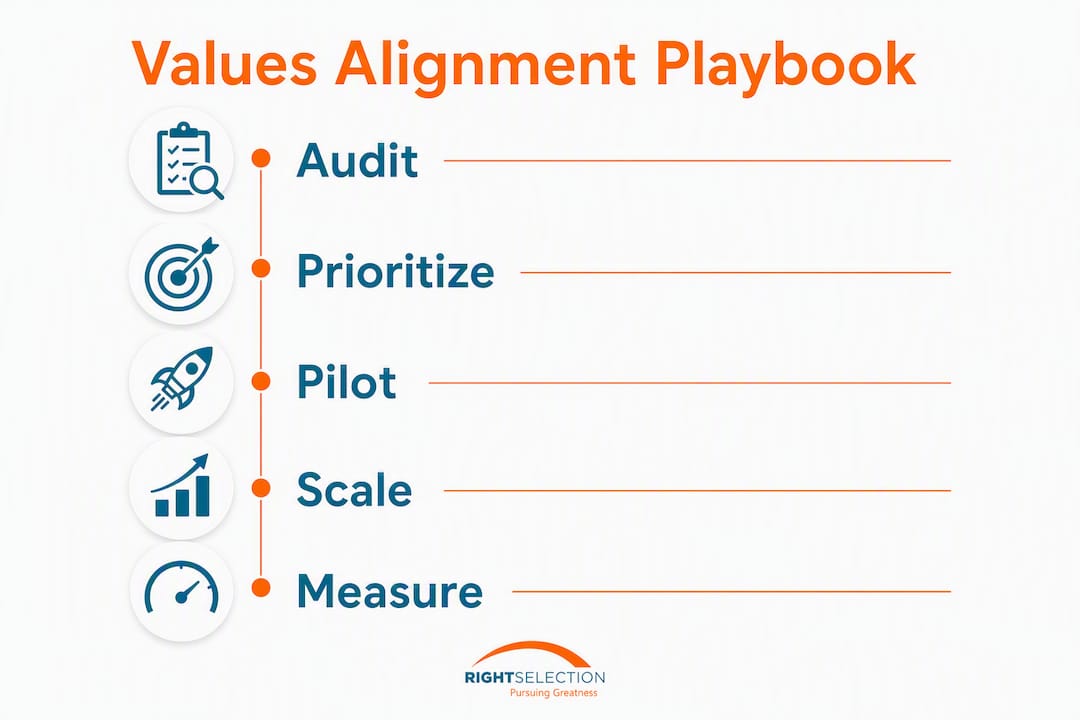
Phase 1: Audit (weeks 1–4)
Map every active engagement program to your stated values using this schema:
| Value | Program | Alignment Status | Gap Description | Owner | Quick Win |
|---|---|---|---|---|---|
| Continuous learning | Tuition reimbursement | Partial | Requires manager approval; many requests denied | L&D Lead | Simplify approval process |
| Inclusion | ERG funding | Aligns | None identified | HR Director | Maintain and publicize |
| Accountability | Performance review | Contradicts | Values not referenced in review criteria | HRBP | Add values rubric to template |
| Wellbeing | PTO policy | Neutral | Policy exists but culture discourages use | People Ops | Manager communication campaign |
Assign a cross-functional team: HR, talent acquisition, finance, and a brand or communications representative. Each brings a different lens on where programs succeed or fail.
Phase 2: Prioritize (weeks 3–6)
Score each program on a simple impact-vs.-effort matrix. High-impact, low-effort fixes go first. Contradictions, where a current policy actively undermines a stated value, are always high priority regardless of effort, because employees notice contradictions between stated values and day-to-day policies and that erodes trust quickly.
Phase 3: Pilot (weeks 6–16)
Select one or two programs for a 90-day pilot. A values-linked recognition program and a manager coaching prompt series are the two highest-return starting points. Define success metrics before launch: recognition frequency tied to values, manager modeling score from pulse surveys, and engagement sub-scores for the pilot cohort.
Phase 4: Scale (weeks 16–26)
Review pilot data at the 90-day mark. Programs that show movement on leading indicators get resourced for broader rollout. Programs that do not get redesigned or retired.
Pro Tip: The most common reason pilots stall is that no single person owns the outcome. Before you launch, put one name next to each pilot with a clear 90-day deliverable and a standing 30-minute check-in on the calendar.
How should managers model values to make programs stick?
Manager behavior is the primary delivery mechanism for any values-aligned engagement program. A recognition program that managers ignore is invisible. A coaching conversation that references values weekly compounds over time.
Roughly 70% of engagement variance is determined by managers, which means HR’s job is to make values-modeling as easy and habitual as possible for the people running teams.
A practical manager checklist, organized by cadence:
Daily:
- Reference one company value when giving feedback or making a decision visible to the team.
- Use values language in Slack, email, or team chat when recognizing a contribution.
Weekly:
- In one-on-ones, ask: “What did you do this week that reflects [value]? What got in the way?”
- Nominate at least one team member for peer recognition tied to a specific value.
Monthly:
- Review team engagement pulse data and flag any drop in values-related sub-scores.
- Run a 10-minute team check-in: “Which of our values felt most real this month? Which felt most distant?”
A sample one-on-one script for connecting work to values:
Five lines. Specific behavior, named value, business connection, and an open question. That structure takes less than two minutes and builds the habit of values-conscious feedback.
Make managers measurable owners of pilot outcomes. A simple scorecard with three metrics, recognition nominations submitted, one-on-one completion rate, and team pulse score on values clarity, reviewed monthly, produces more sustained behavior change than long training programs alone.
How do you embed values across the full HR lifecycle?
Values-aligned engagement does not live in one program. It lives in every touchpoint an employee has with HR, from the first interview question to the last performance conversation.
Hiring
- Write job postings that describe the behaviors your values require, not just the skills.
- Use structured behavioral interview questions mapped to values: “Tell me about a time you had to make a decision with incomplete information. What guided you?” (maps to integrity or accountability).
- Score responses on behavioral evidence, not impression. Did the candidate describe a specific action, or a general preference?
Onboarding
- Dedicate one onboarding session to values translation: what each value looks like in this role, on this team, in the first 90 days.
- Pair new hires with a values buddy, a peer who can model the values in practice, not just explain them.
- Include a 30-day check-in question: “Where have you seen our values in action? Where have you not?”
Performance management
- Add a values rubric to every performance review template. Rate behaviors, not traits.
- Tie at least one development goal per employee to a specific value-linked behavior.
Recognition
Values-based recognition programs increase engagement when recognition explicitly links observed behavior to a stated value. Design your recognition program around this framework: Values → Behaviors → Moments → Message. The nomination form should require the nominator to name the value and describe the specific behavior, not just say “great job.”
Budget tiers for recognition programs:
- Low: Peer-to-peer shout-out channel (Slack, Teams), manager-led verbal recognition in team meetings. Near-zero cost.
- Medium: Digital recognition platform with values tagging, quarterly awards tied to values with modest gift cards or experiences. $5–$20 per employee per quarter.
- High: Annual values awards event, personalized recognition experiences, external speaker or facilitator for a recognition launch. $50–$150 per employee annually.
Learning and development
- Map your L&D catalog to values. Every program should list which value it develops.
- Funded learning programs mapped to values signal that the organization means what it says about growth.
- Include values-modeling as a competency in manager development curricula.
Cross-functional stakeholders to involve: Talent acquisition owns hiring criteria. Finance owns budget for recognition tiers. Brand and communications own the language and channels for recognition messaging. Employee resource groups (ERGs) surface whether values are experienced equitably across different employee populations. Each group catches blind spots the others miss.
What program types work best for values-based engagement?
The right program depends on your capacity, budget, and where the biggest values gaps are. Here is a practical menu organized by effort and cost.
Low effort / low cost:
- Peer-to-peer recognition channel. A dedicated Slack or Teams channel where employees tag a value and name a colleague. Runs itself once launched. Success signal: weekly nomination volume and whether managers participate alongside employees.
- Values story prompts in team meetings. A standing agenda item: “Who lived one of our values this week?” Takes five minutes. Builds the habit of naming values in daily conversation.
- Manager one-on-one prompts. A one-page prompt card HR distributes to managers with values-linked questions for their weekly check-ins.
Medium effort / medium cost:
- Monthly values storytelling series. Employees or leaders share a 5-minute story about a time a company value guided a real decision. Hosted live or recorded. Linking employee engagement to customer experience goals works especially well here: stories that connect internal values to customer outcomes resonate across the organization.
- Manager coaching cohort. A 6-session cohort for 8–12 managers, facilitated by an executive coach, focused on values-modeling behaviors and accountability habits. Right Selection’s executive coaching programs are designed exactly for this format.
- Quarterly values awards. Nominations open to all employees, reviewed by a cross-functional panel, tied to specific behavioral evidence.
High effort / higher investment:
- Speaker-led values series. A curated speaker event or series where thought leaders explore the values your organization is building toward. Right Selection’s roster of 100+ speakers includes facilitators who specialize in culture, leadership, and organizational values. Sample timeline: 6 weeks planning, 1-day event or 3-session series, 2-week feedback collection, iteration for the next quarter.
- Facilitated cross-functional alignment offsite. A half-day or full-day session with HR, leadership, and cross-functional stakeholders to audit programs, close gaps, and set a 12-month values roadmap.
- Paid volunteer time or funded learning programs. Parental leave policies, paid volunteer time, and funded learning programs mapped to values are among the most credible signals an organization can send about what it actually prioritizes.
How do you measure the impact of values-aligned programs?
Measure both leading indicators (behavioral changes you can see now) and lagging indicators (engagement and retention data that takes longer to move). Tracking only lagging indicators means you will not know a program is failing until it has already failed.
Sample KPI dashboard:
| Metric | Type | Owner | Cadence | Pilot Phase | Scale Phase |
|---|---|---|---|---|---|
| Values awareness score (pulse survey) | Leading | HR | Monthly | ✓ | ✓ |
| Manager modeling score (pulse survey) | Leading | HR / People Ops | Monthly | ✓ | ✓ |
| Recognition nominations tied to values | Leading | HR | Bi-weekly | ✓ | ✓ |
| Engagement survey sub-score (values clarity) | Lagging | HR | Quarterly | ✓ | ✓ |
| Voluntary turnover (pilot cohort) | Lagging | HR / Finance | Quarterly | ✓ | |
| eNPS (pilot cohort vs. control) | Lagging | HR | Quarterly | ✓ | ✓ |
Timeline guidance:
- Month 1–3 (pilot): Track leading indicators weekly. Adjust manager prompts and recognition criteria based on early data.
- Month 3 (first check): Review recognition volume, pulse scores, and manager participation. Decide whether to continue, adjust, or retire the pilot.
- Month 6 (assessment): Compare engagement sub-scores and turnover data for the pilot cohort. Build the business case for scaling.
For cost-to-impact estimation, divide total program cost (facilitation, platform, manager time) by the number of employees in the pilot cohort. Compare that per-employee cost to the estimated cost of one voluntary departure in the same cohort. The math usually makes the case for investment without needing additional justification.
What mistakes derail values-alignment efforts?
Most alignment programs fail not because the values are wrong, but because the execution makes the values feel performative. Here are the six most common traps and a corrective action for each.
- Values too vague to act on. Corrective: Run the five translation questions from Section 2 with your leadership team before designing any program.
- Delegating alignment entirely to a benefits broker. Corrective: Brokers optimize for market competitiveness, not cultural fit. Keep program design decisions inside the cross-functional HR team and use brokers for vendor execution only.
- Failing to involve managers. Corrective: Make managers co-designers of the pilot, not just recipients of a new policy. Their buy-in at the design stage determines adoption.
- Mismatched eligibility rules. Corrective: Audit who can access each program. If a program tied to “inclusion” excludes part-time workers or contractors, the contradiction is visible and damaging.
- Generic communication. Corrective: Every program communication should name the specific value it reflects and describe the behavior it rewards. “We are launching a recognition program” is not enough. “We are launching a recognition program to celebrate [value] in action” is.
- Ignoring contradictory policies. Corrective: Policies that contradict stated values damage credibility more than missing perks do. Fix contradictions before adding new programs.
Quick red-flag checklist for managers:
- Can you name the company value this program is designed to reinforce?
- Do the eligibility rules include everyone the value applies to?
- Has this program been communicated with the value named explicitly?
- Is there a policy that currently contradicts this value?
- Does the recognition or reward mechanism require naming a specific behavior?
If the answer to any of these is “no,” the program has a credibility gap that will limit its impact.
What does a values-benefits audit methodology look like?
Treat benefits and engagement programs as ongoing infrastructure, not an annual checkbox. An annual cross-functional values-benefits audit, run with HR, brand, finance, and talent acquisition in the room, surfaces both quick wins and credibility-damaging contradictions before they erode trust.
Audit template fields:
| Value | Concrete expression | Current offering | Alignment score (0–2) | Contradictions | Owner | Priority | Quick-win recommendation |
|---|---|---|---|---|---|---|---|
| Continuous learning | Funded courses, protected time | Tuition reimbursement (approval required) | 1 | Approval rate low; culture discourages requests | L&D Lead | High | Simplify approval; add manager prompt |
| Wellbeing | Flexible schedules, mental health support | EAP available | 1 | EAP underutilized; no manager communication | People Ops | Medium | Manager communication campaign |
| Inclusion | Equitable access to programs | ERG funding | 2 | None | HR Director | Low | Maintain and publicize |
| Accountability | Clear performance criteria | Performance reviews | 0 | Values not in review rubric | HRBP | High | Add values rubric immediately |
Scoring rubric:
- 0 = Contradicts: The current offering actively undermines the stated value.
- 1 = Neutral: The offering exists but does not explicitly reinforce the value.
- 2 = Aligns: The offering explicitly reflects and reinforces the value.
Aggregate scores across all values to identify your lowest-scoring areas. Those become your 90-day pilot priorities.
Sample 90-day recommendations based on audit outcomes:
- Score 0 on any value: Fix the contradiction first. Redesign the policy or communicate a clear timeline for change.
- Score 1 on high-visibility values: Add explicit values language to existing programs. Low cost, high credibility return.
- Score 2 on all values: Shift focus to measurement and storytelling. Publicize what is working.
Pro Tip: Include your benefits broker in the audit as a data source, not a decision-maker. Brokers can tell you what the market offers; your cross-functional team decides what your values require. Involving community and stakeholder voices in program design, even informally, surfaces gaps that internal teams consistently miss.
Right Selection brings your values-alignment pilot to life
Building a values-aligned engagement program is a design challenge as much as an HR challenge. The organizations that get it right combine clear internal ownership with external expertise that accelerates the process and raises the quality of the experience.
Right Selection connects HR leaders and organizational teams with a curated network of 100+ global thought leaders, executive coaches, and corporate facilitators, drawing on over 30 years of experience designing learning experiences that produce measurable outcomes. For values-alignment work specifically, that means three formats that map directly to the playbook in this guide: a speaker-led values series that makes values tangible through real stories and expert perspective; a manager coaching cohort that builds the daily habits values-modeling requires; and a facilitated cross-functional alignment session that runs the audit, closes the gaps, and sets a 12-month roadmap in a single half-day.
If you are ready to move from audit to pilot, the most direct next step is a complimentary coaching call with the Right Selection team to scope the right format for your organization’s size, values, and timeline.
Key Takeaways
Aligning engagement programs with company values requires a cross-functional audit, manager ownership, and a 90-day pilot cycle that measures both behavioral and engagement outcomes.
| Point | Details |
|---|---|
| Audit before designing | Map every program to a stated value and fix contradictions before adding new initiatives. |
| Managers drive 70% of engagement variance | Gallup data shows managers explain 70% of engagement variance; make them pilot owners with simple scorecards. |
| 6 in 10 employees factor values | Talent attraction and retention decisions are directly influenced by values alignment, making this a financial priority. |
| Measure leading and lagging KPIs | Track recognition frequency and manager modeling scores monthly; review engagement sub-scores and turnover quarterly. |
| Right Selection as your pilot partner | Right Selection’s speaker curation, coaching cohorts, and facilitated audits are designed to accelerate values-alignment programs from design to measurable outcomes. |
Values alignment works when it is built into the system, not bolted on
The conventional wisdom in HR is that values alignment is a culture initiative. Run a workshop, refresh the values poster, update the onboarding deck. That framing is why so many programs produce enthusiasm in week one and indifference by week twelve.
What actually produces durable alignment is treating values as operating criteria, the same way you treat budget criteria or compliance criteria. When a manager cannot approve a recognition nomination without naming a specific value, the values become real. When a performance review rubric scores behaviors against values, the values become consequential. When a benefits audit marks a contradiction as a high-priority fix, the values become credible.
The cross-functional audit plus manager ownership model described in this guide works because it closes the gap between what an organization says and what it actually does. That gap is what employees measure every day, whether HR tracks it or not. The organizations that close it consistently, through annual audits, manager accountability, and values-linked program design, build the kind of trust that shows up in retention data and discretionary effort. Right Selection’s 30+ years of experience and roster of thought leaders and coaches exist precisely to help HR teams build that infrastructure with the right expertise behind it.
Useful sources for further reading
- What Does Your Company Really Stand For? — Harvard Business Review / HBS Executive Education.
- Aligning Benefits With Company Values: A Strategic Framework — Q Benefits Administration, including the audit methodology and scoring rubric.
- Values-driven employee benefits: a how-to guide with 13 inspiring examples — Nava Benefits.
The audit template referenced throughout this guide can be requested directly from Right Selection. Contact the team via the complimentary coaching call page to receive a working version and a scoping conversation at no cost.