
A C-suite coaching roadmap is a phased, sponsor-aligned engagement — typically 6–12 months — that connects leadership diagnostics to prioritized business outcomes through structured contracting, deliberate interventions, and a measurement framework that sponsors can actually read. The single most important success factor is three-way alignment between the coach, the executive, and the organizational sponsor before the first session begins.
Here is what a well-built roadmap delivers:
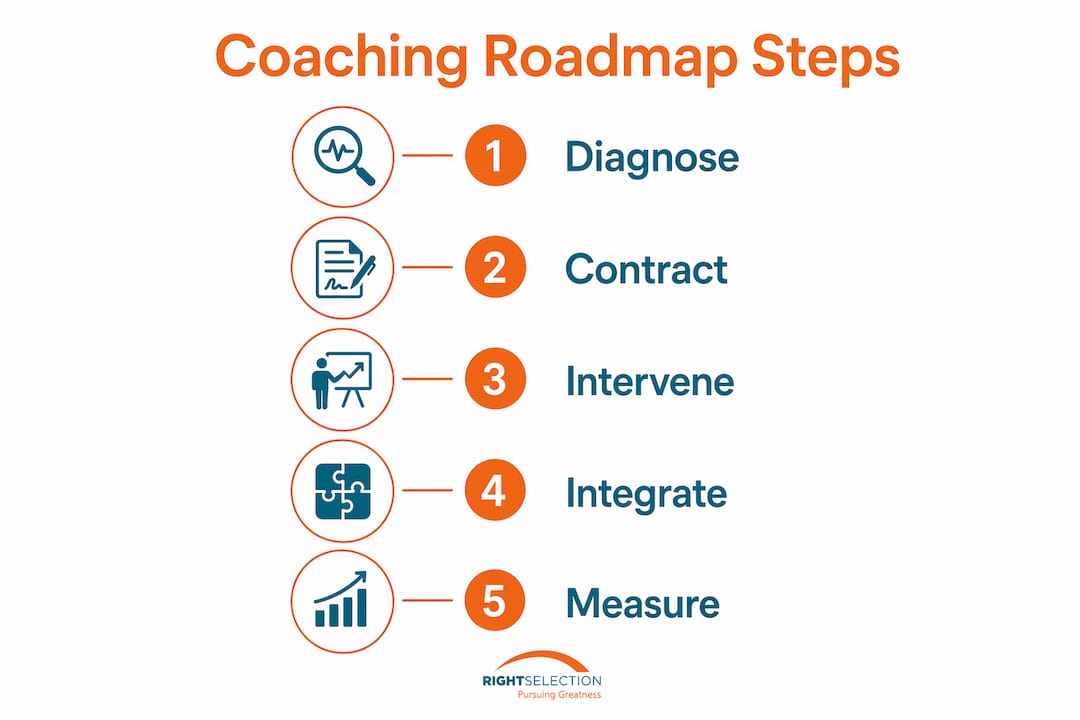
- Core phases: Diagnostic and systemic mapping → multi-party contracting → intervention phase → mid-point review → closure and integration → sustainment handover
- Typical timeline: 6 months for focused transition coaching; 12 months for broader leadership transformation or succession readiness
- Cadence: Biweekly or monthly 1:1 sessions, with sponsor check-ins at months 2, 5, and 11 (or equivalent)
- Single highest-leverage action: Convene the three-way contracting meeting before any coaching begins — this is where most programs succeed or fail
- What this guide delivers: A reusable roadmap template, a contracting checklist, a diagnostic-to-goal conversion framework, a measurement model, and a sustainment plan
The sections below give you each component in the sequence you will actually use them.
Table of Contents
- Why does a formal C-suite coaching roadmap matter now?
- Who must be involved and what the contracting checklist covers
- What does a practical C-suite coaching roadmap look like?
- Which diagnostics should you run, and how do you convert results into goals?
- How do you design the right mix of coaching interventions?
- How do you measure coaching impact and demonstrate ROI?
- How do you select and contract the right C-suite coach?
- How do you embed change and prepare for succession after coaching ends?
- Why multi-party contracting determines whether your program succeeds
Why does a formal C-suite coaching roadmap matter now?
Ad hoc coaching at the C-suite level tends to produce one of three failure modes: misaligned expectations between the sponsor and the executive, no measurement framework to demonstrate value, or a cultural mismatch between the coach’s approach and the organization’s operating norms. Any one of these can quietly derail a program that looked promising on paper.
A formal roadmap addresses all three. When coaching goals are linked to business outcomes — succession readiness, transformation leadership, board confidence — sponsors have a reason to stay engaged, and the executive has a clear line of sight from personal development to organizational impact. That connection is what separates a coaching engagement from an expensive conversation.
The business case for structured programs is well established. Organizations that build a coaching culture see measurable gains in leadership effectiveness, accountability, and promotion readiness, and those gains are most pronounced when senior leaders visibly sponsor the work. Coaching also functions as a diagnostic tool: through structured observation and feedback, coaches surface high-potential leaders whose capabilities might otherwise go underdeveloped.
The risks of skipping structure are equally concrete:
- No sponsorship: Coaching lacks credibility and organizational resources
- Vague goals: Unfocused sessions produce unmeasurable outcomes
- No measurement: ROI cannot be demonstrated to boards or finance
- Cultural mismatch: A coach who cannot read the organization’s political dynamics will give advice the executive cannot use
A structured coaching program that moves through diagnostics, contracting, intervention, and integration is consistently more likely to produce systemic change than one that begins with a conversation and improvises from there.
Who must be involved and what the contracting checklist covers
Getting the right people in the room before coaching begins is not a formality. It is the mechanism by which organizational accountability and individual ownership of growth get reconciled.
Core stakeholders
- The executive (coachee): Owns the development goals and the behavioral commitments
- Organizational sponsor(s): Typically the CEO, CHRO, or board chair; accountable for resourcing and strategic alignment
- The coach: Responsible for process design, confidentiality, and professional ethics
- HR or L&D lead: Connects coaching outcomes to talent systems, succession planning, and performance frameworks
- Board representative: Included when the engagement involves board-readiness or governance development
- Optional advisors: External assessors, peer coaches, or subject-matter experts brought in for specific interventions
Three contracting layers
Multi-party contracting operates at three distinct levels, and gaps at any layer create problems downstream.
- Administrative layer: Logistics, fees, session frequency, scheduling protocols, and cancellation terms
- Professional layer: Coaching goals, KPIs, milestone checkpoints, reporting cadence, and success criteria
- Psychological layer: Confidentiality boundaries, process reporting versus content reporting, escalation paths, and the emotional contract between coach and executive
Contracting checklist
Resolve each of these before the first coaching session:
- Confirm reporting format: process reporting only (themes and progress), never session content
- Define success criteria with the sponsor and executive jointly
- Agree on escalation path if the executive’s behavior poses organizational risk
- Set the sponsor check-in cadence (recommended: months 2, 5, and 11 for a 12-month program)
- Clarify coach supervision requirements and ethical boundaries
- Document confidentiality limits in writing, signed by all three parties
- Align on what happens to coaching artifacts at program close
Pro Tip: Process reporting is the mechanism that keeps sponsors informed without breaching confidentiality. The coach shares themes, progress against goals, and any systemic patterns — never the content of individual sessions. Establish this distinction explicitly in the written contract, and refer to it again at the first sponsor check-in. Ambiguity here is the most common source of trust breakdowns.
For practical guidance on preparing for the first session within this framework, the executive coaching best practices resource covers multi-party alignment in detail.
What does a practical C-suite coaching roadmap look like?
The template below is designed for a 12-month engagement and can be compressed to six months by halving the intervention phase and running diagnostics and contracting concurrently.

Phase structure and sample timeline
| Phase | Months (12-mo) | Months (6-mo) | Key Activities | Sign-off |
|---|---|---|---|---|
| Diagnostic & systemic mapping | 1 | 1 | 360 feedback, stakeholder interviews, role mapping, psychometrics | Coach + executive |
| Multi-party contracting | 1–2 | 1 | Three-way contracting meeting, goal setting, KPI agreement | Coach + executive + sponsor |
| Intervention phase | 3–5 | 2–4 | 1:1 sessions, team coaching, action learning, board advisory | Coach |
| Mid-point review | 5–6 | 3 | Sponsor check-in, 360 pulse, goal recalibration | Coach + sponsor + executive |
| Closure and integration | — | 5 | Stakeholder debrief, behavior documentation, integration planning | Coach + executive |
| Sustainment handover | 12 | 6 | Peer coaching setup, measurement cadence, succession linkage | HR/L&D + sponsor |
What success looks like at each checkpoint
- End of diagnostic phase: Two to three coaching priorities are documented and tied to specific business outcomes
- Post-contracting: All three parties have signed the contracting agreement; reporting format is confirmed
- Mid-point review: At least one behavioral shift is observable by stakeholders; goals are recalibrated if the business context has changed
- Closure: The executive can articulate the behaviors they will sustain and the routines that support them
- Sustainment: HR has a documented plan for ongoing reinforcement, connected to succession readiness
Typical artifacts per phase
- Diagnostic: 360 report, stakeholder interview synthesis, role clarity map
- Contracting: Signed three-way agreement, coaching plan with KPIs
- Intervention: Session notes (coach-held, confidential), action learning project outputs, team feedback
- Mid-point: Progress report (process only), updated goal register
- Closure: Behavior change summary, stakeholder feedback, integration plan
- Sustainment: Peer coaching schedule, measurement dashboard, succession readiness update
When transition urgency is high — a new CEO stepping into a turnaround, for example — compress the diagnostic and contracting phases into a single intensive week and extend the intervention phase. The types of executive coaching programs guide covers program variants and duration options for different transition scenarios.
Which diagnostics should you run, and how do you convert results into goals?
The diagnostic phase is where the coaching roadmap gets its specificity. Generic assessments produce generic goals. The right combination of tools surfaces the two or three priorities that will move the needle on both the executive’s effectiveness and the organization’s outcomes.
Recommended diagnostics
- Tailored 360-degree feedback: Designed for the executive’s specific role and context, not an off-the-shelf instrument. Covers behaviors, communication style, decision-making, and stakeholder relationships.
- Targeted stakeholder interviews: Conducted by the coach with five to eight key stakeholders. Surfaces relational dynamics, political context, and perceptions that a survey cannot capture.
- Role and accountability mapping: Clarifies where the executive’s formal authority ends and influence begins — a common source of friction at C-suite level.
- Strategic readiness assessment: Evaluates the executive’s capacity to operate at the level the role demands, including board fluency and enterprise-scale thinking.
- Psychometrics (selective): Tools such as Hogan Assessments or the Leadership Circle Profile add value when the coaching priority involves derailment risk or leadership identity. Use them purposefully, not as a default.
Diagnostic-to-goal conversion
| Diagnostic | Best for | Typical coaching priority it surfaces |
|---|---|---|
| Tailored 360 | Behavioral patterns, communication style | Stakeholder influence, executive presence |
| Stakeholder interviews | Relational dynamics, political context | Alliance building, trust repair |
| Role/accountability mapping | Structural clarity, delegation | Letting go of operational detail |
| Strategic readiness assessment | Enterprise-level thinking | Board navigation, long-range planning |
| Psychometrics | Derailment risk, identity | Resilience, self-awareness under pressure |
Triangulate results across at least three sources before settling on priorities. A behavior that appears in the 360, surfaces in stakeholder interviews, and connects to a role clarity gap is a genuine coaching priority. A behavior that appears in only one source may be noise. The coach should lead the debrief with the executive; where an external assessor has administered psychometrics, bring them into the debrief session rather than relying on a written report alone.
Developing coaching plans for C-suite executives requires converting diagnostic findings into SMART goals — specific, measurable, achievable, relevant, and time-bound — that connect directly to business outcomes rather than abstract competency labels.
Pro Tip: Limit the coaching plan to two or three priorities. Executives who enter a program with seven development goals typically make progress on none of them. Prioritization is itself a leadership skill, and the diagnostic debrief is the first place to practice it.
How do you design the right mix of coaching interventions?
The intervention phase is where most programs either build momentum or lose it. The design choice that matters most is not which modality to use — it is whether the mix of modalities matches the executive’s specific development priorities and the organization’s context.
Modality guide
- 1:1 coaching: The core of any C-suite program. Provides the confidential space for high-stakes decision support, identity work, and behavioral practice. Biweekly sessions work well for active transitions; monthly sessions suit maintenance phases.
- Team coaching: Appropriate when the executive’s primary development priority involves leading their direct report team more effectively. Requires a separate contracting process with the team.
- Board advisory sessions: Structured preparation for board presentations, governance conversations, or board relationship repair. Distinct from 1:1 coaching — more advisory in nature.
- Action learning projects: Applied change work where the executive leads a real organizational challenge as the learning vehicle. High-impact for executives who learn by doing.
- Digital micro-learning and asynchronous tools: Useful for reinforcing concepts between sessions, not as a substitute for live coaching. Platforms that support coaching program management can consolidate scheduling, process reporting, and shared dashboards without exposing session content.
Modality matrix
| Modality | Best fit | Typical cadence | Resource footprint |
|---|---|---|---|
| 1:1 coaching | Confidential decision support, behavioral change | Biweekly or monthly | Moderate |
| Team coaching | Leadership team dynamics, collective effectiveness | Monthly or quarterly | High |
| Board advisory | Board-readiness, governance fluency | As needed, pre-board meetings | Low to moderate |
| Action learning | Applied change, enterprise problem-solving | Project-based | High |
| Digital/async tools | Reinforcement, reflection, process reporting | Continuous | Low |

Session cadence should reflect the executive’s availability and the urgency of the transition. A newly appointed CEO in a turnaround needs biweekly sessions for the first three months; a seasoned CFO working on board communication may need only monthly sessions with targeted advisory support before key board dates. For a deeper look at how to match modalities to leadership frameworks, the leadership coaching models resource covers fit-for-purpose guidance across enterprise contexts.
Business coaching strategies that structure interventions around real business challenges — rather than abstract competency development — tend to produce faster and more durable behavioral change.
How do you measure coaching impact and demonstrate ROI?
Measurement is the part of the coaching roadmap that most programs design last and should design first. Without a baseline, there is no way to demonstrate change. Without a framework that connects behavior to business outcomes, sponsors cannot justify continued investment.
Leading and lagging indicators
Program measurement should blend behavioral indicators with business KPIs. Leading indicators show early signals of change; lagging indicators confirm that change has translated into organizational impact.
| Indicator type | Examples | Measurement timing |
|---|---|---|
| Leading (behavioral) | 360 pulse scores, stakeholder feedback, coach observation | Baseline, mid-point, end-point |
| Lagging (business) | Team retention, initiative delivery rate, board confidence rating | End-point, 6–12 month follow-up |
Suggested KPIs for C-suite coaching
- Board confidence rating (sponsor-assessed, pre/post)
- Decision speed on strategic priorities (self-reported and sponsor-confirmed)
- Cross-functional alignment score (360 or stakeholder survey)
- Retention of key direct reports (12-month window)
- Initiative delivery rate for programs the executive sponsors
Evaluation cadence
- Baseline: Completed during the diagnostic phase, before any coaching begins
- Mid-point: Pulse 360 and sponsor check-in at the program midpoint
- End-point: Full 360 repeat, stakeholder interviews, and sponsor debrief
- Follow-up: 6–12 months post-program to assess sustainment of behavioral change
The coach owns the process reporting; HR or L&D owns the business KPI tracking. Qualitative evidence — stakeholder narratives, specific examples of changed behavior in high-stakes situations — carries significant weight with boards and finance teams when paired with numeric indicators. A sponsor-ready ROI narrative combines both: a number that shows direction and a story that makes it credible.
For behavioral measurement techniques that support this framework, the behavioral coaching guide covers change indicators and evaluation approaches in depth.
How do you select and contract the right C-suite coach?
Coach selection at the C-suite level is a different exercise than hiring a coach for mid-level leaders. The demands are categorically different: board fluency, comfort with irreversible high-stakes decisions, and the ability to hold a confidential thinking partnership with someone who has very few peers. C-suite coaches need to act as confidential thinking partners for high-stakes decisions, not just as trainers — enterprise experience and board exposure are genuine differentiators, not nice-to-haves.
Selection criteria
- Enterprise leadership background: direct experience in C-suite or SVP roles, not only coaching experience
- Board exposure: demonstrated ability to prepare executives for governance conversations and board relationships
- References from comparable mandates: ask for two to three references from similar organizational contexts
- Credentials and supervision: ICF PCC or MCC level, with active supervision from a qualified supervisor
- Systemic coaching capability: ability to work with the organizational system, not only the individual
- Cultural fit: alignment with the organization’s operating norms and the executive’s communication style
Interview questions for prospective coaches
- “Describe a mandate where the executive’s development priority conflicted with the sponsor’s expectations. How did you manage it?”
- “Give an example of board-level work you have done. What was your role and what was the outcome?”
- “How do you structure process reporting without breaching confidentiality?”
- “What does your supervision arrangement look like, and how does it protect the client?”
Contract terms checklist
- Fees and payment schedule (retainer, per-session, or program fee)
- Session cadence and format (in-person, virtual, or hybrid)
- Cancellation and rescheduling terms
- Process reporting format and frequency
- Confidentiality limits and escalation triggers
- Supervision requirements and ethical boundaries
- Ownership of coaching artifacts at program close
Pricing model guidance
A retainer model suits long-term engagements where session frequency varies with the executive’s needs. A per-session model works for short, focused mandates. A program fee provides budget certainty for a defined scope and is often preferred by HR and finance teams. For transition coaching, a program fee with a defined scope and clear deliverables is usually the cleanest structure.
The role of executive coaches in partnership decisions covers coach-sponsor dynamics and selection criteria in greater depth.
How do you embed change and prepare for succession after coaching ends?
The end of a coaching engagement is not the end of the development work. Without a deliberate handoff, behavioral gains tend to erode within six months as the executive returns to the pressures of the role without the structure of regular coaching.
Handoff checklist
- Document the two to three behaviors the executive will sustain, with specific examples of what they look like in practice
- Identify the routines and habits that support those behaviors (weekly team check-ins, pre-board preparation rituals, decision protocols)
- Map the key relationships the executive has strengthened and the commitments made to those stakeholders
- Record the decision protocols the executive has developed for recurring high-stakes situations
Sustainment activities
- Peer coaching: Pair the executive with a peer at a similar level for monthly check-ins. Structure the conversation around the original coaching priorities.
- Leadership check-ins: Schedule quarterly conversations with the sponsor to review behavioral sustainment against the original KPIs
- Measurement cadence: Run a 360 pulse at six and twelve months post-program to track sustainment
Connecting coaching outcomes to succession planning
Coaching outcomes should feed directly into succession and talent planning. The behaviors documented at program close become the evidence base for promotion and readiness decisions. HR should update the executive’s succession profile within 30 days of program closure, incorporating the coach’s process report and the sponsor’s assessment.
| Sustainment activity | Timing | Owner |
|---|---|---|
| Peer coaching setup | Final month of program | HR/L&D |
| Sponsor quarterly check-in | Months 1, 4 post-program | Sponsor |
| 360 pulse | 6 and 12 months post-program | HR/L&D |
| Succession profile update | Within 30 days of program close | HR |
For executives navigating role transitions, the career transition coaching resource covers sustainment strategies specific to succession scenarios.
Why multi-party contracting determines whether your program succeeds
Of all the elements in a C-suite coaching roadmap, contracting is the one most often treated as administrative and least often treated as strategic. That gap is where programs fail.
Coaching designer Sari van Poelje makes the point directly: a signed agreement is not enough. Multi-party alignment before the first session — genuine alignment, not just signatures — is what predicts success. The three contracting layers (administrative, professional, and psychological) each carry failure risk when left unresolved.
How gaps at each layer cause failure
- Administrative gaps: Ambiguous fees or cancellation terms create friction that erodes the coach-sponsor relationship before the program gains momentum
- Professional gaps: Coaching goals that the executive privately disagrees with, or KPIs the sponsor set without the executive’s input, produce passive resistance
- Psychological gaps: Unresolved confidentiality ambiguity destroys the executive’s willingness to be honest in sessions
What good contracting looks like
A well-run contracting meeting produces three outcomes: the executive owns their goals, the sponsor owns the organizational accountability, and the coach owns the process. When all three parties leave the room with clarity about their role and the boundaries of the others’, the coaching has already begun.
Practical checklist for the contracting meeting
- Open with the purpose: align on what success looks like for each party
- Review and agree on the three contracting layers explicitly
- Confirm process reporting format and frequency
- Establish confidentiality limits in writing
- Agree on escalation path for organizational risk scenarios
- Set the first sponsor check-in date before leaving the room
Pro Tip: Protect the coach’s neutrality by keeping the sponsor out of goal-setting conversations with the executive until both parties have independently articulated what they want from the program. Bring those perspectives into the three-way meeting as starting points for negotiation, not as a done deal. This preserves psychological safety and surfaces misalignments before they become problems.
Right Selection’s approach to executive coaching frameworks emphasizes this multi-party alignment as the foundation of every engagement, with coach supervision and ethical boundaries built into the program design from the outset.
Key Takeaways
A C-suite coaching roadmap succeeds when sponsor alignment, diagnostic rigor, and a measurement framework are built in from the start, not added after the program is underway.
| Point | Details |
|---|---|
| Start with three-way contracting | Align coach, executive, and sponsor on goals, reporting, and confidentiality before the first session. |
| Run a multi-source diagnostic | Combine a tailored 360, stakeholder interviews, and role mapping to surface two to three genuine coaching priorities. |
| Match modalities to priorities | Use 1:1 coaching as the core, then add team coaching, board advisory, or action learning based on the specific development goal. |
| Measure leading and lagging indicators | Track behavioral change at baseline, mid-point, and end-point; connect lagging KPIs to business outcomes for sponsor reporting. |
| Build sustainment into the close | Document sustained behaviors, set up peer coaching, and update the succession profile within 30 days of program closure. |
| Right Selection for program design | Right Selection matches organizations with curated coaches and designs bespoke C-suite programs with built-in measurement and sponsor alignment. |
What practitioners consistently get wrong about C-suite coaching
The conventional wisdom says the hardest part of a C-suite coaching program is finding the right coach. After working with organizations across industries, the more accurate observation is that the hardest part is the contracting meeting — specifically, getting the sponsor to show up with genuine curiosity rather than a predetermined development agenda for the executive.
Sponsors who arrive at the contracting meeting with a fixed list of behaviors they want changed are not sponsoring a coaching program. They are commissioning a behavior modification service. The distinction matters because executives at C-suite level are acutely sensitive to whether their development is genuinely supported or quietly managed. When they sense the latter, they disengage from the coaching while maintaining the appearance of participation. The program produces a report that says all the right things and changes nothing.
The roadmap structure described in this guide addresses this by separating the sponsor’s input (organizational context, strategic priorities, success criteria) from the executive’s goal ownership (personal development commitments, behavioral focus areas) before the three-way meeting brings them together. That sequencing is not procedural. It is the mechanism by which psychological safety gets built into the program architecture.
The other underestimated factor is sustainment. Most programs invest heavily in the intervention phase and treat the final month as a wrap-up. The executives who sustain behavioral change are almost always the ones whose organizations built a peer coaching structure and a measurement cadence into the post-program period. The compound effect of monthly peer check-ins over twelve months is far greater than any single coaching session, and it costs a fraction of the program investment.
Right Selection brings curated coaching to your C-suite program
Building a C-suite coaching roadmap from scratch requires the right coach, a proven program structure, and a measurement framework that sponsors will trust. Right Selection delivers all three through a curated matching process that draws on 30+ years of experience and a network of 100+ global coaches, speakers, and thought leaders.
Where most coaching engagements begin with a generic intake form, Right Selection starts with a bespoke program design conversation — aligning on your organization’s strategic priorities, the executive’s transition context, and the outcomes your board needs to see. Coaches are matched for enterprise experience, board fluency, and cultural fit, not just credential lists. Program management includes built-in process reporting, sponsor check-in scheduling, and a measurement framework from day one.
Whether you need a single executive coached through a high-stakes transition or a cohort program for your senior leadership team, Right Selection designs the engagement around your outcomes. Explore the complimentary coaching call to discuss your program needs with the Right Selection team, or visit rightselection.com to see the full roster of coaches and program options.
Curated sources and further reading
The sources below informed this guide and offer deeper reading on contracting, diagnostics, measurement, and program design for C-suite coaching.
- Designing an Executive Coaching Program: A Systemic and Psychological Framework — Intact Academy. The most thorough practitioner resource on phased program design and multi-party contracting. Recommended first read for coaches designing a new program.
- Building a Coaching Strategy and Culture — Institute OD. Covers integration of coaching into talent systems, sponsorship requirements, and measurement frameworks. Recommended for HR and L&D leaders building a coaching culture.
- How to Develop Coaching Plans for C-Suite Executives — Lite14. Practical guidance on 360 design, stakeholder interviews, and SMART goal conversion.
- C-Suite Coaching for CEOs and CxOs — Stratos Coaching. Useful profile of the capabilities required at enterprise level, including board fluency and CEO partnership.
- Executive Coaching: Your Secret Weapon for C-Suite Succession Planning — Leadership and Development. Covers succession integration, ROI framing, and common failure modes.
- ClickCoach: Coaching Program Management Platform — ClickCoach. Practical tool for scheduling, process reporting dashboards, and multi-coach program governance.
- Executive Coaching Frameworks Explained for Leaders — Right Selection. Overview of coaching models and how to select the right framework for an enterprise engagement.
- Executive Coaching Best Practices for Corporate Leaders — Right Selection. Multi-party alignment and contracting guidance for corporate programs.