

Career transition coaching is a time-limited, evidence-based coaching partnership that moves an employee from one role or career direction to another with clarity, structure, and measurable outcomes. For HR leaders and event organizers, it reduces disruption during organizational change, improves internal placement rates, and converts what could be a chaotic talent moment into a predictable mobility result. Dr. Julia Yates defines career coaching as collaborative, ethical, and grounded in evidence-based approaches focused on client-defined success. That definition holds especially true for transition work, where the stakes are higher and the timeline is compressed.
This article covers the core methodology, who benefits most, program formats and timelines, how to weave coaching into L&D and event programming, and a practical vendor selection checklist. Right Selection, with its curated roster of 100+ coaches and speakers including Arthur Carmazzi, works with HR and event teams on exactly this kind of engagement.
Table of Contents
- What does career transition coaching mean, and how does it work?
- Who benefits, and when should you deploy this intervention?
- What formats, timelines, and deliverables should HR plan for?
- How do you integrate coaching into L&D programs and events?
- How do you choose the right coach or partner?
- Key Takeaways
- Why organizations underestimate the compound effect of transition coaching
- How Right Selection supports your transition coaching programs
- Useful sources
What does career transition coaching mean, and how does it work?
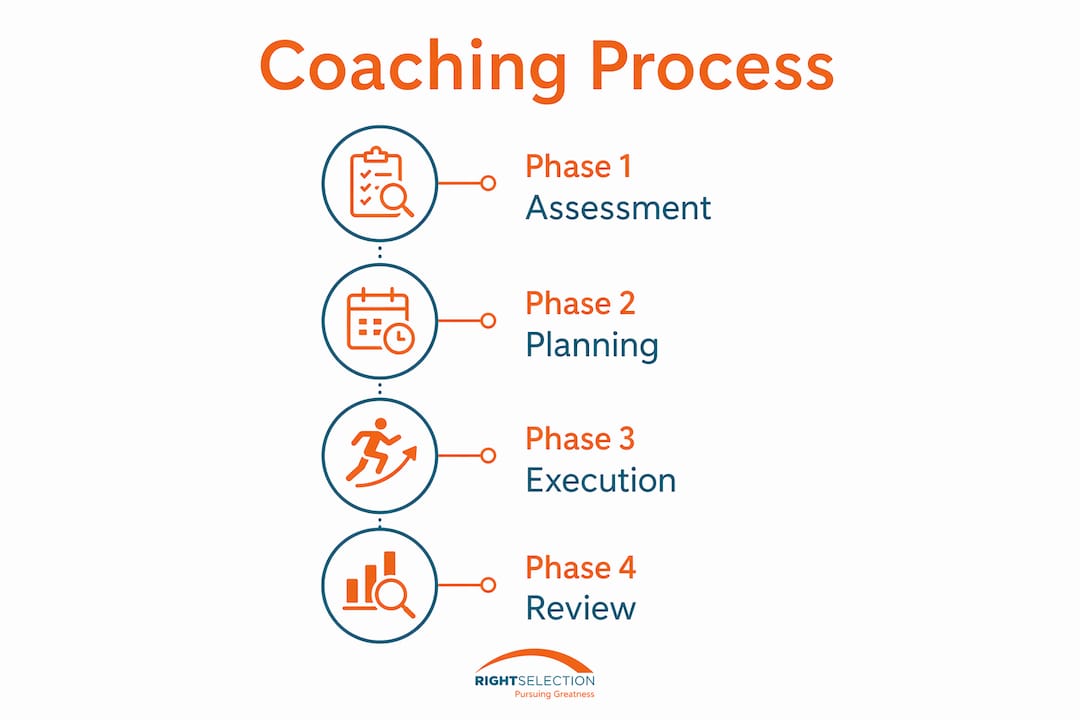
Career transition coaching is a structured partnership combining three core elements: assessment, strategy, and execution. Unlike general career coaching, which is ongoing and developmental, transition coaching is time-bound and tied to a specific role change such as a promotion, a sector pivot, or a restructuring-driven exit. That distinction matters for procurement: you are buying a defined intervention, not an open-ended relationship.
The process runs in three steps HR can use directly in scoping documents:
- Assessment — The coach maps the employee’s strengths, transferable skills, values, and current market data to establish a clear baseline.
- Strategy — Together, coach and employee define target roles, build a career narrative, and set a realistic timeline with milestones.
- Execution — The coach supports résumé and LinkedIn optimization, networking strategy, interview preparation, and where relevant, pilot projects or stretch assignments.
Throughout all three phases, the coaching relationship remains non-directive. Coaches use powerful questioning to build self-efficacy and agency rather than prescribing answers. Ethical codes from bodies such as the International Coaching Federation (ICF) govern this model, and evidence-based approaches drawn from coaching psychology keep the work grounded in what actually produces results.
Pro Tip: When drafting a Statement of Work, require the vendor to specify the assessment tools used, the frequency of progress reviews, and how outcomes will be measured. A provider who cannot answer those three questions is not operating a coaching model.

Who benefits, and when should you deploy this intervention?
The clearest organizational candidates for transition coaching are mid-career leaders with substantial experience, where integrated coaching is often decisive for successful pivots or promotions. High-potential managers approaching their first senior leadership role, executives moving across sectors, and employees affected by restructuring all represent high-return cohorts.
Four use cases generate the strongest organizational ROI:
- Internal mobility and promotion readiness — Coaching accelerates time-to-productivity for employees stepping into expanded roles, reducing the performance dip that typically follows a promotion.
- Leadership transitions — Executives moving from functional to enterprise-wide roles benefit from coaching that addresses both the tactical shift and the identity recalibration the move requires.
- Scaled outplacement — During restructures, treating transition coaching as a strategic tool prevents role drift and protects employer brand by giving affected employees a structured, dignified exit pathway.
- Event-linked coaching — Conferences and offsites that pair a keynote or workshop with follow-up coaching sessions convert inspiration into sustained behavior change.
For each use case, set a KPI before the program starts. Internal mobility programs should track internal placement rate and retention at 6 and 12 months. Outplacement programs should measure time-to-placement and candidate net promoter score. Event-linked programs should capture pre/post confidence scores and 90-day goal completion rates. These metrics give L&D teams the data to justify budget in the next planning cycle. For guidance on career advancement coaching techniques that map to these use cases, Right Selection’s resource library is a practical starting point.
What formats, timelines, and deliverables should HR plan for?
Most transition coaching programs run 3–6 months, with the format chosen based on cohort size, budget, and whether the program is standalone or event-linked.
| Format | Typical Length | Key Deliverables |
|---|---|---|
| 1:1 coaching | 3–6 months | Action plan, interview readiness package, 30/90 integration plan |
| Cohort transition program | 4–6 months | Shared curriculum, peer accountability structure, group milestone reviews |
| Event-linked intensive | 1–2 days + follow-up | Pre-event assessment, live coaching clinic, 4-week post-event 1:1 sessions |
KPIs HR should track across all formats: time-to-productivity in new role, internal placement rate, retention at 6 and 12 months, candidate net promoter score, and cost-per-placement compared to external hiring.
On budget, 1:1 coaching is priced per seat and suits senior leaders or high-potential individuals where individual investment is justified. Cohort programs reduce per-seat cost by sharing curriculum and group modules. Event-linked intensives are often the most cost-efficient entry point, particularly when a speaker or facilitator is already contracted for an offsite. Digital resources and group modules are the primary scaling levers when budget is constrained. For a deeper look at executive coaching best practices and how to structure these programs operationally, Right Selection’s blog covers the full range.
How do you integrate coaching into L&D programs and events?
Weaving transition coaching into existing L&D or event programming requires deliberate sequencing. Done well, it converts a one-time event into a sustained development arc.
- Scope outcomes first. Define what a successful transition looks like before selecting a coach or speaker. Align those outcomes with your talent framework and succession plan.
- Run baseline assessments before the event. Pre-event assessments give coaches and speakers data to personalize content, and they establish the measurement baseline for post-program tracking.
- Schedule coaching touchpoints around the event. A pre-event discovery session, a live coaching clinic during the offsite, and 1:1 follow-up sessions at 30 and 90 days create a learning arc rather than a single spike.
- Align data sharing and confidentiality agreements. Coaches operate under strict confidentiality. Agree upfront on what aggregate data will be shared with HR and what stays between coach and employee.
- Track at 30, 90, and 180 days. Follow-up surveys at those intervals capture behavior change, goal completion, and retention signals that justify continued investment.
Sample event formats that work well: a panel discussion on career transitions followed by a live coaching demonstration; small-group coaching clinics during an offsite afternoon; or a speaker session on leadership identity paired with individual reflection exercises that feed into post-event 1:1 coaching. Arthur Carmazzi, available through Right Selection, brings this kind of integrated speaker-coach capability to corporate events.
How do you choose the right coach or partner?
Selection criteria should be non-negotiable on five dimensions: evidence-based methodology, relevant sector experience, measurable outcomes, an active ethical code (ICF or equivalent), and the ability to integrate labor market data and digital tools rather than relying on intuition alone. Good coaches combine human judgment with digital tools to build personal brand and track development — that combination is what separates a coaching program from a résumé service.
Interview questions worth asking every candidate vendor:
- What assessment tools do you use, and how do they inform the coaching strategy?
- How do you measure progress, and what data do you share with the organization?
- Can you provide anonymized outcome metrics from comparable engagements?
- How do you handle confidentiality when the organization is also a stakeholder?
- What does your SOW look like, and how do you define program completion?
Request coach certifications, a sample SOW, anonymized case outcomes, and at least two client references before signing. For a structured procurement checklist, Right Selection’s guide on selecting an industry-specific executive coach is worth reviewing before issuing an RFP.
Red flags to walk away from: any provider guaranteeing placement outcomes, a purely transactional résumé service with no coaching model, or a vendor who cannot produce a data collection plan. Coaches do not place clients in roles — that is the recruiter’s function. A provider who conflates the two is misrepresenting the service.
Key Takeaways
Career transition coaching is a time-limited, evidence-based intervention that HR teams can deploy across internal mobility, outplacement, and event programming to produce measurable talent outcomes.
| Point | Details |
|---|---|
| Core definition | A 3–6 month, evidence-based coaching partnership focused on moving an employee from one role to another with measurable outcomes. |
| Best use cases | Internal mobility, promotion readiness, outplacement during restructures, and event-linked coaching intensives. |
| KPIs to track | Time-to-productivity, internal placement rate, retention at key milestones, and candidate net promoter score. |
| Vendor selection | Require ICF credentials, a sample SOW, anonymized outcome data, and a clear data collection plan before contracting. |
| Right Selection | Connects HR and event teams with curated coaches and speakers, including event-linked coaching packages and custom SOWs for talent mobility. |
Why organizations underestimate the compound effect of transition coaching
Most HR leaders treat career transitions as individual events. A promotion happens, an offsite wraps up, a restructure concludes. The organization moves on. What gets lost in that framing is the compound effect of unmanaged transitions: the high-potential manager who plateaus because no one helped her reframe her identity alongside her new title; the restructured employee who lands poorly and becomes a reputational liability; the conference attendee who leaves energized but reverts within three weeks because there was no follow-up structure.
Dr. Julia Yates’ definition of career coaching as collaborative, ethical, and evidence-based is not just academic framing. It is a procurement standard. When organizations demand that standard from every coaching engagement, they stop buying inspiration and start buying outcomes. The difference shows up in retention data, in promotion success rates, and in the quality of talent that stays through a restructure rather than walking out the door.
The organizations that treat transition coaching as a strategic tool rather than a remedial one are the ones building talent pipelines that hold. That shift in perspective is, in my view, the single most underutilized lever in corporate L&D today.
How Right Selection supports your transition coaching programs
Right Selection gives HR and event teams direct access to a curated network of 100+ coaches, speakers, and facilitators with over 30 years of experience delivering measurable leadership outcomes. Where most booking services stop at speaker placement, Right Selection designs the full session arc: pre-event assessments, live coaching clinics, custom SOWs for talent mobility programs, and post-event 1:1 follow-up packages that convert a single event into a sustained development program.
For organizations planning outplacement programs, internal mobility cohorts, or leadership offsites that need a coaching component, Right Selection handles scoping, coach matching, and outcome measurement in one engagement. The roster includes Arthur Carmazzi for event-linked coaching and speaker sessions, alongside specialists across sectors and transition types. To discuss a program or explore the speaker roster, book a complimentary coaching call or visit Right Selection to review available coaches and formats.
Useful sources
- Dr. Julia Yates — Defining Career Coaching (Open University) — Authoritative academic definition of career coaching; useful for SOW language and credibility benchmarking when evaluating vendors.
- Erickson Coaching — Career Transition Coaching Glossary — Explains the non-directive partnership model and three-phase methodology; reference when drafting program scope documents.
- Monday.com — Career Transition Coaching Guide — Covers the distinction between transition and general coaching, typical timelines, and organizational use cases; useful for internal briefing documents.
- Career Transitions Trends — What to Expect, Costs, and Whether It Works — Practitioner-level guidance on mid-career cohorts, digital tool integration, and budget shapes; useful for procurement benchmarking.
- Indeed — What Is Career Coaching and Why Is It Valuable? — Accessible overview of coaching deliverables and the balance between tactical and identity-level work; useful for communicating program value to employees.
- iResearchNet — Career Transition Coaching (Coaching Psychology) — Academic grounding in transition theory and positive psychology; useful for E-E-A-T validation and program design rationale.
- Annual Reviews — Career Transition and Professional Identity — Peer-reviewed research on identity dynamics during career transitions; supports the case for coaching that addresses both practical and psychological dimensions.