

Neuroscience gives executive coaching a practical, evidence-grounded lens that accelerates habit formation, builds stress-resilient execution, and sharpens decision-making under pressure. The core insight is straightforward: a brain in perceived threat defaults to protection, not progress. When coaching is designed around that biological reality, behavioral change becomes more predictable and more durable.
Three outcomes leaders consistently report from neuroscience-informed coaching:
- Faster habit transfer: Micro-experiments tied to emotional significance create neural reinforcement that single-session insight cannot.
- Greater resilience under stress: Leaders who understand their own threat-response patterns can regulate state before high-stakes conversations, not after.
- Clearer decision execution: Prefrontal cortex engagement, the brain’s planning and judgment center, depends on nervous-system safety. Coaching that builds that safety produces more consistent follow-through.
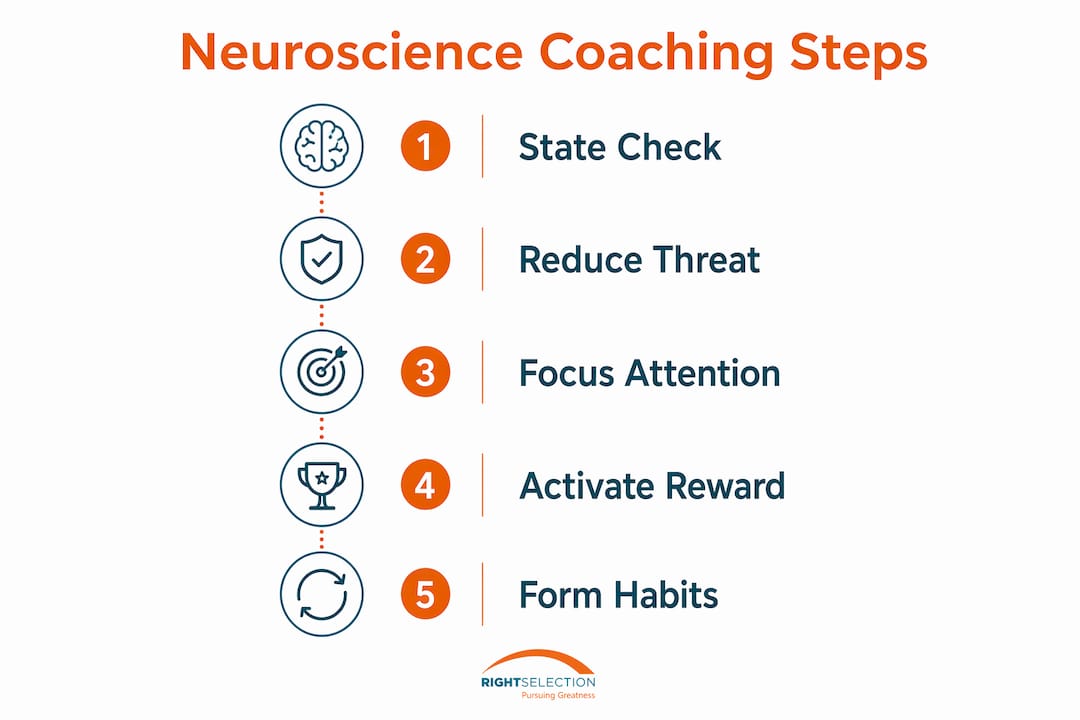
One practical step you can take today: Before a coachee commits to any action plan, run a 60-second “state check.” Ask: “On a scale of 1–10, how settled do you feel right now?” A score below 6 signals the plan needs to wait, or be simplified, until regulation improves.
One boundary worth stating clearly: neuroscience-informed coaching is not clinical care. Coaches who use brain science as a lens are not therapists. When a client presents with active self-harm, unmanaged trauma, or severe mood disorders, the right move is a referral to a licensed mental health professional, not a deeper coaching conversation.
Table of Contents
- What does neuroscience actually add to executive coaching?
- How does neuroscience change what coaches actually do?
- How do you fold neuroscience into GROW, 360s, and development plans?
- What does the research actually support, and where are the limits?
- How do you measure the impact of neuroscience-informed coaching?
- Your first 90 days: a practical implementation plan
- Key Takeaways
- Why the “neuroscience coaching” trend gets one thing consistently wrong
- Right Selection brings neuroscience-informed coaching to your leadership team
- Selected sources and further reading
What does neuroscience actually add to executive coaching?
The role of neuroscience in executive coaching is not to replace models like GROW or 360 feedback. It is to improve the coach’s working theory about why a client is stuck and what state they need to be in before a given question will land. Think of it as upgrading the coach’s diagnostic toolkit, not swapping out the entire practice.
Neuroplasticity
The brain’s ability to reorganize itself through experience. For coaching, this means adult behavioral change is biologically possible at any career stage. Neuroplasticity research confirms that repetition paired with emotionally meaningful practice drives durable new patterns. A single “aha” moment is insufficient; the neural pathway needs repeated activation to become the default.
Threat response: amygdala vs. prefrontal cortex
When the brain perceives threat, the amygdala triggers a protective response that effectively takes the prefrontal cortex offline. The prefrontal cortex handles planning, judgment, and impulse control. A simple mental model: threat → reflex; safe → reflect. Coaching that ignores a client’s threat state is asking the wrong brain region to do the work.

Attention and executive function
Executive function, the cluster of cognitive skills governing focus, working memory, and cognitive flexibility, is highly sensitive to stress and fatigue. Decision-making research shows that under stress, System 1 automatic processing dominates and cognitive bias increases. Leaders who understand this can design their own conditions for better decisions rather than relying on willpower alone.

Reward, prediction error, and dopamine
The brain’s reward system releases dopamine not just when something good happens, but when an outcome is better than predicted. Small wins that exceed expectation create a neurochemical signal that reinforces the behavior. This is why micro-experiments with visible progress markers outperform large, distant goals.
Habit formation and repetition
Habits are encoded through repetition in the basal ganglia, a region that operates largely outside conscious awareness. Changing a leadership habit requires deliberately disrupting the existing loop (cue, routine, reward) and substituting a new routine with enough repetition to encode it. Coaching that maps habits explicitly and designs substitution routines accelerates this process.
Stress physiology and energy management
Chronic stress elevates cortisol, which impairs memory consolidation and prefrontal function. Sleep, nutrition, and movement are not soft wellness topics; they are performance levers with direct neural consequences. Neuroscience-based coaching frameworks treat physiological homeostasis as a prerequisite for transformational leadership change, not an afterthought.
How does neuroscience change what coaches actually do?
Translating brain science into session-level practice requires concrete protocols, not just conceptual awareness. The following moves are repeatable, non-clinical, and immediately applicable.
The SAFE loop: a session-level protocol
- State: Open every session with a brief state check. Ask the client to rate their current nervous-system activation (1–10). If the score is low, run a 60–90 second reset before any strategy work.
- Aim: Once state is regulated, clarify the single most important outcome for this session. One aim, not five.
- Friction: Identify the specific obstacle, cognitive, behavioral, or environmental, that has blocked progress since the last session.
- Experiment: Design one small, concrete experiment the client will run before the next session. The experiment must be doable on a bad day.
This loop reflects the practitioner principle that state-first sequencing is necessary because a stressed brain de-prioritizes future-focused execution.
A 60–90 second state-reset protocol
When a client arrives activated (score of 6 or above on the threat scale), use this sequence before any content work:
- Three slow breaths with a longer exhale than inhale (4 counts in, 6 counts out).
- Feet flat on the floor, brief attention to physical contact with the chair.
- One orienting question: “What’s one thing that’s working well right now?”
This is framed as performance preparation, not therapy. The distinction matters for both the client’s receptivity and the coach’s professional scope.
Sample session prompts
- “Before we build the plan, where are you right now, physically and mentally? What would help you think more clearly in the next 30 minutes?”
- “What’s the smallest version of this change that would still count as progress?”
- “If you were going to do this on your most pressured day next week, what would need to be true?”
These prompts are designed to reduce threat, activate prefrontal engagement, and surface realistic friction before commitment.
Pro Tip: Use spatial metaphors rather than anatomical explanations. Saying “imagine you’re watching this from the balcony” activates perspective-taking and reduces threat more effectively than explaining the amygdala. Over-teaching brain anatomy engages defensive analytical processing and slows behavioral uptake.
How do you fold neuroscience into GROW, 360s, and development plans?
Neuroscience does not require discarding familiar frameworks. Experts in the field consistently position brain science as a lens that optimizes when and how to use existing models, not a replacement. For a deeper look at how these frameworks compare, the leadership coaching models guide is a useful companion resource.
Neuroscience adjustments to common frameworks
| Framework step | Standard approach | Brain-informed adjustment |
|---|---|---|
| GROW: Goal | Set the goal immediately | Run a state check first; simplify the goal if threat is elevated |
| GROW: Reality | Explore current situation | Ask about energy and stress load; surface cognitive biases from fatigue |
| GROW: Options | Generate possibilities | Use spatial metaphors and “worst-day” filtering to test option viability |
| GROW: Will | Commit to actions | Design micro-experiments, not grand plans; build in a visible progress marker |
| 360 Feedback | Deliver ratings and themes | Frame feedback as data, not judgment; allow processing time before response |
| Development plan | List goals and timelines | Add a regulation strategy and a “friction log” to each goal |
Adapting 360 feedback to reduce threat
360 feedback is one of the highest-threat moments in a leader’s development cycle. Receiving critical data about your own behavior activates the same neural threat response as physical danger. Coaches can reduce this by framing the debrief as “patterns worth exploring” rather than verdicts, spacing the delivery across two sessions, and pairing each theme with a micro-experiment rather than a remediation goal.
A short checklist for program designers
- Assessment: Establish a baseline state-regulation score and a behavioral anchor (one observable habit to change).
- Pilot design: Build in three micro-experiments over six weeks, each doable under stress.
- Measurement: Capture self-report state data, manager observation ratings, and one objective KPI at 30, 60, and 90 days.
- Scale: Before scaling, confirm the pilot produced at least one observable behavioral shift and one positive state-regulation outcome.
The right amount of neuroeducation during an engagement is usually one brief explanation per concept, delivered when the client asks why something is being done. Front-loading brain science lectures reduces the time available for actual behavioral practice.
What does the research actually support, and where are the limits?
The evidence base for brain science in coaching is growing but still maturing. Here is an honest account of what is solid, what is emerging, and where coaches must stay within their lane.
Research that supports core claims
- Neuroplasticity and behavior change: Amy Arnsten’s work at Yale on prefrontal cortex function under stress, and Michael Merzenich’s research on adult neuroplasticity, provide the biological foundation for repetition-based coaching interventions.
- Integrated neuroscience coaching frameworks: Applied research on integrated frameworks shows that coaching programs combining neuroscience principles with attention to physiological needs produce more consistent approach-oriented leadership behaviors than goal-only coaching.
- State and decision quality: Research connecting stress to System 1 dominance supports the practical case for state-first sequencing in coaching sessions.
- Patricia Riddell’s practitioner synthesis (University of Reading) offers one of the most rigorous frameworks for applying neuroscience within coaching without overclaiming.
Common misconceptions to correct
- “Neuroscience will rewire leaders quickly.” Neural change through coaching takes weeks to months of consistent practice, not a single session or a weekend program.
- “More brain science = better coaching.” Over-explaining neuroanatomy can trigger analytical resistance and reduce behavioral uptake.
- “The brain is like code you can reprogram.” Neural patterns are probabilistic, not deterministic. Coaching creates conditions for change; it does not guarantee it.
When to refer to clinical care
Coaches must refer a client to a licensed mental health professional when any of the following appear:
- Active self-harm or suicidal ideation
- Unmanaged trauma responses (flashbacks, dissociation, severe hypervigilance)
- Severe mood disorders that impair daily functioning
- Substance dependence affecting performance
- Persistent symptoms that do not respond to state-regulation techniques after multiple sessions
The coaching container is a performance and development space. Staying within that boundary protects both the client and the coach.
How do you measure the impact of neuroscience-informed coaching?
Measurement is where many neuroscience-informed programs lose credibility. Vague claims about “mindset shifts” are not enough. The following framework gives leaders and program designers a concrete measurement architecture.
| Metric | When to measure | Example instrument or KPI |
|---|---|---|
| Nervous-system state | Start and end of each session | Self-report 1–10 scale; note trend over multiple sessions |
| Habit uptake | Weeks 3–6 | Frequency log of target behavior (daily check-in) |
| Micro-experiment completion | Weekly | Binary: completed / not completed; note friction |
| Manager observation rating | 30 and 60 days | Structured 3-question rating on target behavior |
| 360 behavioral shift | 90 days | Pre/post comparison on 2–3 target competencies |
| Business KPI | 90 days | Agreed metric tied to leadership behavior (e.g., team retention, decision speed) |
What “signal” looks like vs. noise
A genuine signal is a consistent directional trend across at least three data points, not a single good session. If a leader’s state scores improve from an average of 4 to an average of 7 over eight sessions, and their manager observes the target behavior more frequently, that is signal. One strong session followed by regression is noise.
Realistic timelines: state regulation improvements are often visible within 2–4 weeks. Habit-level behavioral change typically requires 6–12 weeks of consistent micro-experiments. Observable leadership behavior shifts that register on a 360 usually take 3–6 months.
Measurement checklist for pilot design:
- Define one primary behavioral metric before the engagement starts.
- Agree on the measurement method with the client and their manager.
- Capture baseline data in week one.
- Review data at 30, 60, and 90 days and adjust experiments accordingly.
Your first 90 days: a practical implementation plan
Weeks 0–2: contracting and baseline
- Agree on scope in writing: coaching is non-clinical, focused on performance and behavioral development.
- Establish a baseline state-regulation score and identify one target behavior to change.
- Ask the coach these questions before signing: “How do you use state regulation in sessions? What does a micro-experiment look like in your practice? How do you decide when to refer a client to clinical support? What does success look like at 90 days?”
- Red flags at this stage: a coach who promises rapid neural rewiring, uses clinical diagnostic language, or cannot describe a concrete measurement approach.
Weeks 3–6: micro-experiments
- Run small, doable behavioral experiments designed to work even under stress.
- Log friction daily: what made the experiment harder or easier than expected?
- Overcoming leadership blind spots often surfaces here; use the friction log as a mirror.
- Adjust the experiment design based on what the friction log reveals, not based on motivation levels.
Weeks 7–12: iterate and measure
- Review state-regulation trend data and habit-uptake frequency.
- Conduct a mid-point manager observation rating.
- If the pilot is producing signal, design the scale-up: identify two or three other leaders who would benefit, and build a shared reinforcement loop (peer check-ins, brief group debrief sessions).
- If the pilot is not producing signal after 12 weeks, examine whether the experiments were too large, the state-regulation baseline was too low, or a clinical referral is warranted.
Key Takeaways
Neuroscience improves executive coaching outcomes by prioritizing nervous-system state, designing stress-resilient micro-experiments, and using brain science as a diagnostic lens rather than a replacement for proven coaching frameworks.
| Point | Details |
|---|---|
| State comes first | Run a state check before any goal-setting to support effective planning and change. |
| Small experiments beat grand plans | Design micro-experiments doable on a bad day; visible progress markers drive dopamine-reinforced repetition. |
| Neuroeducation is a lens, not a lecture | Brief metaphors and one-sentence explanations outperform anatomy lessons; over-teaching triggers resistance. |
| Non-clinical boundary is non-negotiable | Refer clients with active self-harm, unmanaged trauma, or severe mood disorders to licensed clinical professionals. |
| Right Selection for pilot design | Right Selection connects leaders with vetted coaches who apply brain-informed methods within a structured, measurable pilot framework. |
Why the “neuroscience coaching” trend gets one thing consistently wrong
The most common failure in neuroscience-informed coaching is not bad science. It is misplaced emphasis. Programs spend the first three sessions teaching leaders about the prefrontal cortex and the amygdala, then wonder why behavioral change stalls. The brain science is accurate. The sequencing is backwards.
What actually produces change is not understanding neuroscience. It is experiencing a different nervous-system state during a coaching conversation and then designing a behavioral experiment small enough to survive the week. The neuroeducation is useful context, but it is not the mechanism. The mechanism is repetition plus emotional significance, which is exactly what neuroplasticity research has shown for decades.
There is also a subtler problem: coaches who lead with brain science can inadvertently signal to clients that the coach’s framework matters more than the client’s experience. The most effective practitioners use neuroscience to sharpen their own hypotheses about a client’s state and resistance patterns, then ask better questions. The client never needs to know the word “amygdala” for the approach to work.
For leaders evaluating coaches, the right question is not “Do you use neuroscience?” It is “How do you design experiments that work when I’m under pressure?” That question separates practitioners who understand the biology from those who are simply using the vocabulary.
Right Selection brings neuroscience-informed coaching to your leadership team
Knowing the science is one thing. Finding a coach who applies it with the discernment and structure your organization actually needs is another challenge entirely. Right Selection has spent over 30 years curating an elite network of coaches, speakers, and leadership development specialists, including practitioners like Mark C. Thompson and Liz Wiseman, who bring both intellectual depth and measurable outcomes to every engagement.

For leaders ready to pilot a brain-informed coaching program, Right Selection handles the curation, session design, and measurement architecture so you can focus on the work itself. Every engagement is tailored to your specific business goals and leadership context, not a generic program pulled off a shelf. The result is a coaching experience with a clear behavioral metric, a defined 90-day arc, and a coach whose methods hold up under the scrutiny of your most demanding stakeholders.
This article is general informational content, not clinical or professional advice. Evaluate coach fit, credentials, and references carefully for your specific situation. Book a complimentary coaching call with Right Selection to discuss your pilot design.
Selected sources and further reading
“Neuroscience for Coaches” (MIT Press) — Amy Brann. The most accessible practitioner-facing synthesis of neuroplasticity and behavior-change research; directly applicable to session design and micro-experiment frameworks.
“Neuroscience Coaching: Theory, Research and Practice” — Patricia Riddell, University of Reading. A rigorous academic-practitioner framework for applying brain science within coaching without overclaiming; essential reading for coaches who want to use neuroscience as a lens rather than a lecture.
“Neuroscience of Coaching: Theory, Research and Practice” (Chapter 10) — Patricia Riddell. Covers System 1/System 2 dynamics and their implications for leadership decision-making under stress; directly relevant to bias and state management.
“The Development and Testing of an Integrated Neuroscience Coaching Framework” — SA Journal of Industrial Psychology, 2023. Applied research demonstrating that integrated neuroscience frameworks support transformational leadership behaviors and psychological needs homeostasis.
“The Neuroscience-Based Method Every Coach Needs Now” — ANHCO. A practitioner-facing guide to state-first sequencing, the SAFE loop, and micro-experiment design; practical and non-clinical in framing.
Henley Business School: “Neuroscience and Coaching: Understanding the Brain’s Role in Behaviour and Decision-Making” — A concise institutional summary connecting brain research to coaching practice; useful for leaders who want a credible, accessible entry point.
PMC / National Institutes of Health — Coaching and Behavioral Change Review — Peer-reviewed synthesis of evidence on coaching outcomes and behavioral change mechanisms; provides the scientific grounding for claims about habit formation and state regulation in professional development contexts.