

What leadership blind spots are and why coaching is the answer
Leadership blind spots are the gaps between how leaders see themselves and how others actually experience their behavior. A global study found that leaders on average have 7.6 blind spots, impacting over one-third of key leadership behaviors. This is not a fringe problem; it is a near-universal condition of leadership.
Coaching is the most direct path to closing those gaps. A skilled coach creates a structured, psychologically safe space where leaders can examine the patterns they cannot see on their own. Through tools like the LEA 360 and IDI assessments, coaching translates abstract feedback into clear, targeted development priorities.
What coaching does that self-reflection alone cannot:
- Surfaces perception gaps using objective, data-driven assessments
- Normalizes blind spots as universal human traits, not personal failures
- Guides leaders through reflective dialogue to examine assumptions and habits
- Converts feedback into specific behavioral goals with built-in accountability
- Builds self-awareness that strengthens communication, decision-making, and team trust
Why unaddressed blind spots cost leaders more than they realize
Blind spots do not stay contained. Left unexamined, they erode trust, slow decisions, and block the kind of open dialogue that drives innovation. The gap between a leader’s intentions and their actual impact widens quietly, often until disengagement or turnover makes it visible.

The organizational cost is real. When leaders misread how they are perceived, they misalign their teams, create confusion around priorities, and unintentionally signal that candid feedback is unwelcome. Coaching grounded in strengths and credible feedback, as Gallup’s research demonstrates, consistently improves team cohesion and leadership impact. The inverse is equally true: leaders who skip this work tend to repeat the same patterns at greater scale as they advance.
Heightened self-awareness does not just reduce friction. It builds the relational foundation that high-performing teams depend on.
Five common leadership blind spots and how coaching addresses each
Most leaders share a recognizable set of blind spots, even when the specific behaviors differ. Coaching addresses each one through a combination of objective data, reflective dialogue, and deliberate practice.
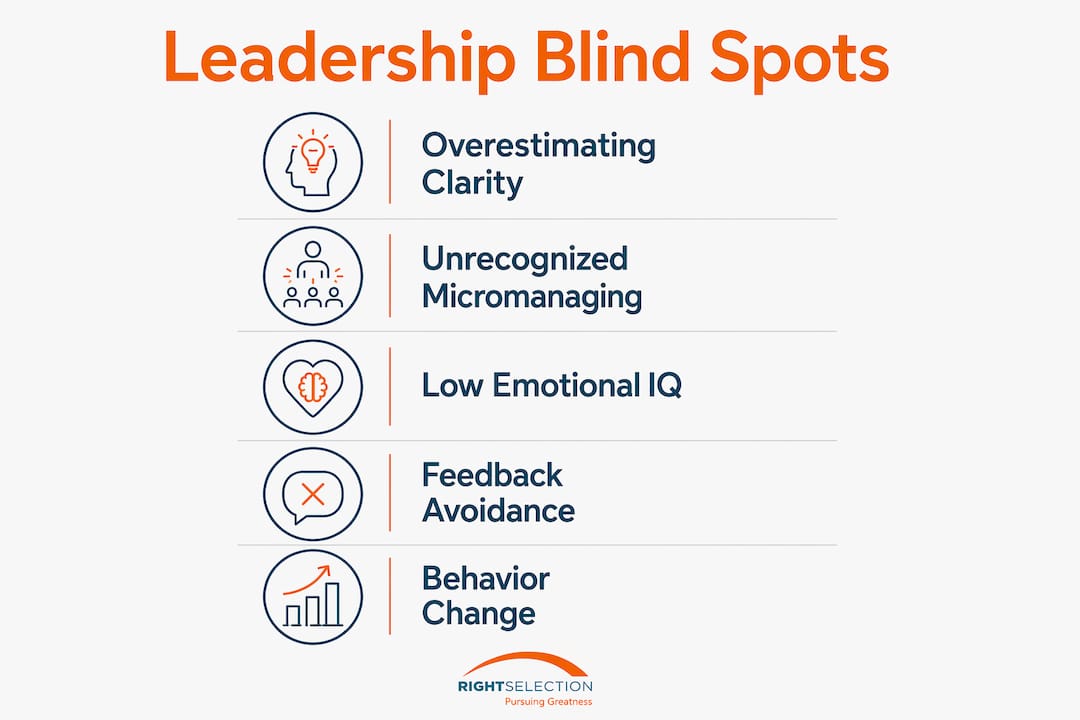
1. Overestimating communication clarity
Leaders often believe they are clear and transparent while their teams experience confusion or mixed messages. Research shows leaders tend to underestimate how thoroughly they communicate, meaning the gap runs in both directions. Coaching helps leaders practice active listening, adapt their tone to context, and validate understanding before moving on.
2. Micromanaging without recognizing it
A decisive leader can come across as domineering. Coaching builds awareness of when a strength, like attention to detail, becomes overused and starts limiting the team’s autonomy and growth. The goal is not to abandon the strength but to calibrate it.

3. Neglecting emotional intelligence
Leaders who do not recognize their own stress responses can unintentionally transmit anxiety to their teams. Coaching increases emotional regulation and relational awareness, helping leaders manage their internal state before it shapes the room.
4. Avoiding or dismissing feedback
Some leaders assume their team shares the same priorities and context. When feedback arrives that challenges that assumption, the instinct is often defensiveness. Coaching shifts that instinct toward curiosity, reframing feedback as data rather than criticism.
5. Undervaluing constructive tension
Leaders who prioritize harmony over honest debate often suppress the disagreement that drives better decisions. Coaching helps them see productive conflict as a path to innovation, not a threat to cohesion.
“Awareness alone doesn’t eliminate blind spots, but it opens the door to meaningful change. Through guided coaching and reflection, leaders can translate feedback into daily practices that strengthen relationships and performance.” — MRG Research
Pro Tip: When working with a coach on any of these blind spots, ask for behavioral experiments rather than broad commitments. Testing one small change in a low-stakes conversation is far more sustainable than overhauling your entire leadership style at once.
How to turn blind spot awareness into lasting behavior change
Awareness is the starting point, not the finish line. The harder work is converting what you now know into habits that hold under pressure.
Four strategies that consistently work in coaching engagements:
- Create a feedback loop. Make it clear, repeatedly, that you welcome dissenting opinions and honest input. Then prove it by acting on what you hear. Anchoring feedback to outcomes rather than ego makes this sustainable.
- Find a trusted sounding board. Not every challenge is suitable for a team discussion. Executive coaches and mentors provide the unfiltered perspective that colleagues rarely feel safe offering.
- Run small-scale behavioral experiments. Testing new approaches in low-risk situations before applying them in high-stakes environments reduces the fear of failure and makes new habits stick. Small shifts often produce outsized results.
- Be patient and consistent. Change tied to identity or long-held success patterns takes time. Track progress, revisit feedback regularly, and treat development as a continuous loop: learn, apply, reflect, refine.
One pattern worth naming directly: leaders often try to solve blind spots by working harder at what they already do. Coaching redirects that energy toward awareness and strategic behavior change, which is a fundamentally different kind of effort.
Pro Tip: Use a personal leadership map, a written record of your coaching goals, behavioral experiments, and progress notes, to track your development between sessions. Coaches who work within frameworks like CliftonStrengths or the LEA 360 often build this into the engagement from the start.
How Right Selection’s coaching expertise accelerates this work
Right Selection brings over 30 years of experience connecting leaders with coaches and thought leaders who specialize in exactly this kind of development. The results speak clearly: leaders who engage with Right Selection’s curated coaching programs report stronger team alignment, sharper decision-making, and measurable shifts in how they are perceived by their organizations.
What sets Right Selection’s approach apart:
- A roster of 100+ expert coaches and speakers, each matched to specific leadership challenges and organizational contexts
- Tailored session design that aligns coaching goals with real business outcomes, not generic frameworks
- Access to executive coaching best practices drawn from decades of working with senior leaders across industries
- Coaching programs built around data-driven assessments and reflective dialogue, consistent with the methods that research consistently validates
- Commitment to measurable outcomes, so leaders and organizations can track progress over time
The compound effect of consistent, well-matched coaching is not abstract. Leaders who commit to this process expand their behavioral range, build deeper trust with their teams, and lead with greater discernment at every level of complexity. Right Selection’s behavioral coaching frameworks are designed to make that progression structured and sustainable.
For leaders exploring how business coaching can be embedded into organizational development, the evidence for structured coaching programs continues to grow across industries and leadership levels.
Right Selection connects you with the coaches who make this real
Right Selection is not a generic speaker bureau. It is a curated network built specifically for leaders who want measurable growth, not just a motivating session. For executives working to close the gap between how they lead and how they are experienced, Right Selection matches you with coaches who have the expertise, the tools, and the commitment to make that shift lasting.
Every engagement starts with understanding your specific leadership context, your blind spots, your goals, and the organizational dynamics at play. From there, Right Selection designs a coaching experience that fits. With 100+ coaches and thought leaders on the roster and over three decades of placement experience, the right match is not a guess. It is a deliberate process.
Book a complimentary coaching call with Right Selection today and take the first concrete step toward leading with greater clarity, trust, and impact.
Key Takeaways
Coaching is the most direct and evidence-based method for leaders to identify, understand, and overcome the blind spots that limit their effectiveness and organizational impact.
| Point | Details |
|---|---|
| Blind spots are universal | A global study found that leaders on average have 7.6 blind spots, affecting over one-third of key leadership behaviors. |
| Coaching converts awareness to action | Tools like LEA 360 and IDI turn abstract feedback into targeted development plans with built-in accountability. |
| Small experiments drive lasting change | Testing new behaviors in low-risk situations reduces fear of failure and makes new habits sustainable before high-stakes application. |
| Feedback loops require consistency | Anchoring feedback to outcomes rather than ego, and revisiting it regularly, turns awareness into measurable leadership development. |
| Right Selection accelerates the process | With 100+ expert coaches and 30+ years of experience, Right Selection matches leaders to curated coaching programs that deliver measurable outcomes. |