

Transformational leadership is defined as a leadership style that inspires team members to exceed their own expectations by connecting personal growth to a shared organizational vision. First formalized by researcher Bernard Bass, the model organizes around the Four I’s framework: Inspirational Motivation, Idealized Influence, Intellectual Stimulation, and Individualized Consideration. These four dimensions work together to shift teams from compliance to genuine commitment. With transformational leadership explained clearly, corporate leaders and HR professionals can apply it with precision rather than guesswork.
What is transformational leadership and how does it work?
Transformational leadership is a dynamic system focused on cultural change, not just charisma. Bass’s Full Range Leadership Model positions it as the highest tier of leadership effectiveness, sitting above transactional approaches that rely on rewards and penalties. The model works because it aligns personal and organizational goals, creating conditions where people perform at a higher level because they want to, not because they are told to.
The Four I’s give the model its structure. Inspirational Motivation means communicating a compelling vision that gives work meaning. Idealized Influence means modeling the values and behaviors you expect from others. Intellectual Stimulation means challenging teams to question assumptions and think creatively. Individualized Consideration means treating each team member as a whole person with unique development needs. Together, these four dimensions produce enhanced follower commitment and performance that transactional methods alone cannot achieve.

Objectives and Key Results (OKRs) are one practical tool that connects this vision to daily execution. OKRs bridge vision to execution by translating high-level aspirations into measurable milestones every team member can track. This makes the transformational leader’s vision tangible rather than abstract.
What are the measurable benefits of transformational leadership?
Transformational leadership increases job satisfaction and team commitment by emphasizing intrinsic motivation and shared purpose. This matters because organizations facing rapid change need people who stay engaged without constant external pressure. When teams understand why their work matters, they show greater resilience and loyalty during periods of disruption.
The organizational benefits extend beyond morale. Research links this leadership style to higher rates of innovation, stronger talent development pipelines, and cultures built on trust and purpose alignment. Leaders who practice Individualized Consideration, the fourth of the Four I’s, invest in coaching and feedback that accelerates individual growth. That investment compounds over time, producing teams that are more capable and more committed.
Key benefits include:
- Higher employee retention driven by purpose alignment and personal recognition
- Greater innovation output because Intellectual Stimulation encourages creative problem-solving
- Stronger organizational resilience as purpose-aligned cultures perform better under pressure
- Faster talent development through individualized coaching and feedback loops
- Deeper trust between leaders and teams, reducing friction during organizational change
Pro Tip: Before adopting a transformational leadership approach, survey your team on current levels of psychological safety and purpose clarity. Teams that score low on both need foundational trust-building before higher-order intellectual stimulation will land well.
How does transformational leadership differ from transactional leadership?
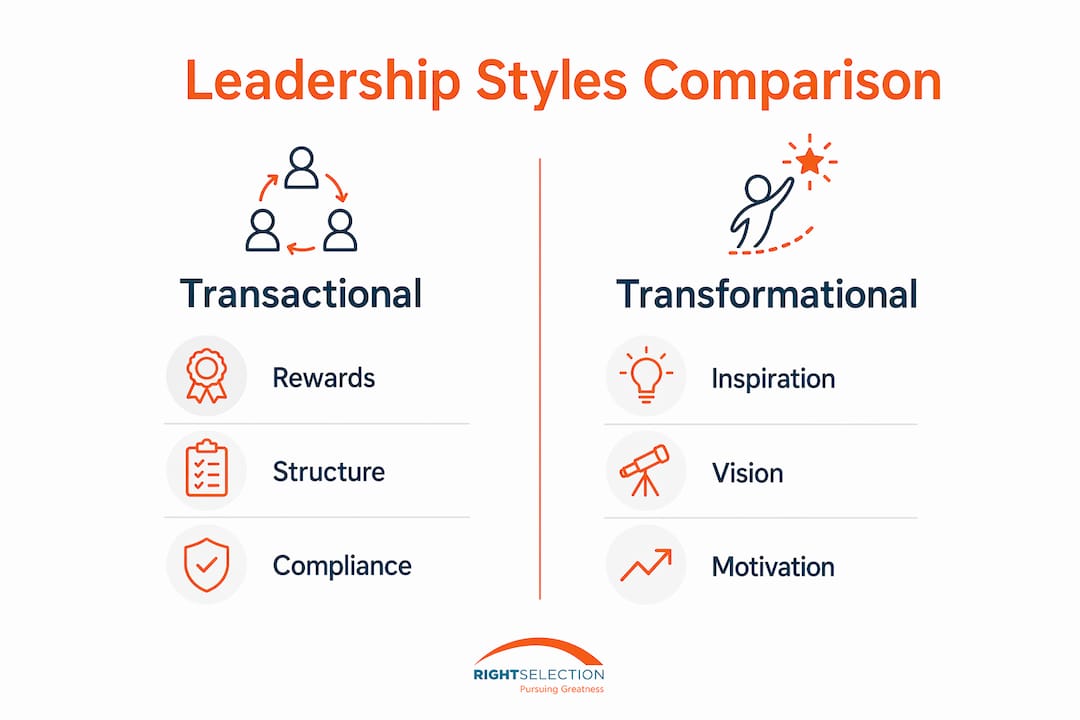
Transactional leadership focuses on structure, clear expectations, and a reward-and-penalty system to drive performance. It works well for routine operations where consistency and compliance are the primary goals. Transformational leadership, by contrast, focuses on inspiring people to go beyond defined roles by connecting their work to a larger purpose.
The critical insight is that these two styles are complementary, not mutually exclusive. The Full Range Leadership Model, developed by Bass and Bruce Avolio, explicitly combines both. Transactional methods provide the operational backbone. Transformational methods provide the motivational engine. Leaders who use only one approach leave performance on the table.
| Dimension | Transactional leadership | Transformational leadership |
|---|---|---|
| Core motivation | External rewards and penalties | Intrinsic purpose and personal growth |
| Primary focus | Task completion and compliance | Vision, culture, and innovation |
| Leadership behavior | Sets clear rules and monitors results | Models values and coaches individuals |
| Best-use context | Stable, process-driven environments | Change, growth, and innovation cycles |
| Team outcome | Consistent performance | Exceeds expected performance |
A common misconception is that transformational leaders never use structure or accountability. In practice, the most effective leaders use transactional methods for daily operational stability and shift to transformational methods when driving change or developing talent. Knowing when to switch between the two is itself a mark of leadership maturity.
What practical steps can leaders take to implement transformational leadership?
Implementation requires a deliberate sequence. Jumping straight to high-level vision communication without building the right conditions first produces confusion rather than inspiration. Follow these steps to apply the transformational leadership style with real impact.
Audit team maturity first. Teams lacking role clarity react negatively to transformational demands. Before introducing intellectual stimulation or bold vision, confirm that your team has clear responsibilities, adequate resources, and basic psychological safety.
Craft and communicate a specific vision. A vision statement is not a slogan. It names a concrete future state, explains why it matters, and connects to each team member’s daily work. Vague aspirations do not inspire. Specific, meaningful ones do.
Deploy OKRs to make vision measurable. OKRs improve trust and progress tracking by giving teams a shared language for measuring progress toward transformational goals. Each objective should trace directly back to the vision you have communicated.
Practice Individualized Consideration through structured coaching. Schedule regular one-on-one conversations focused on each person’s growth, not just task updates. Use executive coaching methods to sharpen your own ability to give feedback that develops rather than just evaluates.
Stimulate intellectual engagement deliberately. Assign stretch projects, invite dissenting opinions in team meetings, and reward curiosity. Intellectual Stimulation does not happen by accident. It requires leaders to create space where questioning the status quo is safe and expected.
Measure leadership effectiveness regularly. Use 360-degree feedback tools, employee engagement surveys, and OKR completion rates to track whether your approach is producing the outcomes you intend. Adjust based on what the data shows, not what feels right.
Pro Tip: Avoid performative transformation. Pushing high expectations without support causes burnout, not breakthrough. Every bold vision you communicate must be paired with the coaching, resources, and psychological safety your team needs to pursue it.
Examples of transformational leadership in action
Transformational leadership shows up differently depending on the industry and organizational size, but the underlying pattern is consistent. The leader sets a compelling direction, models the values required to get there, and invests personally in the people doing the work.
Elon Musk at Tesla and SpaceX is frequently cited as an example of transformational leadership in practice. He communicated visions that most observers considered unrealistic, attracted talent motivated by the mission itself, and pushed teams to rethink what was technically possible. The results, whether or not one agrees with his methods, demonstrate the performance ceiling that transformational leadership can raise.
Transformational leadership also appears in less dramatic contexts. A regional HR director who redesigns the onboarding process to connect new hires to company values from day one is practicing Idealized Influence. A team manager who creates a monthly “challenge assumption” session is practicing Intellectual Stimulation. The scale differs. The principles are identical.
Common pitfalls in application include:
- Skipping the audit step and applying transformational pressure to teams that need operational clarity first
- Confusing charisma with transformation, treating personal magnetism as a substitute for genuine coaching and vision
- Neglecting transactional foundations, which causes accountability gaps that undermine even the most inspiring vision
- Treating culture change as a one-time event rather than a sustained commitment that requires consistency over months and years
Organizational culture is the environment in which transformational leadership either thrives or stalls. Leaders who invest in psychological safety, open communication, and shared values create the conditions where the Four I’s can produce their full effect.
Key takeaways
Transformational leadership produces its strongest results when leaders combine a clear, specific vision with genuine individualized coaching, operational accountability, and a culture built on psychological safety.
| Point | Details |
|---|---|
| Four I’s are the foundation | Inspirational Motivation, Idealized Influence, Intellectual Stimulation, and Individualized Consideration drive performance together. |
| Audit before you inspire | Assess team maturity and role clarity before applying intellectual stimulation or high-level vision work. |
| Pair with transactional methods | Use transactional leadership for operational stability and transformational leadership for change and growth. |
| OKRs make vision measurable | Objectives and Key Results translate transformational goals into daily, trackable milestones for every team member. |
| Avoid performative transformation | Bold vision without personalized support causes burnout. Coaching and resources must accompany every high expectation. |
What I have learned about transformational leadership after years of working with leaders
Most managers I have worked with understand the theory of transformational leadership within the first hour of any session. The harder lesson takes much longer: the gap between communicating a vision and actually living it in front of your team is where most leadership efforts fail.
The leaders who get this right are not necessarily the most charismatic people in the room. They are the most consistent ones. They show up to one-on-ones prepared. They remember what each team member said they wanted to grow toward three months ago. They ask questions that challenge thinking rather than confirm their own views. That consistency, compounded over time, is what builds the trust that transformational leadership requires to function.
I have also seen the burnout trap play out more times than I can count. A leader reads about transformational leadership, gets genuinely excited, and starts setting ambitious goals and communicating bold visions. Six months later, the team is exhausted and the leader is frustrated. The missing piece is almost always Individualized Consideration. Vision without coaching is just pressure. The role of executive coaching in leadership decisions is precisely to close that gap, giving leaders the skills to support their people as well as inspire them.
The future of this leadership style is not in doubt. As organizations face faster change cycles and more complex talent dynamics, the ability to connect people to purpose and develop them as individuals becomes a core competitive capability. The leaders who invest in that capability now will be the ones their organizations rely on most.
— Dipti
How Right Selection helps leaders put this into practice
Right Selection has spent over 30 years connecting organizations with the thought leaders, coaches, and corporate trainers who make transformational leadership a practical reality rather than a theoretical ideal.
Whether you are a senior leader building a culture of purpose or an HR professional designing a leadership development program, Right Selection curates the right expert for your specific goals. Every engagement is designed around your team’s maturity, your organization’s context, and the outcomes you need to measure. Speakers like Doug Lipp bring real-world experience in leadership culture directly to your teams. With a roster of 100+ global thought leaders, Right Selection matches you with the voice your organization needs to move from vision to results.
FAQ
What is transformational leadership in simple terms?
Transformational leadership is a style where leaders inspire team members to exceed normal performance by connecting their work to a meaningful shared vision and investing in their personal development.
What are the four characteristics of transformational leadership?
The four characteristics are Inspirational Motivation, Idealized Influence, Intellectual Stimulation, and Individualized Consideration. Together, these dimensions form Bernard Bass’s foundational framework for the transformational leadership style.
How does transformational leadership differ from transactional leadership?
Transactional leadership uses rewards and penalties to drive compliance. Transformational leadership uses vision, coaching, and purpose to inspire people to go beyond their defined roles. The Full Range Leadership Model combines both for maximum effectiveness.
Can transformational leadership cause burnout?
Yes. Pushing high expectations without providing individualized coaching and adequate support causes team exhaustion. Effective transformational leaders pair every ambitious goal with the resources and personal attention their teams need to pursue it.
How do you implement transformational leadership in a corporate setting?
Start by auditing team maturity and role clarity, then communicate a specific vision, deploy OKRs to make goals measurable, and build a consistent coaching practice that addresses each team member’s individual development needs.