
Mentoring is a directive, experience-driven relationship where a seasoned professional shares career guidance and organizational wisdom, while coaching is non-directive, focused on unlocking an individual’s own solutions through questioning and reflection. Understanding the role of mentoring vs coaching professionals rely on is not a matter of preference. It is a matter of choosing the right tool for the right development goal. Both methods drive growth, but they operate through fundamentally different mechanisms. Organizations that confuse the two, or use only one, leave significant talent potential on the table.
What is the role of mentoring vs coaching professionals need to know?
Mentoring is defined as a relationship in which a more experienced professional guides a less experienced one through career decisions, organizational culture, and long-term growth. The Chartered Institute of Personnel and Development (CIPD) and the International Coaching Federation (ICF) both recognize mentoring and coaching as distinct disciplines, each with its own methodology and purpose. Knowing which to apply, and when, is one of the most consequential decisions a leader or HR professional makes.
Coaching, by contrast, centers on facilitating self-discovery. A coach does not tell the coachee what to do. Instead, the coach asks open-ended questions that help the individual identify their own path forward. This distinction matters because the two approaches produce different outcomes and suit different development contexts.

The compound effect of applying both methods thoughtfully is significant. Organizations combining mentoring and coaching report better retention, stronger leadership pipelines, and measurable business impact compared to organizations using either approach in isolation.
How does mentoring support professional growth?
Mentoring works through a relationship built on trust, respect, and the deliberate transfer of experience. A mentor draws on their own career history to help a mentee navigate decisions, avoid common pitfalls, and build confidence in unfamiliar territory. The relationship is typically driven by the mentee’s agenda, meaning the mentee sets the direction and the mentor responds with guidance.
Mentoring relationships typically last one to two or more years, which allows for deep organizational integration and genuine career development. That duration is not incidental. Long-term engagement gives mentees time to absorb cultural knowledge that no formal training program can teach.
The career impact of mentoring is well documented. A Sun Microsystems study tracking more than 7,000 mentoring pairs over 14 years found that mentees are promoted 5x more often than peers without mentors, and mentoring participants show 72% retention rates compared to 49% for non-participants. Those numbers reflect the compound effect of sustained guidance on career trajectory.
Mentoring excels in specific organizational scenarios:
- Onboarding and cultural integration: New hires with mentors acclimate faster and feel connected to organizational values sooner.
- Leadership succession: Senior leaders mentoring high-potential employees transfer tacit knowledge that formal programs cannot replicate.
- Career navigation: Professionals at crossroads benefit from a mentor who has walked a similar path and can offer perspective grounded in real experience.
- Diversity and inclusion: Mentorship programs that pair underrepresented professionals with senior sponsors accelerate equitable advancement.
Pro Tip: When launching a mentorship program, match mentors and mentees on complementary goals rather than identical backgrounds. Diverse pairings produce richer perspective and broader organizational learning.
How does coaching enhance individual performance?
Coaching is defined as a structured, non-directive process that helps individuals close specific skill gaps, shift behaviors, and improve performance within a defined timeframe. The ICF describes coaching as partnering with clients in a thought-provoking process that inspires them to maximize their personal and professional potential. The key word is “partnering.” A coach does not hold the answers. The coachee does.
Coaching relationships usually span 3–12 months, targeting defined challenges or development goals. That shorter timeframe creates focus and accountability. Both coach and coachee know they are working toward a specific outcome, which keeps sessions purposeful.
The GROW model is the industry-standard coaching framework used to structure these conversations. GROW stands for Goal, Reality, Options, and Will. It moves a coaching conversation from defining what the individual wants to achieve, through an honest assessment of the current situation, to generating options and committing to action. Leaders who apply GROW consistently report that it transforms vague development conversations into concrete plans.
Applying coaching techniques for leaders follows a clear sequence:
- Set the goal. Define what success looks like at the end of the coaching engagement, not just the session.
- Assess reality. Explore the current situation honestly, including obstacles and resources already available.
- Generate options. Ask open-ended questions to surface solutions the coachee has not yet considered.
- Commit to action. Agree on specific steps, timelines, and accountability measures before closing the session.
Effective coaching requires resisting the impulse to give advice. This is the hardest part for most leaders. The instinct to solve problems is strong, but premature advice short-circuits the coachee’s own thinking and reduces long-term ownership.
The business case for coaching is clear. 87% of organizations that invest in coaching report a positive return on investment, with executive coaching delivering 5–7x ROI. The global coaching industry reached $5.34 billion by 2025, reflecting how widely organizations now recognize its effectiveness.
Pro Tip: Before your next coaching conversation, write down three open-ended questions you plan to ask. This simple preparation prevents the slide into advice-giving and keeps the session coachee-centered. For a deeper look at applying these principles, the executive coaching best practices guide from Right Selection offers a practical framework.
What are the key differences between mentoring and coaching?
Mentoring and coaching are complementary, not interchangeable. Each addresses a different layer of professional development, and understanding where they diverge helps leaders deploy them with precision.
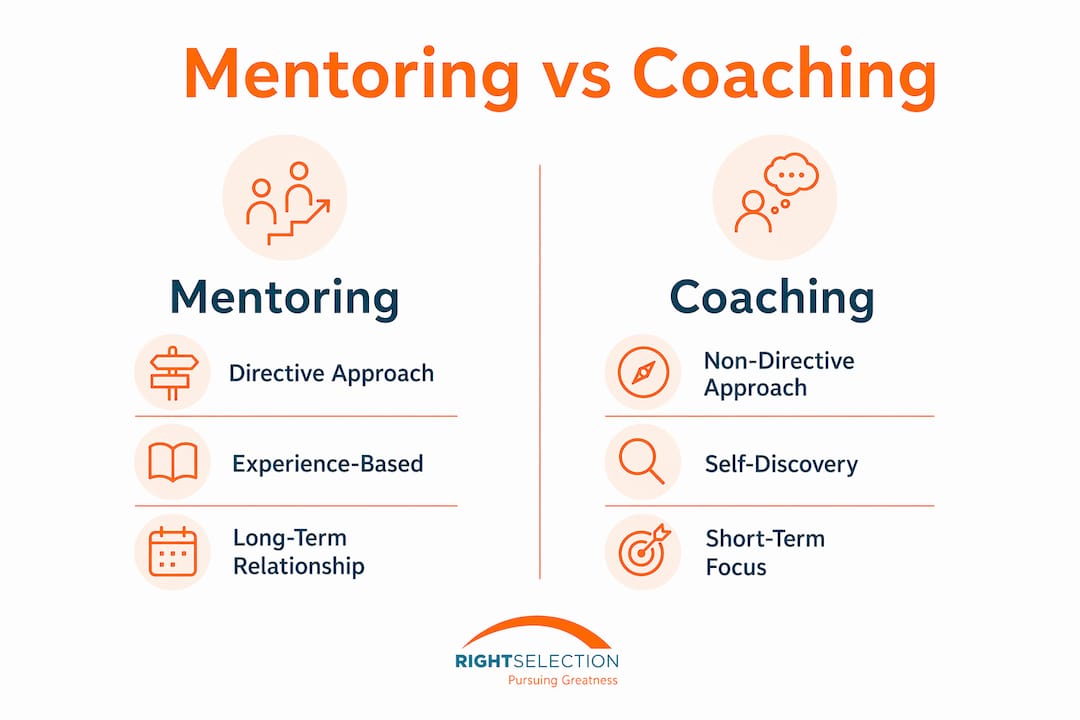
| Dimension | Mentoring | Coaching |
|---|---|---|
| Approach | Directive, advice-based | Non-directive, question-based |
| Duration | 1–2+ years | 3–12 months |
| Focus | Career growth, culture, identity | Specific skills, behaviors, performance |
| Driver | Mentee’s agenda | Defined development goal |
| Role of experience | Central, the mentor’s experience is the resource | Secondary, the coach facilitates the coachee’s thinking |
| Outcome | Long-term career navigation | Measurable behavioral change |
The distinction between directive and non-directive is the most important one. A mentor says, “Here is what I did when I faced that situation.” A coach says, “What options have you considered?” Both responses are valuable. Neither is universally correct. The right response depends on what the individual needs at that moment.
Coaching leadership style differs from mentoring in a way that Daniel Goleman’s research on leadership styles makes explicit. Coaching asks questions to develop people over time. Mentoring gives advice grounded in lived experience. Leaders who can flex between both modes are significantly more effective than those who default to one style.
Layering both approaches addresses different psychological needs. Coaching builds the self-efficacy that comes from solving your own problems. Mentoring builds the confidence that comes from knowing someone experienced believes in your potential. Together, they create a development environment that is both challenging and supportive. For a detailed look at how coaching frameworks apply across the employee lifecycle, the role of coaching in employee development guide from Right Selection covers this in depth.
When should you use mentoring versus coaching?
Choosing between mentoring and coaching starts with a clear diagnosis of what the individual actually needs. The wrong choice does not just waste time. It can frustrate the professional and undermine trust in the development program.
Coaching is the right choice when:
- A professional has a specific skill gap that needs closing within a defined period.
- A leader is navigating a behavioral change, such as moving from a directive to a more collaborative management style.
- An employee is preparing for a promotion and needs to build confidence in a new competency area.
- The goal is measurable and can be tracked over a 3–12 month engagement.
Mentoring is the right choice when:
- A new hire needs to understand the unwritten rules of the organization.
- A high-potential employee is building toward a senior leadership role and needs a sponsor who can open doors.
- A professional is at a career crossroads and needs perspective from someone who has navigated similar decisions.
- The organization is building a leadership pipeline and needs to transfer institutional knowledge before senior leaders retire.
Blended programs produce the strongest outcomes. Effective leadership development programs layer coaching to build specific skills and mentoring to provide organizational context that formal training cannot teach. The two methods reinforce each other when designed intentionally.
Setting clear expectations at the start of any developmental relationship is non-negotiable. Both parties need to understand whether the relationship is a coaching engagement or a mentoring relationship, because the behaviors expected of each role are different. Psychological safety, the confidence that honest conversation will not carry professional consequences, is the foundation on which both methods depend. You can also explore how to attract top talent by building programs that combine both approaches effectively.
Key takeaways
Mentoring and coaching are most powerful when used together, each addressing the developmental needs the other cannot meet.
| Point | Details |
|---|---|
| Mentoring is directive | Mentors share lived experience to guide long-term career growth and cultural integration. |
| Coaching is non-directive | Coaches ask questions to help individuals discover their own solutions and build ownership. |
| Duration differs significantly | Mentoring spans 1–2+ years; coaching typically runs 3–12 months with defined goals. |
| Layered programs outperform single methods | Organizations combining both report stronger retention, leadership development, and business impact. |
| Choose based on the development need | Use coaching for skill gaps and behavioral change; use mentoring for career navigation and culture transfer. |
What I have learned from watching leaders confuse these two methods
The most common mistake I see in leadership development is leaders who think they are coaching when they are actually mentoring. They ask one question, hear the answer, and immediately launch into advice. That is mentoring behavior, and it is not wrong. But it is not coaching. The distinction matters because the coachee never gets the chance to develop their own thinking.
The second mistake is the opposite: leaders who withhold useful experience in the name of “staying non-directive” when a mentee genuinely needs guidance. A junior professional navigating their first major organizational conflict does not need Socratic questioning. They need someone who has been there to say, “Here is what I would consider.”
The leaders I have seen develop the most effective teams are the ones who hold both capabilities simultaneously. They know when to ask and when to tell. They have developed enough discernment to read the room and shift their approach mid-conversation when needed. That flexibility is a skill, and it is one that can be built through personal development coaching and deliberate practice.
My strongest recommendation to any leader reading this: resist the urge to institutionalize one method and call it done. Build both. Train your managers in coaching techniques. Create formal mentorship programs with clear matching criteria and structured check-ins. Measure outcomes. The compound effect of both methods, applied with consistency and commitment, is what separates organizations that develop leaders from those that merely hire them.
— Dipti
Right Selection’s approach to mentoring and coaching programs
Right Selection has spent over 30 years connecting organizations with thought leaders, coaches, and corporate trainers who bring both mentoring and coaching expertise to every engagement. The difference between a generic development program and one that actually shifts behavior lies in the quality of the facilitator and the precision of the design.
Right Selection curates programs that match the specific development goals of your organization, whether that means embedding the GROW model into your leadership culture, building a formal mentorship program for high-potential employees, or designing a blended intervention that addresses both skill development and career navigation. Every program is built around your business goals and your people. Visit Right Selection to learn how a customized mentoring or coaching program can strengthen your leadership pipeline and drive measurable outcomes.
FAQ
What is the main difference between mentoring and coaching?
Mentoring is directive and experience-based, with a mentor sharing career guidance and organizational knowledge. Coaching is non-directive, using open-ended questions to help individuals discover their own solutions.
How long does a typical coaching engagement last?
Coaching relationships usually span 3–12 months, focused on specific skill-building or behavioral change within a defined timeframe.
What is the GROW model in coaching?
The GROW model stands for Goal, Reality, Options, and Will. It is the industry-standard framework for structuring coaching conversations from goal-setting through to committed action steps.
When should an organization use mentoring instead of coaching?
Mentoring works best for long-term career navigation, cultural integration, and leadership succession planning, especially when an individual needs guidance from someone with direct experience in a similar role or context.
Can mentoring and coaching be used together?
Yes, and organizations that layer both approaches consistently report stronger retention and leadership development outcomes than those relying on a single method.