
Organizational transformation through leadership is the process by which leaders catalyze and sustain meaningful change by aligning vision, engaging people, and building adaptive capability across every level of an organization. Strategy sets direction, but leadership determines durability. The difference between a change initiative that sticks and one that quietly fades is almost always the quality, consistency, and commitment of the leaders driving it. This guide gives corporate leaders and change agents a research-backed framework for leading transformation that lasts, covering leadership styles, governance structures, common pitfalls, and the cultural conditions that make change permanent.
What leadership styles and frameworks drive organizational transformation?
Transformational leadership is the most consistently effective style for driving organizational change. A systematic review of 104 peer-reviewed articles found that transformational leadership improves performance in 90% of cases by accelerating innovation, deepening employee engagement, and aligning stakeholders around a shared purpose. That figure is not a coincidence. Transformational leaders create conditions where people feel connected to something larger than their individual role, which makes them more willing to absorb the discomfort that change always brings.
Adaptive leadership complements this by building resilience at the team level. A 2026 study of 382 employees using Partial Least Squares Structural Equation Modeling confirmed that adaptive leadership reduces uncertainty and strengthens employee resilience during volatile transformations. Resilience matters because most transformations encounter unexpected friction. Leaders who model calm, curiosity, and flexibility give their teams permission to do the same.

The MIT Sloan “Step Up, Step Back” framework offers a practical balance point between these two styles. The principle is straightforward: leaders step up by setting clear strategic intent and non-negotiable priorities, then step back to create space for local problem-solving and ownership. This balance prevents two common failure modes. The first is over-direction, where leaders micromanage execution and kill initiative. The second is under-direction, where leaders delegate without clarity and leave teams confused about what actually matters.
Three additional behaviors consistently separate effective transformation leaders from ineffective ones:
- Communication cadence. Leaders who communicate the “why” behind change repeatedly and through multiple channels reduce resistance faster than those who rely on a single announcement.
- Ethical modeling. Teams watch what leaders do, not what they say. Leaders who visibly hold themselves to the same standards they set for others build the trust that transformation requires.
- Vision specificity. Vague aspirations like “become more agile” do not move people. Specific, time-bound outcomes tied to real business results do.
Pro Tip: When launching a transformation, write a one-page “leadership contract” that names your three non-negotiable priorities and the three behaviors you commit to modeling. Share it with your direct team. Accountability becomes visible when it is written down.
How do leadership behaviors and governance structures influence transformation outcomes?
Governance is the part of transformation that most leaders underinvest in. A BCG 2026 framework recommends establishing a transformation office to provide governance, accountability, and a regular cadence of leadership engagement. Without a dedicated structure, transformation work competes with business-as-usual priorities and loses every time.
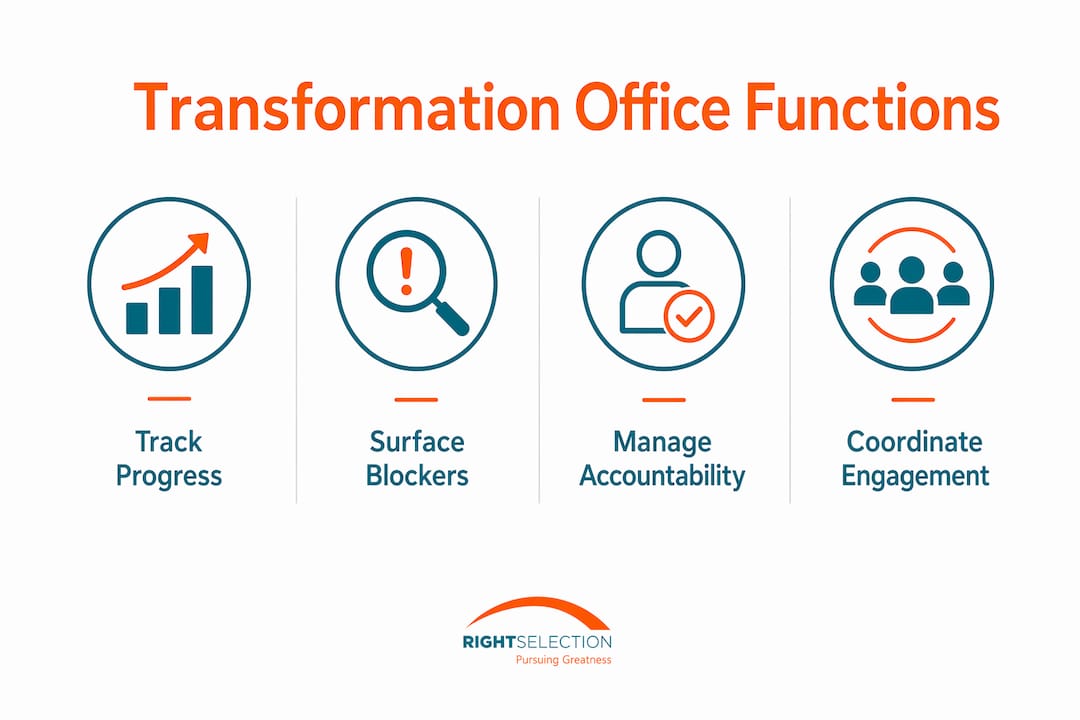
The transformation office serves four functions. First, it tracks progress against milestones and surfaces blockers early. Second, it coordinates cross-functional workstreams so that HR, finance, and operations are moving in the same direction. Third, it owns the communication rhythm, including weekly leadership team meetings and quarterly town halls for the broader workforce. Fourth, it creates a feedback loop between frontline experience and senior decision-making.
Leadership alignment is not a soft outcome. BCG analytics show that alignment on roles and responsibilities increases transformation success rates by 27%. That is a significant performance gain from a single governance input. When leaders disagree in private and present false consensus in public, employees sense the contradiction and disengage.
The following sequence describes how high-performing transformation governance typically operates:
- Define the transformation charter. Establish scope, success metrics, and decision rights before any workstream begins.
- Stand up the transformation office. Assign a dedicated leader with direct access to the CEO or executive sponsor.
- Set the engagement calendar. Schedule weekly leadership syncs, monthly cross-functional reviews, and quarterly town halls in advance.
- Establish a culture dashboard. Track leading indicators like manager effectiveness scores, pulse survey results, and internal mobility rates alongside financial metrics.
- Close the loop publicly. When employees raise concerns through town halls or surveys, leaders must respond visibly and specifically. Silence signals that feedback is not valued.
| Governance element | Why it matters |
|---|---|
| Transformation office | Creates accountability and prevents workstream drift |
| Weekly leadership meetings | Keeps senior team aligned and surfaces blockers early |
| Quarterly town halls | Maintains workforce trust and two-way communication |
| Culture dashboard | Tracks behavioral change, not just financial outcomes |
| Decision rights charter | Eliminates ambiguity about who owns what |
What common leadership challenges hinder transformation and how can they be overcome?
The most persistent obstacle to transformation is not resistance from the frontline. It is leadership behavior that contradicts the stated direction of change. Organizational inertia frequently stalls transformation when leaders rely on communication alone without aligning incentives, reskilling teams, or modeling new behaviors daily. Announcements do not change organizations. Repeated, consistent actions do.
The shift from “power-over” to “power-with” leadership is where many senior leaders struggle most. IMD research shows that transitioning to co-creation models unlocks ownership and adaptive capacity in ways that directive control cannot. Leaders who have built careers on being the smartest person in the room often find this shift personally threatening. Recognizing that instinct is the first step to overcoming it.
Employee resistance is another challenge that leaders frequently misread. A 2026 academic study found that transformation feels like an identity threat to employees, not just a process change. People resist because they fear losing the professional identity they have built. Effective leaders reframe change as identity gain by co-creating a new shared identity with their teams rather than imposing one from above.
Practical strategies for overcoming these challenges include:
- Reframe resistance as information. When employees push back, treat it as a signal about what is unclear, unfair, or poorly designed. Resistance that is engaged constructively often surfaces the best ideas for improving the change.
- Align incentives with new behaviors. If the performance management system still rewards the old way of working, no amount of communication will shift behavior. Incentives must change before culture can.
- Build psychological safety deliberately. Leaders who admit uncertainty, ask questions, and acknowledge mistakes create the conditions where teams will take the risks that transformation requires.
- Reskill before you restructure. Asking people to work in new ways without giving them the tools to do so generates anxiety, not performance.
Pro Tip: Before your next all-hands meeting on transformation, ask three frontline employees what they are most worried about. Use their exact language in your opening remarks. That act of listening, made visible, does more for trust than any polished presentation.
How can leaders build a culture that supports ongoing transformation?
Culture is not a background condition for transformation. It is either the primary accelerator or the primary brake. Sustainable transformation requires embedding behaviors into daily routines, governance structures, and measurement systems rather than relying on one-off communications or offsite events.
The first step is an honest culture diagnostic. Leaders need to know the gap between the culture they have and the culture the transformation requires. This means measuring actual behaviors, not stated values. Pulse surveys, manager effectiveness scores, and 360-degree feedback tools all provide data. The goal is to identify two or three specific behavioral shifts that will have the highest impact on transformation outcomes.
Leaders who model transparency, inclusion, and adaptability in their daily interactions create a compound effect over time. A leader who shares bad news directly, invites dissenting views in meetings, and changes course when evidence demands it gives the entire organization permission to operate the same way. That permission is what makes cultural change durable.
Embedding new behaviors requires connecting them to existing processes. Performance reviews should assess how leaders demonstrate transformation behaviors, not just whether they hit financial targets. Onboarding programs should introduce new employees to the transformation narrative from day one. Team meeting structures should include time for reflection on what is working and what needs to change.
| Culture lever | Practical application |
|---|---|
| Behavioral diagnostics | Run quarterly pulse surveys tied to transformation behaviors |
| Leader modeling | Include culture behaviors in senior leader performance reviews |
| Onboarding integration | Embed transformation narrative in new employee orientation |
| Meeting design | Add a standing agenda item for “what we learned this week” |
Pro Tip: Pick one meeting each week where you, as the leader, speak last. Listening before you share your view changes the quality of the conversation and signals that you value input over authority.
Key takeaways
Organizational transformation through leadership succeeds when leaders align governance structures, model the behaviors they require, and treat culture as a measurable outcome rather than an assumption.
| Point | Details |
|---|---|
| Leadership style determines durability | Transformational and adaptive leadership styles consistently outperform directive approaches in sustaining change. |
| Governance structures prevent drift | A transformation office with a defined engagement calendar keeps accountability visible and workstreams aligned. |
| Alignment multiplies success rates | BCG data shows leader alignment on roles and responsibilities raises transformation success rates by 27%. |
| Resistance signals opportunity | Treating employee resistance as constructive feedback surfaces better solutions and builds psychological safety. |
| Culture must be measured, not assumed | Embedding new behaviors into performance reviews, onboarding, and meeting design makes cultural change stick. |
What I have learned about leading transformation that most frameworks miss
The frameworks are sound. The research is clear. And yet transformation still fails at a surprisingly high rate. After years of working with corporate leaders and change agents across industries, I have come to believe that the gap is almost never strategic. It is emotional.
Leaders underestimate how much their own anxiety about change transmits to their teams. When a senior leader is visibly uncertain but pretends to be confident, people notice. They do not trust the message, and they do not trust the messenger. The leaders I have seen drive the most durable transformations are the ones who are honest about what they do not know while being absolutely clear about what they are committed to. That combination of humility and conviction is rare, and it is the most powerful leadership signal I have observed.
The second thing most frameworks miss is the role of coaching in leadership development during transformation. Leaders are being asked to change their own behavior at the same time they are asking their organizations to change. That is genuinely hard. Without a coach, a peer group, or a structured reflection practice, most leaders default to their existing habits under pressure. Deliberate leadership development is not a luxury during transformation. It is a prerequisite.
The third overlooked element is the quality of the governance conversation, not just the governance structure. You can have a transformation office, a weekly meeting, and a culture dashboard and still fail if the conversations in those meetings are performative rather than honest. The leaders who get this right create forums where bad news travels fast and is met with curiosity rather than blame.
My honest advice: invest as much in your own development as you are asking your organization to invest in its change. The compound effect of consistent, deliberate leadership growth shapes the outcome of transformation more than any single initiative.
— Dipti
How Right Selection accelerates leadership-driven change
Right Selection has spent over 30 years connecting organizations with the global thought leaders, coaches, and corporate trainers who build the leadership capabilities that transformation demands. The work is specific, not generic. Each engagement is designed around your business goals and the precise behavioral shifts your leaders need to make.
Whether you need an executive speaker to align your senior team around a transformation vision, a coaching program to develop adaptive leadership at scale, or a leadership training framework that ties directly to measurable outcomes, Right Selection curates the right expertise for your context. Speakers like Arthur Carmazzi and Ron Thomas bring deep, practical experience in transformational leadership and culture change. Explore Right Selection’s full roster to find the right voice for your next transformation initiative.
FAQ
What is organizational transformation through leadership?
Organizational transformation through leadership is the process by which leaders drive sustainable, large-scale change by aligning vision, engaging people, and building adaptive capability. It differs from project-based change management by requiring ongoing behavioral commitment from leaders at every level.
Which leadership style is most effective for organizational change?
Transformational leadership is the most consistently effective style. A systematic review of 104 peer-reviewed articles found it improves organizational performance in 90% of cases by driving innovation, engagement, and stakeholder alignment.
How does a transformation office support leadership in change?
A transformation office provides governance, accountability, and a structured engagement cadence including weekly leadership meetings and quarterly town halls. BCG research identifies it as a key mechanism for preventing workstream drift and maintaining leader alignment.
Why do employees resist organizational transformation?
Employees resist transformation because it feels like an identity threat, not just a process change. Leaders who reframe change as identity gain and co-create a new shared identity with their teams reduce resistance and build lasting commitment.
How can leaders align leadership training with transformation goals?
Leaders should connect training to business strategy by identifying the specific behavioral shifts the transformation requires, then selecting coaching and development programs that build those exact capabilities. Generic leadership training rarely moves transformation outcomes.