

The role of keynote speakers in leadership programs is to act as strategic anchors who initiate mindset shifts, establish shared language, and align leadership teams around common principles before deeper training begins. This is not a ceremonial function. When selected with discernment and integrated with purpose, keynote speakers drive measurable behavior change that compounds across an organization. Keynotes set the psychological safety and shared vocabulary that make every subsequent workshop, coaching session, and peer conversation more productive. The difference between a program that transforms and one that merely informs often comes down to how well the opening keynote was chosen and deployed.
What measurable benefits do keynote speakers bring to leadership programs?
The business case for investing in quality keynote speakers is grounded in data, not intuition. 87% of organizations report returns equal to up to five times the speaker’s fee, with 65% reporting sustained internal reinforcement of key messages for one to six weeks after the event. That sustained reinforcement matters because behavior change does not happen in a single session. It requires repeated exposure to the same ideas through different formats.

Mission alignment is where keynotes create their most underappreciated financial return. A 10% improvement in mission connection reduces employee turnover by 8.1% and increases profitability by 4.4%. For a mid-size organization with 500 employees, that turnover reduction alone can represent hundreds of thousands of dollars in avoided recruitment and onboarding costs. A well-chosen leadership seminar speaker can catalyze that alignment in a single session.
92% of event decision-makers reported positive returns when keynote speakers are integrated into program strategy rather than treated as standalone entertainment. That figure drops significantly when keynotes are booked without a clear connection to program objectives. The integration method matters as much as the speaker’s quality.
| Outcome | Impact |
|---|---|
| Return on speaker investment | Up to 5x the speaker fee reported by 87% of organizations |
| Post-event message reinforcement | 65% sustain key message reinforcement for 1–6 weeks |
| Strategic integration success rate | 92% positive returns when keynotes align with program goals |
| Mission alignment effect on turnover | 10% improvement reduces turnover by 8.1% |
| Mission alignment effect on profitability | 10% improvement increases profitability by 4.4% |
Pro Tip: Before booking any speaker, define two or three specific behavioral outcomes you want participants to demonstrate 90 days after the event. Use those outcomes as your primary selection filter, not the speaker’s biography.
Transformational vs. motivational speakers: what is the real difference?
The industry term for what most organizations actually need is a transformational keynote speaker, not a motivational one. The distinction is not semantic. Motivational speakers generate energy and enthusiasm in the room. Transformational keynote speakers create the cognitive, emotional, and behavioral conditions for genuine, lasting mindset shifts that persist long after the applause fades. Most leadership programs need the latter and too often book the former.
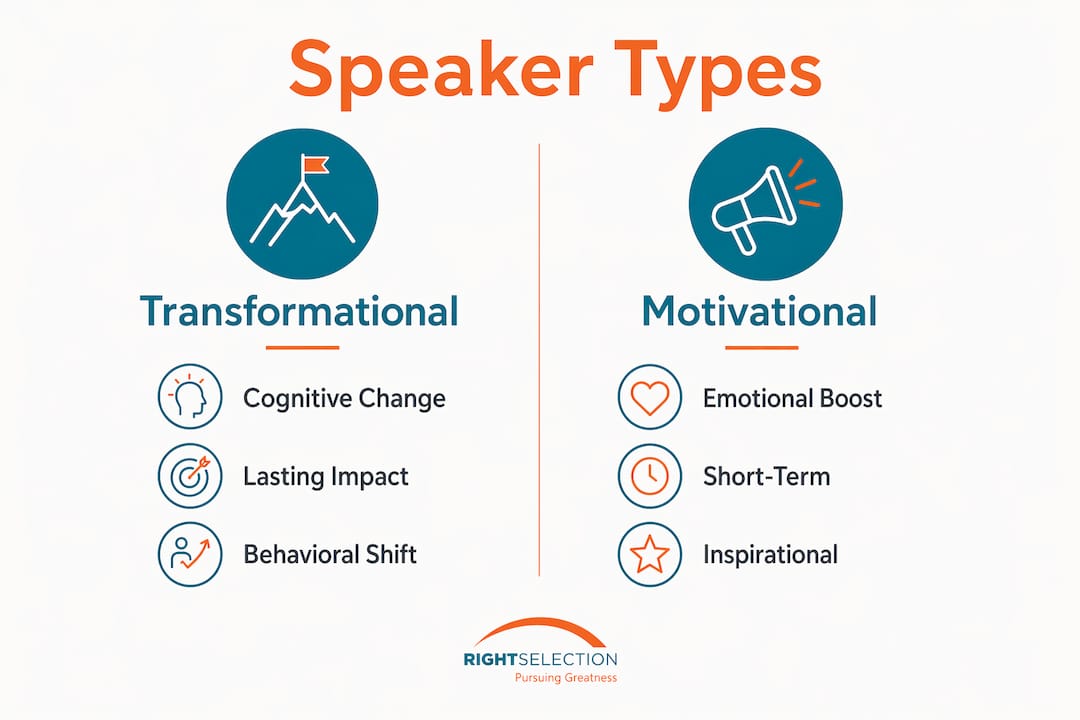
Nick Jankel, a leadership development expert, argues that leaders must move beyond motivational models entirely. The motivational approach treats inspiration as the end goal. The transformational approach treats inspiration as the starting condition for structured change. Josh Linkner, entrepreneur and innovation speaker, reinforces this by noting that the audience’s feeling and subsequent actions after a keynote are the true measures of speaker value, more than fame or credentials.
Here is what separates transformational leadership event speakers from their motivational counterparts:
- Audience diagnosis first. Transformational speakers invest time before the event understanding the specific challenges, language, and culture of the audience. Motivational speakers typically deliver the same talk with minor adjustments.
- Frameworks over stories. Transformational keynotes leave participants with a repeatable model they can apply on Monday morning. Motivational keynotes leave participants with memorable anecdotes.
- Behavioral anchors. Transformational speakers design their sessions to create specific behavioral commitments, not just emotional peaks.
- Post-event utility. The content of a transformational keynote integrates with follow-up workshops and coaching. Motivational content rarely connects to what comes next.
“The keynote is not the intervention. It is the catalyst that makes every other intervention more effective.” — Nick Jankel
Pro Tip: When evaluating speakers, ask for references from organizations in your industry and ask those references one question: What did your people do differently three months after the keynote?
How do you select and integrate keynote speakers into leadership programs?
Speaker selection done well works backward from desired outcomes. You start with the behavioral change you need and then identify which speaker’s methodology, experience, and communication style is most likely to produce it. Selecting speakers based on their ability to create tailored, transformative experiences aligned with audience challenges consistently yields better leadership outcomes than selecting based on name recognition alone.
A common selection mistake is booking based on celebrity rather than on how audiences feel and act after the keynote. A Fortune 500 executive with a famous name may generate pre-event excitement but deliver generic content that fails to connect with your team’s specific leadership challenges. A less prominent speaker with deep expertise in your industry’s leadership context will almost always produce stronger results.
The integration framework below compares selection criteria and integration methods by their relative impact on program ROI:
| Selection Criterion | Integration Method | Impact Level |
|---|---|---|
| Audience challenge alignment | Pre-event briefing and content customization | High |
| Behavioral outcome clarity | Post-keynote facilitated workshops | High |
| Framework applicability | Embedding models into coaching sessions | High |
| Speaker’s industry experience | Peer discussion groups post-event | Medium |
| Speaker’s delivery style | Manager reinforcement conversations | Medium |
| Speaker’s public profile | Event-only exposure with no follow-up | Low |
Pre-event briefing is the most underused tool in leadership program design. A thorough briefing gives the speaker access to your organization’s current challenges, strategic priorities, and team dynamics. Speakers like Marshall Goldsmith and Arthur Carmazzi are known for this level of preparation, and it shows in the specificity and relevance of their sessions.
Sustained impact requires integrating keynote insights with facilitated workshops and continued leadership program elements. Plan the follow-through activities before you book the speaker, not after. The keynote should be the opening chapter of a learning arc, not a self-contained event.
Pro Tip: Schedule a 60-minute debrief workshop within 48 hours of the keynote while the content is still fresh. Use that session to convert keynote concepts into team-specific commitments and action plans.
How can leadership programs sustain the impact of keynote speakers?
The most common failure in leadership development is treating the keynote as the program rather than as the program’s catalyst. Treating a keynote as a standalone event limits its impact significantly. The organizations that achieve lasting change use the keynote to establish a shared language and then build every subsequent learning activity around that language.
Practical frameworks give that shared language operational structure. The FLEX model, the PBED (Plan, Brief, Execute, Debrief) cycle used by organizations like Afterburner, and the ORCA framework each provide teams with repeatable processes for applying keynote concepts to real leadership decisions. These frameworks drive sustainable behavior change by closing the gap between strategic inspiration and daily execution.
Peer coaching is the distribution mechanism that makes these frameworks stick. High-impact learning distributed horizontally through peer coaching reaches more leaders more consistently than vertical cohort programs alone. When a keynote speaker introduces a concept and peers then coach each other on applying it, the compound effect on organizational capability is measurably stronger.
Here is a step-by-step reinforcement sequence that organizations can implement after any leadership keynote:
- Within 24 hours: Send a structured reflection prompt to all participants asking them to identify one insight and one specific behavior they will change.
- Within 48 hours: Run a facilitated debrief workshop to convert individual reflections into team commitments.
- Week two: Introduce the keynote’s core framework into an existing team meeting format so it becomes part of regular operations.
- Week four: Conduct peer coaching pairs where participants share progress on their behavioral commitments.
- Week eight: Hold a manager-led review session to assess which behaviors have changed and which need additional support.
- Week twelve: Measure outcomes against the behavioral goals defined before the keynote and report results to program sponsors.
Embedding a shared language and practical behavioral models from keynotes into daily leadership operations is what separates programs that produce lasting change from those that produce temporary enthusiasm. The keynote opens the door. The reinforcement sequence is what walks the organization through it.
Key takeaways
Keynote speakers in leadership programs deliver measurable ROI only when selected for audience alignment and integrated into a structured reinforcement sequence, not treated as standalone events.
| Point | Details |
|---|---|
| Strategic selection matters most | Choose speakers based on behavioral outcomes, not celebrity or credentials. |
| ROI is real and measurable | 87% of organizations report returns up to 5x the speaker fee with strategic integration. |
| Transformational beats motivational | Speakers who create frameworks and behavioral anchors outperform those who only inspire. |
| Reinforcement drives lasting change | A structured six-step post-keynote sequence converts inspiration into sustained behavior change. |
| Peer coaching amplifies reach | Distributing keynote concepts through peer coaching extends impact across the full organization. |
What i have learned about keynote speakers and real leadership change
After years of working with organizations to curate and deploy keynote speakers across leadership programs, the pattern is consistent. The programs that produce genuine, lasting change are the ones where the HR leader or CLO treated the keynote as the beginning of a conversation, not the conclusion of one.
The shift from motivational to transformational keynotes is not just a trend. It reflects a more mature understanding of how adults change behavior. Inspiration is necessary but not sufficient. People need a framework they can use, a language they can share with colleagues, and a structure that holds them accountable. The best leadership event speakers I have seen deliver all three.
The mistake I see most often is prioritizing speaker fame over audience fit. A globally recognized name generates excitement in the planning phase, but if the content does not connect to the specific leadership challenges your team faces, the energy dissipates within days. The speakers who produce the strongest outcomes are those who invest in understanding your organization before they step on stage.
My advice to any corporate leader or HR professional designing a leadership program: view the keynote as one element in a larger development ecosystem. Pair it with coaching, peer learning, and structured reinforcement. Measure outcomes at 30, 60, and 90 days. When you do that, the keynote’s value compounds over time rather than fading after the event.
— Dipti
Find the right keynote speaker for your leadership program
Right Selection has spent over 30 years curating an elite roster of 100+ global thought leaders, coaches, and corporate trainers for exactly this purpose. Speakers like May Sayed Ali, Muneer Al Busaidi, and Ramez Helou are known for delivering transformational keynotes that connect inspiration to practical leadership execution. Each engagement is designed around your specific business goals and audience needs, not a generic template.
Right Selection does not just book speakers. The team works with you to design the full session arc, from pre-event briefing through post-keynote reinforcement, so your program achieves the measurable outcomes your organization needs. Explore the full Right Selection speaker roster and find the right fit for your next leadership program.
FAQ
What is the role of keynote speakers in leadership programs?
Keynote speakers serve as strategic anchors in leadership programs, establishing shared language, psychological safety, and a common framework that makes all subsequent training more effective. Their primary function is to initiate the mindset shifts that structured learning activities then reinforce.
How do you measure the ROI of a leadership keynote speaker?
87% of organizations report returns up to five times the speaker’s fee when keynotes are integrated into program strategy. Measure ROI by tracking behavioral changes at 30, 60, and 90 days post-event against the outcomes defined before the speaker was selected.
What makes a keynote speaker transformational vs. motivational?
Transformational keynote speakers create cognitive, emotional, and behavioral conditions for lasting change by delivering repeatable frameworks and behavioral anchors. Motivational speakers generate enthusiasm but rarely produce the structured behavior change that leadership programs require.
How soon after a keynote should follow-up activities begin?
Follow-up should begin within 24–48 hours of the keynote while content is fresh. A structured debrief workshop within 48 hours converts individual insights into team commitments and significantly increases the likelihood of sustained behavior change.
How do you choose the right keynote speaker for a leadership event?
Start with the specific behavioral outcomes you need and select speakers whose methodology aligns with those outcomes. Audience challenge alignment and content customization produce higher ROI than speaker fame or credentials alone.