
Continuous learning is defined as the ongoing, deliberate process of acquiring new skills, knowledge, and perspectives to remain effective in a changing environment. For leaders, it is not optional. The half-life of professional skills is shrinking rapidly, and leaders who stop learning fall behind in ways that compound over time. Why leaders need continuous learning comes down to one core truth: the business environment changes faster than any fixed skill set can keep pace with. Leadership experts now identify “learnability,” the ability to learn, unlearn, and relearn quickly, as the single most critical leadership skill in volatile markets.
Why leaders need continuous learning: the core case
Continuous learning, known in leadership development circles as lifelong learning or continuous professional development, is the structured habit of growing beyond your current knowledge base. It covers everything from formal executive education to peer coaching, reflective journaling, and deliberate exposure to unfamiliar ideas. The distinction matters because many leaders confuse attending a one-day workshop with genuine development. Real continuous learning changes behavior, not just awareness.
The consequences of stopping are measurable. Organizations relying on legacy leadership playbooks show clear performance deficits compared to those that build continuous learning loops into their culture. That gap widens every year as technology, workforce expectations, and competitive dynamics shift. Leaders who treat their existing knowledge as sufficient are, in effect, accumulating what researchers call “learning debt.” Learning debt accumulates when development is deferred, creating compounded performance deficits and invisibly outdated practices. The longer the debt goes unpaid, the harder it is to close.
What specific leadership skills does continuous learning improve?
Continuous learning sharpens the skills that separate good managers from great leaders. The benefits are not abstract. They show up in how leaders communicate, decide, and connect with their teams.
- Communication. Leaders who seek ongoing feedback and reflect on their interactions become clearer, more persuasive communicators. They learn to adjust their message for different audiences rather than defaulting to one style.
- Decision-making and problem-solving. Exposure to new frameworks, case studies, and cross-industry thinking gives leaders more mental models to draw from. Better mental models produce faster, more accurate decisions under pressure.
- Emotional intelligence. Leaders who develop empathy and resilience gain a competitive advantage in AI-driven environments. Human-centric traits motivate teams in ways that automated systems cannot replicate.
- AI fluency. Understanding how artificial intelligence tools work, and where they fall short, is now a baseline leadership competency. Leaders who lack this understanding cannot redesign workflows effectively or evaluate AI-generated outputs with discernment.
- Adaptability. Continuous learners build the mental flexibility to pivot when conditions change, rather than defending outdated approaches out of habit.
Reflection-based practices such as journaling and weekly reviews convert daily experience into genuine learning. They also build emotional intelligence and sharpen decision-making over time. These practices take less than 20 minutes a day and produce compounding returns across a leadership career.
Pro Tip: Schedule a 15-minute weekly review every Friday. Write down one decision you made, what you assumed, and what you would do differently. This single habit accelerates learning faster than most formal training programs.
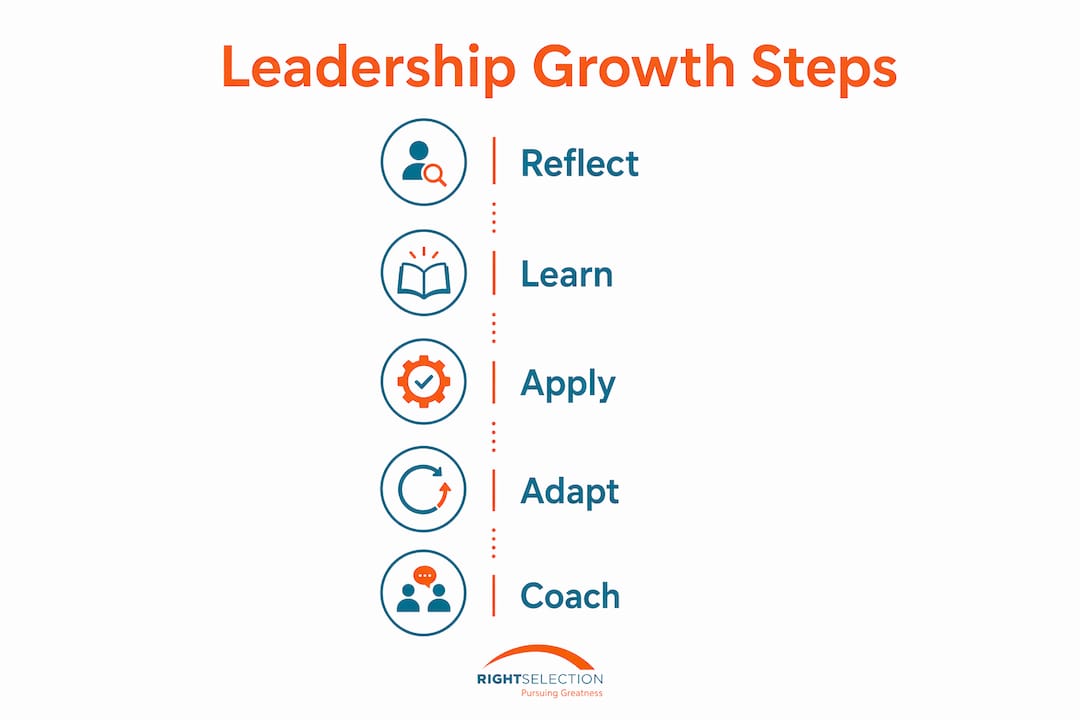
How does continuous learning help leaders adapt to change?
The pace of technological and organizational change has made adaptability a survival skill, not a leadership bonus. Leaders who do not actively update their knowledge base become obsolete without realizing it.
- Recognize the shrinking skill half-life. Technical skills that were current three years ago may already be outdated. Leaders must audit their knowledge regularly, not just when a crisis forces the issue.
- Address learning debt before it compounds. Deferred development does not stay neutral. It accumulates into a gap between what a leader knows and what the role demands. Closing that gap gets harder the longer it is ignored.
- Manage the shift to skill-based workforce models. Many organizations are moving away from job-based structures toward skill-based architectures. Leaders who understand this shift can build teams and assign work more effectively.
- Develop AI fluency to avoid workslop. Without deep understanding of tools like AI, leaders risk poor implementation that produces low-quality outputs, burnout, and talent erosion. Misapplication is as damaging as non-adoption.
- Practice unlearning as a deliberate skill. Unlearning requires leaders to actively discard behaviors that were once rewarded. This is harder than learning new skills because it confronts existing identity and past success.
“The ability to learn, unlearn, and relearn is more valuable than mastery of current knowledge in volatile environments. Leaders who cling to what made them successful yesterday become the biggest obstacle to what their organizations need tomorrow.”
The leaders who adapt most effectively are not those with the most experience. They are the ones most willing to question whether their experience still applies. That mindset is a product of consistent, deliberate learning practice, not seniority.
Why fostering a learning culture drives organizational growth

Leaders who commit to their own development create a visible signal that learning is valued. That signal shapes organizational culture more powerfully than any policy document.
Talent retention is directly connected to learning culture. Professionals, particularly high performers, leave organizations where growth stalls. When leaders model curiosity and invest in their own development, they attract and retain people who share those values. The inverse is equally true. Leaders who project certainty and discourage questions create environments where talented people feel underutilized and eventually leave.
Psychological safety is the foundation of a learning culture. Leaders build it by admitting what they do not know, asking questions in meetings, and treating mistakes as data rather than failures. These behaviors cost nothing and produce outsized returns in team engagement and creative output.
| Approach | Traditional leadership training | Continuous development |
|---|---|---|
| Format | Isolated workshops or annual programs | Embedded in daily work and routines |
| Feedback | Delayed or absent | Ongoing and specific |
| Behavior change | Rare without follow-through | Built through coaching and practice |
| Organizational impact | Hard to measure | Tied to business outcomes |
| Leader engagement | Passive reception | Active participation and reflection |
Leadership development connected to business needs with ongoing coaching, practice, and feedback produces lasting capability improvements. Isolated training does not. The table above shows why the format of development matters as much as the content.
The systemic challenge is real. Less than 1% of public budgets in many high-income countries is allocated to adult learning. That funding gap means organizations cannot rely on external systems to develop their leaders. The responsibility falls on leaders themselves and on the organizations that understand the return on investment.
Pro Tip: Replace one standing meeting per month with a team learning session. Invite a speaker, discuss a book chapter, or debrief a recent project for lessons learned. This embeds learning into the rhythm of work without adding to anyone’s schedule.
Practical strategies for building a personal learning routine
Busy leaders do not lack motivation to learn. They lack a system. Without structure, learning gets displaced by urgent tasks every time.
- Build a personal learning stack. A deliberate, diversified learning ecosystem outperforms reliance on chance or generic training. Combine coaching, peer learning, curated reading, and structured reflection into a weekly routine. Treat it as a non-negotiable commitment, the same way you treat a board meeting.
- Use microlearning for time efficiency. Fifteen-minute focused learning sessions, applied consistently, produce more behavioral change than a two-day offsite attended once a year. Frequency matters more than duration.
- Set learning goals tied to business challenges. Vague goals like “read more” produce vague results. Specific goals like “understand how large language models affect our customer service workflow by the end of Q2” create focus and accountability.
- Seek out thought leadership beyond your industry. The most useful insights often come from adjacent fields. A manufacturing leader who studies behavioral economics, or a finance executive who reads about organizational psychology, develops mental models that peers inside their industry simply do not have. Exploring thought leadership across disciplines builds the kind of perspective that shapes decisions over time.
- Avoid performative learning. Attending conferences, collecting certificates, and listing courses on a profile is not the same as developing capability. The measure of learning is behavioral change, not participation. Ask yourself after every learning experience: what will I do differently on Monday?
The compound effect of consistent learning is significant. Leaders who invest 30 minutes per day in deliberate development accumulate hundreds of hours of growth per year. That growth shows up in sharper thinking, better decisions, and stronger teams. For guidance on choosing programs that produce this kind of impact, the executive leadership development program selection process is worth understanding before committing to any format.
Key Takeaways
Continuous learning is the defining leadership competency of 2026, and leaders who build deliberate learning systems outperform those who rely on experience alone.
| Point | Details |
|---|---|
| Learnability is the top skill | The ability to learn, unlearn, and relearn matters more than mastery of current knowledge. |
| Learning debt is a real risk | Deferred development compounds into performance gaps that become harder to close over time. |
| Culture starts with the leader | Leaders who model learning create environments where talent stays and grows. |
| Isolated training does not work | Development connected to business needs, coaching, and feedback produces lasting change. |
| Systems beat motivation | A personal learning stack with diverse, consistent inputs outperforms sporadic effort. |
What I have learned about leaders who stop growing
I have worked with hundreds of leaders across industries, and the pattern is consistent. The ones who plateau are rarely the least talented. They are the ones who stopped being curious. They reached a level of seniority where their knowledge was rarely challenged, and they mistook that comfort for competence.
The uncomfortable truth about leadership development is that unlearning is harder than learning. A leader who built a career on a particular style of decision-making or communication does not easily set that aside, even when the evidence suggests it is no longer working. The identity investment is too high. That is why the most important shift is not acquiring new skills. It is developing the willingness to question whether your current skills are still the right ones.
What I find most encouraging is that the leaders who commit to executive coaching practices and structured reflection consistently report that the process feels uncomfortable at first and indispensable within months. Discomfort is not a sign that learning is going wrong. It is a sign that it is working. Normalize that discomfort, and you normalize growth.
The measure of a learning culture is not how many programs an organization offers. It is whether leaders ask questions in public, admit uncertainty without losing credibility, and treat every setback as a source of data. That behavior is contagious. When leaders live it, teams follow.
— Dipti
Right Selection and your leadership development goals
Building a continuous learning practice requires the right expertise, not just good intentions. Right Selection connects corporate leaders and organizations with a curated network of over 100 global thought leaders, coaches, and trainers who specialize in exactly this kind of development.
Speakers like Mark C. Thompson and Brian Tracy bring decades of experience helping leaders build the skills, mindset, and habits that produce measurable organizational results. Right Selection’s approach goes beyond booking a speaker. Every session is designed around your specific business goals and audience needs, so the learning connects directly to the challenges your leaders face. With over 30 years of experience, Right Selection delivers development that changes behavior, not just awareness. Explore leadership training best practices to understand what effective, outcome-driven development looks like in practice.
FAQ
Why is continuous learning important for leaders?
Continuous learning keeps leaders effective as skills, technologies, and workforce models evolve. Leaders who stop learning accumulate a “learning debt” that compounds into measurable performance gaps over time.
What is learnability and why does it matter in leadership?
Learnability is the ability to learn, unlearn, and relearn quickly. Leadership experts identify it as the most critical skill in volatile markets because it enables leaders to adapt rather than defend outdated approaches.
How does continuous learning improve team performance?
Leaders who model learning create psychological safety and a culture where teams feel encouraged to grow. That culture directly improves engagement, retention, and the quality of collective decision-making.
How can busy leaders find time for continuous learning?
A personal learning stack built around microlearning, weekly reflection, and curated inputs requires as little as 30 minutes per day. Consistency and intentionality matter more than the volume of time invested.
What is the difference between training and continuous development?
Training is a one-time or periodic event. Continuous development is an ongoing process connected to real business challenges, supported by coaching, feedback, and deliberate practice that produces lasting behavioral change.