

Leadership pipeline programs are structured talent development frameworks designed to prepare emerging leaders to step into critical roles before vacancies occur. Organizations that treat leadership continuity as a planned process rather than a reactive scramble consistently outperform those that do not. Understanding why leadership pipeline programs matter is the first step toward building the kind of internal capacity that sustains growth through market shifts, leadership transitions, and organizational change. The evidence is clear: 63% of CEOs are promoted internally, which means the quality of your internal development pipeline directly determines the quality of your future leadership.
Why leadership pipeline programs matter for organizational performance
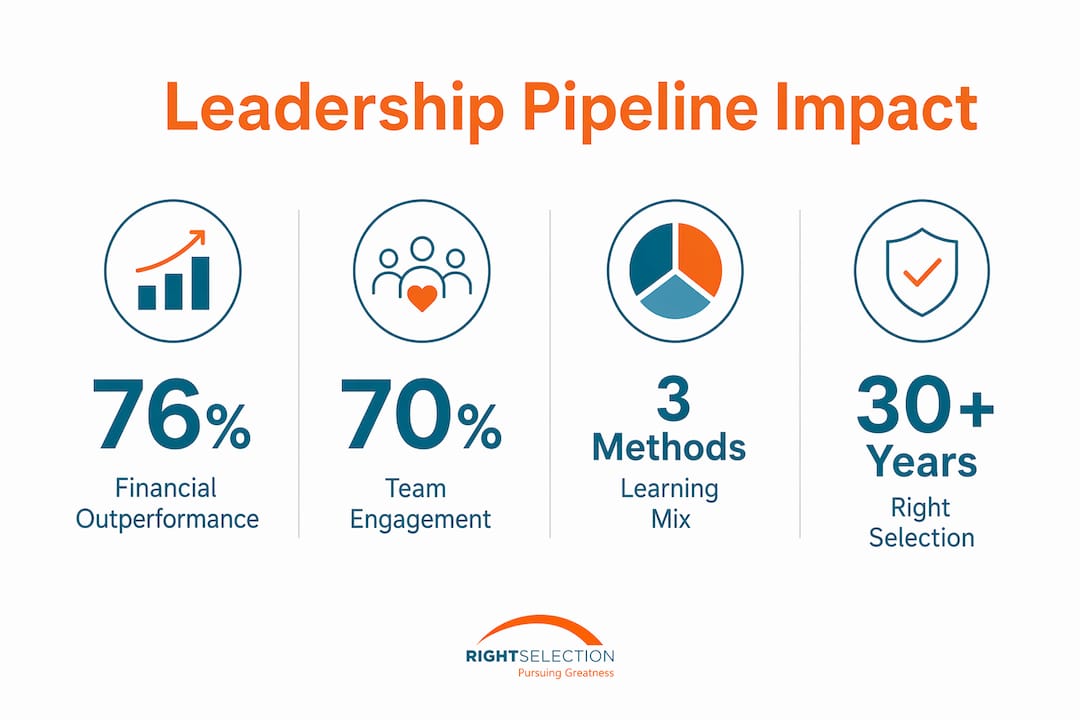
Companies with confident CEO succession and pipeline planning are 76% more likely to outperform their peers financially, compared to just 33% of companies without such strategies. That gap is not a coincidence. It reflects the compound effect of having leaders who are prepared, aligned with company values, and ready to perform from day one.
The impact of leadership programs extends well beyond the executive suite. Managers influence about 70% of the variance in employee engagement across their teams. That statistic means your middle management layer is the single greatest driver of whether your workforce stays committed or quietly disengages. Organizations that invest in developing those managers through structured programs have seen turnover drop by 29 percentage points over three years. Reduced turnover at that scale translates directly to lower recruitment costs and preserved institutional knowledge.
Program design also determines how much leadership capability actually transfers to the job. Multi-component programs combining workshops, mentoring, and feedback deliver an effect size of 0.68 on leadership competency improvement, compared to 0.39 for single-method programs. The difference is not marginal. It means organizations that rely on a single annual training event are leaving significant development potential unrealized.

Pro Tip: When evaluating your current program, ask whether it combines at least three learning methods: formal instruction, peer mentoring, and structured feedback. If it relies on only one, the research suggests you are getting roughly half the development impact you could.
The financial case for leadership development is equally concrete. A healthcare organization linked its leadership competency program to 35 capstone projects that generated $54 million in measurable financial return. That outcome demonstrates what becomes possible when leadership development connects directly to real business problems rather than generic skill-building exercises.
What challenges do leadership pipeline programs solve?
The most common failure mode in succession planning is not a lack of talent. It is a lack of preparation. Organizations that rely on reactive external hiring when senior roles open face longer time-to-productivity, higher compensation costs, and cultural integration risk. A structured pipeline eliminates that reactive cycle by building a bench of ready leaders continuously.
Leadership readiness gaps create a specific kind of organizational risk. When a high-performing individual contributor gets promoted into a management role without adequate preparation, the result is often role mismatch: the organization loses a strong contributor and gains a struggling manager. Pipeline programs address this by building leadership competencies before the promotion, not after.
Retention suffers when employees see no clear path to growth. Talented professionals leave organizations not only for higher pay but for better development opportunities. A visible, well-communicated pipeline signals that the organization is committed to growing its people, which directly influences whether high-potential employees stay or leave.
Leadership pipeline programs fail when treated as isolated procurement exercises rather than continuous enterprise initiatives. Many organizations fund a leadership program once, declare success after the first cohort, and then let the pipeline go dormant. That approach produces a one-time output, not a durable capability.
One of the most persistent blind spots is concentrating development resources at the top tier only. Mid-level managers drive 70% of team engagement, yet they are frequently the most underdeveloped layer in the organization. Effective pipelines treat frontline and mid-level managers as the foundation of leadership capacity, not an afterthought.
Pro Tip: Audit your current development spend by organizational level. If more than 60% of your budget targets senior leaders, you likely have a pipeline gap at the manager level where engagement impact is highest.
How do you design an effective leadership pipeline program?
The single strongest predictor of leadership development success is a thorough needs analysis conducted before program design begins. Organizations collectively spend $60 billion annually on leadership development, yet many programs fail because they skip this step and default to generic off-the-shelf content. A needs analysis identifies the specific competency gaps, role transitions, and business challenges the program must address.
Effective program design follows a clear sequence:
- Conduct a needs analysis tied to specific role transitions and business outcomes, not general leadership themes.
- Map the pipeline by level, identifying the competencies required at each stage from individual contributor to senior leader.
- Combine learning methods, integrating workshops, executive coaching, mentoring, cross-functional projects, and structured feedback.
- Align with succession planning, so every development activity connects to a specific future role or readiness milestone.
- Track readiness continuously, using data to identify who is ready now, who needs 12 months, and who needs a different path.
- Evaluate beyond satisfaction scores, measuring behavioral change and business impact using a multi-level framework.
Measuring leadership program success using multi-level frameworks like Kirkpatrick’s model better captures impact on behavior and performance than satisfaction surveys alone, enabling evidence-based program refinements.
Alignment with business strategy is not optional. A program that develops leadership skills in isolation from the organization’s actual direction produces leaders who are capable in the abstract but misaligned in practice. Right Selection’s approach to aligning leadership training with business strategy reflects this principle: every development initiative should trace directly back to a specific organizational goal.
Pro Tip: Build a “readiness dashboard” that tracks each high-potential leader’s progress against defined milestones. Update it quarterly. This turns succession planning from a once-a-year board conversation into a living, operational process.
The types of leadership development programs available range from cohort-based academies to one-on-one executive coaching to action learning sets. The right combination depends on your organization’s size, culture, and the specific transitions you are preparing leaders for. No single format works universally.
How do leadership pipelines build long-term organizational resilience?
Leadership pipelines create resilience by ensuring the organization is never dependent on a single leader or a single external hiring cycle. When a senior leader departs unexpectedly, a functioning pipeline means the organization has identified successors, assessed their readiness, and begun their preparation. The transition becomes a managed process rather than a crisis.
Strong leadership pipelines are particularly valuable for small and mid-sized enterprises, where the loss of one key leader can disproportionately disrupt operations. Internal succession preserves institutional knowledge, client relationships, and cultural continuity in ways that external hires rarely replicate quickly.
The compound effect of pipeline development shows up over time in several measurable ways:
- Culture continuity: Leaders developed internally carry the organization’s values forward, reducing the cultural drift that often follows external executive hires.
- Knowledge transfer: Mentoring relationships within the pipeline pass tacit knowledge from experienced leaders to emerging ones, preserving what cannot be documented.
- Engagement multiplier: Leaders who were developed internally tend to invest more deliberately in developing their own teams, creating a self-reinforcing cycle.
- Change readiness: Organizations with deep pipelines adapt faster to restructuring, acquisitions, and growth because they have leaders prepared for expanded scope.
The technology and leadership intersection adds another dimension to pipeline resilience. As AI and governance complexity reshape leadership demands, organizations with continuous development programs adapt their leadership competency models faster than those running periodic programs.
Kirkpatrick’s four-level evaluation model provides the framework for measuring whether pipeline investments are producing real organizational outcomes. Level 1 measures participant reaction. Level 2 measures learning. Level 3 measures behavioral change on the job. Level 4 measures business results. Most organizations stop at Level 1 or 2. The organizations that reach Level 4 are the ones that can demonstrate, as the healthcare example showed, a direct financial return on leadership development investment.
Key Takeaways
Leadership pipeline programs are the most reliable mechanism organizations have for ensuring that leadership capacity grows in step with business ambition.
| Point | Details |
|---|---|
| Pipeline programs drive financial outperformance | Companies with strong succession planning are 76% more likely to outperform peers financially. |
| Mid-level managers are the highest-leverage tier | Managers drive 70% of engagement variance; developing them produces the greatest organizational return. |
| Multi-method programs outperform single-method | Combining workshops, mentoring, and feedback delivers nearly double the competency improvement effect size. |
| Needs analysis predicts program success | Skipping needs analysis is the leading reason leadership development programs fail despite large budgets. |
| Evaluation must reach business outcomes | Using Kirkpatrick’s model to measure behavioral change and financial impact separates effective programs from expensive ones. |
What I have learned about building pipelines that actually work
After years of working with organizations across industries, the pattern I see most often is this: companies invest in leadership development when a crisis forces them to, then scale back once the immediate pressure eases. That cycle produces leaders who are perpetually underprepared for the next challenge.
The organizations that get this right treat pipeline development the way they treat financial planning. It is continuous, data-informed, and connected to specific business outcomes. They do not run a leadership program. They build a leadership system.
The most common mistake I see from HR leaders is promoting high-potential employees too quickly because the pipeline looks thin. Thinness in the pipeline is a symptom of underinvestment at the mid-level, not a reason to accelerate promotions. Rushing someone into a role they are not ready for damages both the individual and the team they lead.
What actually works is patience combined with deliberate development. Identify your mid-level managers early. Give them cross-functional exposure, structured mentoring, and honest feedback. Measure their readiness against specific role criteria, not general impressions. And when you evaluate the program, go beyond satisfaction scores. Ask whether leadership behavior has changed and whether that change has produced measurable team or business outcomes.
The executive coaching best practices that work in isolation work even better when embedded in a broader pipeline structure. Coaching without a pipeline context produces individual growth. Coaching within a pipeline produces organizational readiness.
— Dipti
How Right Selection helps you build a leadership pipeline
Right Selection has spent over 30 years connecting organizations with the world’s leading thinkers on leadership, talent development, and organizational performance.

When you are ready to move from a generic training calendar to a pipeline that produces measurable leadership readiness, Right Selection’s network of 100+ global speakers, coaches, and corporate trainers gives you the depth to design programs that work at every level of your organization. Speakers like Liz Wiseman bring research-backed frameworks on scaling leadership capacity, while Mark C. Thompson delivers practical insight on strategic leadership and organizational growth. Every engagement is curated to align with your specific business goals, not a standard catalog. Visit Right Selection to explore how tailored leadership development can build the pipeline your organization needs.
FAQ
Why do leadership pipeline programs matter for business performance?
Companies with strong pipeline and succession planning are 76% more likely to outperform their peers financially. A prepared internal bench reduces transition costs and sustains performance through leadership changes.
What is the difference between succession planning and a leadership pipeline?
Succession planning identifies who will fill specific roles. A leadership pipeline is the broader development system that prepares multiple leaders across levels so that succession candidates are ready when needed.
How do you measure the success of a leadership pipeline program?
Kirkpatrick’s four-level model measures reaction, learning, behavioral change, and business results. Programs that reach Level 4 can demonstrate direct financial returns, as one healthcare program did with $54 million in outcomes.
Which leadership tier should organizations prioritize in pipeline development?
Mid-level managers are the highest-priority tier because they drive 70% of team engagement variance. Concentrating development only at the senior level leaves the largest engagement lever underdeveloped.
How often should a leadership pipeline program be updated?
Pipeline programs require continuous maintenance, not annual reviews. Readiness assessments, competency models, and development plans should be reviewed at least quarterly to reflect business changes and individual progress.