

Strategic leadership development is the process of building leaders who balance long-term organizational vision with the day-to-day execution required to achieve it. Unlike general management training, it focuses on cultivating voluntary influence, meaning the ability to move people toward shared goals without relying solely on authority. Research from LeadershipIQ shows that managers account for 70% of the variance in team engagement. That single statistic explains why organizations that treat leadership development as a core investment consistently outperform those that treat it as an occasional expense. Harvard Kennedy School, LeadershipIQ, and HR Dive all point to the same conclusion: structured, intentional development programs produce measurable gains in retention, engagement, and organizational resilience.
What is strategic leadership development vs. traditional training?
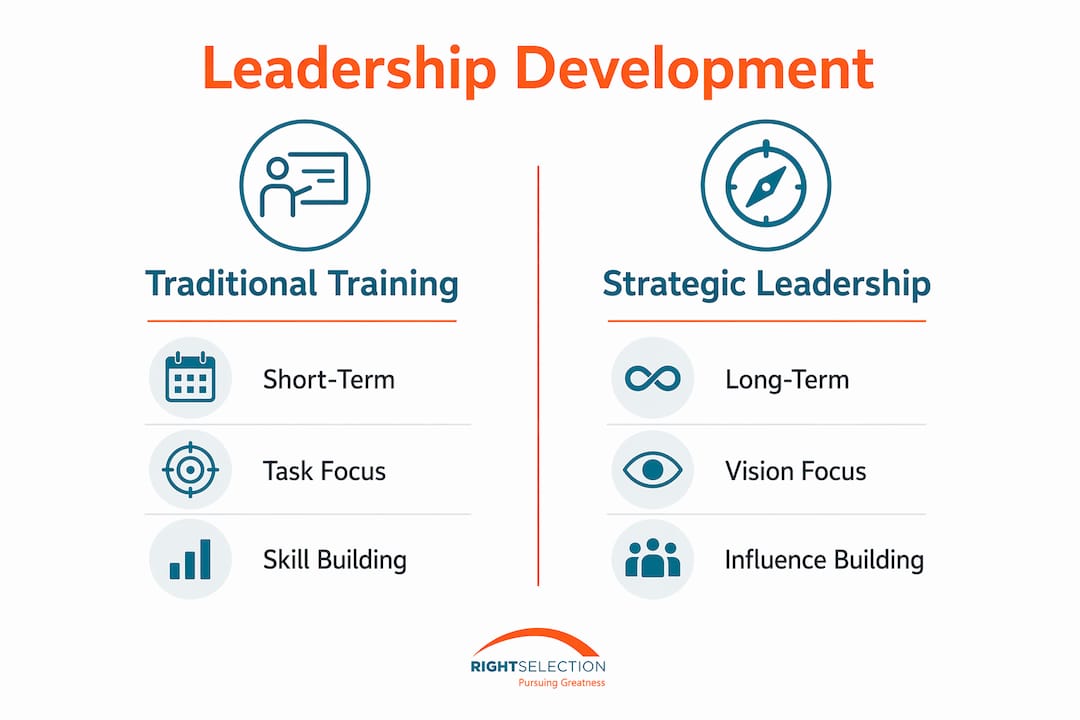
Strategic leadership development differs from traditional management training in one fundamental way: it shifts the question leaders ask. Traditional training teaches managers to ask, “How do we get this done?” Strategic leadership development teaches leaders to ask, “Should we be doing this?” That distinction separates task completion from long-term consequence thinking.

Traditional management programs focus on process efficiency, compliance, and short-term performance metrics. Strategic leadership programs focus on organizational adaptability, stakeholder alignment, and future-oriented decision-making. The scope is broader, the time horizon is longer, and the influence required is more relational than hierarchical.
Here is where the practical difference shows up most clearly:
- Tactical managers optimize existing systems. Strategic leaders question whether those systems still serve the organization’s direction.
- Traditional training is often event-based, a workshop, a seminar, a one-day offsite. Strategic leadership development is continuous and cyclical, embedded in real work rather than separated from it.
- Management training focuses on individual performance. Strategic leadership development focuses on how one leader’s behavior shapes the culture and capability of an entire organization.
- Traditional programs rarely address emotional intelligence or voluntary influence. Strategic leadership development treats both as non-negotiable competencies.
Pro Tip: Before enrolling your leadership team in any program, ask the provider one question: “How does this program change the questions our leaders ask, not just the answers they give?” If they cannot answer clearly, the program is likely management training repackaged.
The distinction matters because organizations that only develop managers eventually hit a ceiling. They become operationally proficient but strategically rigid. Strategic leadership training builds the capacity to adapt, which is the competency most organizations need most and develop least.
Which core skills and frameworks define strategic leadership?
Effective strategic leadership development builds four core capabilities: strategic vision, sound decision-making, business acumen, and emotional intelligence. These are not soft skills. They are the specific competencies that determine whether a leader can align an organization around a long-term direction while maintaining the trust required to execute it.
Harvard Kennedy School’s 4P model provides one of the most widely cited frameworks for developing these capabilities. The four components are:
- Perception: Reading data, context, and signals accurately to form grounded strategic insight.
- Process: Designing and managing decision-making systems that are transparent and repeatable.
- People: Building the relational and emotional intelligence needed to earn voluntary commitment from teams and stakeholders.
- Projection: Shaping narratives and communicating vision in ways that create alignment and momentum.
The 4P model is particularly useful because it addresses both cognitive and relational dimensions of leadership. Most programs focus heavily on the cognitive side, strategy, analysis, and planning, while underinvesting in the relational side. The leaders who struggle most in senior roles are rarely the ones who lack strategic thinking. They are the ones who cannot bring others along with them.
Pro Tip: Use the 4P model as a diagnostic before designing any leadership development program. Map each participant’s current strengths and gaps across all four dimensions. Programs that skip this step tend to deliver generic content that misses the actual development needs of the room.
The table below compares general leadership development models with strategic leadership-specific approaches to clarify what each delivers:
| Dimension | General Leadership Development | Strategic Leadership Development |
|---|---|---|
| Primary focus | Individual skills and behaviors | Organizational direction and influence |
| Time horizon | Short to medium term | Long term and future-oriented |
| Core framework | Situational leadership, DISC, Myers-Briggs | Harvard 4P model, strategic vision frameworks |
| Influence model | Positional authority | Voluntary commitment and consensus-building |
| Measurement | Behavior change, 360 feedback | Business outcomes, engagement, retention |
| Development method | Workshops and e-learning | Experiential learning embedded in real work |
How are strategic leadership programs designed for impact?
The most effective strategic leadership programs follow a diagnostic-first design process. They assess capability gaps before building content, not after. Organizations that skip the diagnostic phase tend to deliver programs that feel relevant in the room but produce little measurable change back on the job.
A well-designed program follows this sequence:
- Assess the current state. Map existing leadership capabilities against the organization’s strategic priorities. Identify where the gaps are largest and where the cost of those gaps is highest.
- Define measurable outcomes. Specify what success looks like in behavioral and business terms before the program begins. Vague goals produce vague results.
- Design for application, not just awareness. Build in structured opportunities for leaders to apply new skills in real work contexts between sessions. Awareness without application does not produce behavior change.
- Integrate with talent management systems. Connect program participation to performance reviews, succession planning, and promotion criteria. Only 1 in 3 managers currently understand how their performance reviews relate to leadership growth opportunities. That disconnect undermines program credibility.
- Build in feedback loops. Use peer coaching, 360 assessments, and manager check-ins to create accountability between formal sessions.
- Evaluate and iterate. Measure outcomes at 30, 60, and 90 days post-program. Adjust content and delivery based on what the data shows.
This approach reflects what the research consistently supports: leadership development is most effective when it is continuous, cyclical, and embedded in the flow of real work rather than delivered as a standalone event. One-time workshops create awareness. Sustained programs create capability.
Cost is a real consideration. Specialized strategic leadership modules at institutions like TIAS Business School can reach approximately $7,800 per participant per module. That investment is justifiable when programs are designed with clear ROI metrics. It becomes difficult to defend when programs lack measurable outcomes, which is precisely why leadership development must demonstrate business impact to sustain funding during financial pressure.
What business outcomes does strategic leadership development produce?
The business case for strategic leadership development is well-supported by data. Organizations that implement structured programs see measurable gains across engagement, retention, and performance.
“Employees perform better when they understand how their daily work connects to broader organizational goals. Strategic leaders create that connection consistently.” — HR Dive
The numbers behind this are significant. High-differentiation leaders boost engagement by 35% compared to average leaders. Given that managers account for 70% of engagement variance, the quality of leadership is the single largest controllable driver of team performance. No compensation package, benefits program, or culture initiative comes close to matching that impact.
Retention data is equally compelling. Organizations with structured leadership development programs saw a 29 percentage point decrease in employee turnover over three years. In practical terms, that means fewer recruiting costs, less institutional knowledge walking out the door, and stronger team continuity.
The benefits extend beyond individual teams:
- Organizational adaptability increases when leaders are developed to think beyond their immediate function and consider cross-functional consequences.
- Culture alignment improves when senior leaders model the behaviors the organization claims to value, not just the behaviors that get short-term results.
- Decision quality rises when leaders are trained to weigh long-term consequences alongside immediate pressures.
- Succession depth strengthens when leadership development is embedded in talent pipelines rather than reserved for the C-suite.
The risk of underinvesting is equally clear. Organizations that treat leadership development as discretionary spending tend to lose their best people to organizations that do not. The importance of leadership development is not a philosophical argument. It is a retention and performance argument backed by consistent evidence.
Key takeaways
Strategic leadership development produces measurable business outcomes only when it is designed as a continuous, diagnostic-driven process rather than a series of isolated training events.
| Point | Details |
|---|---|
| Definition clarity | Strategic leadership development builds voluntary influence and long-term vision alongside execution capability. |
| Core framework | Harvard Kennedy School’s 4P model covers perception, process, people, and projection as the foundation. |
| Program design | Start with a capability gap assessment before building any program content or selecting delivery formats. |
| Engagement impact | Leaders who excel at performance differentiation drive 35% higher team engagement than average leaders. |
| Retention ROI | Structured programs have reduced employee turnover by 29 percentage points over three years in documented cases. |
Why strategic leadership development deserves more rigor than it gets
I have spent years working alongside organizations that invest in leadership development and still wonder why the needle does not move. The pattern is almost always the same. The program was well-intentioned, the speakers were credible, and the content was sound. But the design was built around what was convenient to deliver rather than what the organization actually needed.
The most common mistake I see is treating strategic leadership development as a content problem when it is actually a system problem. You cannot send leaders to a two-day program and expect them to return as strategic thinkers if the culture, the performance reviews, and the daily incentives all reward tactical execution. The program and the environment have to reinforce each other.
The second mistake is underestimating the relational dimension. Strategic leaders influence people who do not have to follow them. That requires emotional intelligence, credibility, and consistency over time. These are not traits you develop in a workshop. They develop through deliberate practice, honest feedback, and the kind of executive coaching that challenges leaders to examine their own blind spots.
The organizations I have seen get this right share one habit: they demand measurable outcomes from every program before it begins. They define what success looks like in behavioral and business terms, and they hold providers accountable for delivering it. That level of discernment separates leadership development that compounds over time from leadership development that simply fills a calendar.
— Dipti
Build your strategic leadership capability with right selection
Right Selection has spent over 30 years curating an elite network of global thought leaders, coaches, and corporate trainers who specialize in exactly this kind of development. Every program is designed around your organization’s specific goals, not a generic curriculum.
For organizations ready to build genuine strategic leadership capability, Right Selection connects you with proven experts like Mark C. Thompson and Brian Tracy, both of whom bring decades of experience in leadership development, strategic thinking, and organizational transformation. Whether you need a modular executive program, a keynote to anchor a leadership offsite, or a sustained coaching engagement, Right Selection designs the experience around your outcomes. Explore the full speaker roster to find the right fit for your next leadership initiative.
FAQ
What is strategic leadership development in simple terms?
Strategic leadership development is the process of building leaders who can set long-term direction, influence others voluntarily, and align daily decisions with organizational goals. It goes beyond task management to develop judgment, vision, and relational intelligence.
How does strategic leadership differ from management?
Strategic leaders ask whether an action aligns with long-term organizational goals, while managers focus on how to execute existing tasks. The distinction is one of scope, time horizon, and the type of influence each role requires.
What are the key skills for strategic leaders?
The core skills are strategic vision, sound decision-making, business acumen, and emotional intelligence. Harvard Kennedy School’s 4P model organizes these into perception, process, people, and projection as a practical development framework.
How long does a strategic leadership development program take?
Effective programs are continuous rather than time-bound, typically spanning six to twelve months and integrating experiential learning with formal sessions. One-time workshops build awareness but rarely produce lasting behavior change.
What ROI can organizations expect from leadership development?
Organizations with structured programs have documented a 29 percentage point reduction in employee turnover over three years. Teams led by high-performing strategic leaders show 35% higher engagement than those led by average managers.