

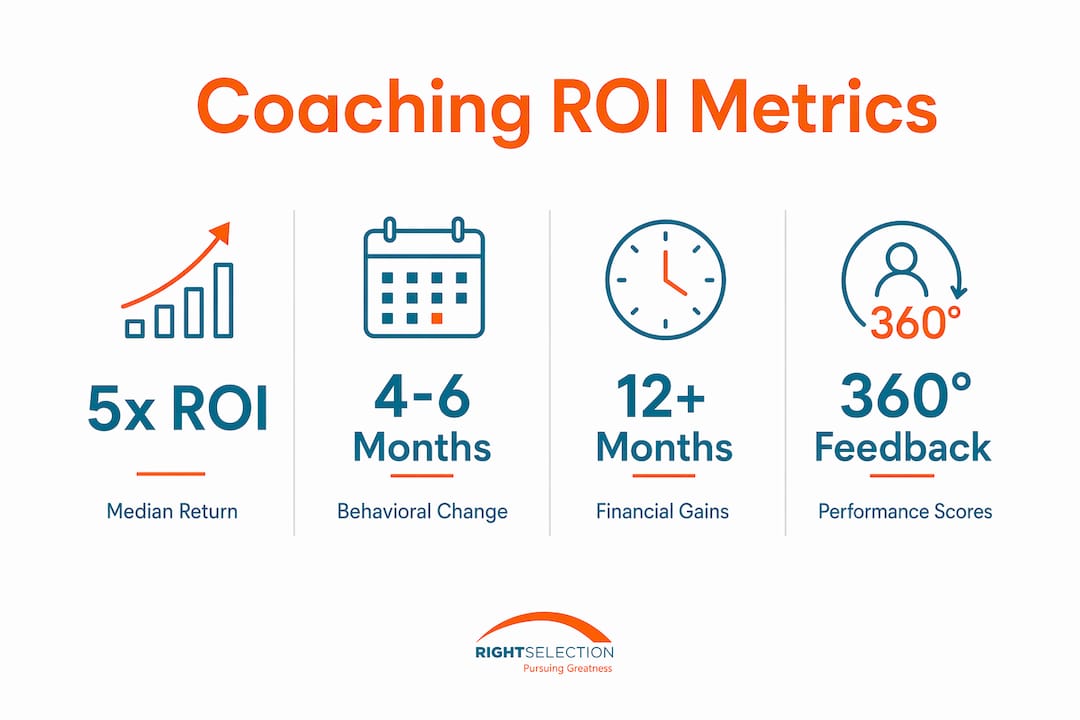
Executive coaching is defined as a structured, goal-directed development process that produces quantifiable improvements in leadership behavior and business outcomes. That definition matters because it separates coaching from soft-skill training and positions it squarely as a business investment. Research from the International Coaching Federation and PwC confirms that organizations tracking coaching ROI report positive returns in 86% of cases, with a median return of 5x to 7x the investment. Understanding why executive coaching delivers measurable ROI requires looking at both the science behind behavior change and the measurement systems that make those returns visible and defensible.
What scientific evidence proves executive coaching ROI?
The strongest evidence for coaching’s impact comes from controlled research, not anecdote. A 2023 meta-analysis of 39 randomized controlled trial samples involving 2,528 participants found statistically significant positive effects on cognitive leadership behaviors, including goal-setting, complex skill adoption, and decision quality. That finding is significant because it rules out placebo effects and self-reporting bias, the two most common objections CFOs raise when reviewing coaching budgets.
The returns extend beyond individual performance. Executive coaching reduces leadership burnout by rebalancing job demands and available resources, and a 2026 study of 123 coachees linked coach support directly to measurable improvements in both performance and well-being. Lower burnout translates into lower turnover, and turnover is one of the most expensive line items in any talent budget.
“The strongest returns come from changing what leaders do, not just improving how they feel about their role. Goal-directed behaviors and complex skill adoption are where the financial value accumulates.” — Academy of Management review, 2023
The table below summarizes the key outcome categories and their associated evidence base.
| Outcome Category | Evidence Source | Typical Measurement Window |
|---|---|---|
| Cognitive leadership behaviors | 2023 RCT meta-analysis (39 samples) | 4–6 months |
| Burnout reduction and well-being | 2026 JD-R study, 123 coachees | 3–6 months |
| Financial and retention impact | ICF/PwC 2024 global survey | 12+ months |
| Median ROI multiple | ICF/PwC, MetrixGlobal, PwC studies | 12–18 months |
The compound effect of these outcomes is what makes coaching a defensible capital allocation. A leader who sets clearer goals, manages stress more effectively, and retains their team creates financial value that flows through the entire organization, not just their own performance review.
How do companies measure and attribute coaching ROI?
Measuring the return on investment in coaching is a methodology problem before it is a data problem. The ICF states clearly that causality and attribution require pre-coaching baselines, control groups where feasible, and outcome metrics agreed with sponsors before coaching delivery begins. Without those foundations, any ROI figure is a post-hoc story, not a business case.
The most defensible measurement frameworks track outcomes across three distinct layers:
- Service compliance: Session attendance, completion rates, and coach-coachee alignment scores confirm the program ran as designed.
- Progress against goals: 360-degree feedback, manager assessments, and self-reported goal completion scores track behavioral change in real time.
- Business impact: Attrition rates, promotion velocity, team engagement scores, and revenue contribution data connect coaching to organizational outcomes.
This three-layer architecture, recommended in ICF’s reporting guidance, gives CFOs and boards a structured view of where value is accumulating and at what pace. It also protects the coaching investment during budget cycles, because the data speaks before anyone has to advocate for it.
Pro Tip: Lock your outcome metrics with the sponsoring executive before the first coaching session. Metrics agreed after the fact are almost impossible to defend as causal evidence. Treat the measurement plan as part of the coaching contract.

The timing of measurement matters as much as the metrics themselves. Early coaching ROI typically appears in behavioral shifts within 4–6 months. Financial and retention results require 12 or more months of follow-up measurement to surface reliably. Organizations that measure only at program end miss the behavioral data that explains the financial results.
What factors drive variability in coaching returns?
Not all coaching engagements produce equal returns. Several factors consistently predict whether a program will generate strong, measurable impact or deliver ambiguous results.
- Engagement length: 6–12 month coaching engagements produce more durable behavior change than shorter programs, particularly for complex leadership skills. A six-session program may shift awareness. A twelve-month engagement changes how a leader operates under pressure.
- Goal specificity: Vague improvement targets like “become a better communicator” produce vague results. Specific, measurable goals tied to real operating challenges, such as reducing team attrition by 15% or improving direct report engagement scores by 10 points, create accountability and make ROI calculation straightforward.
- Coach expertise and methodology alignment: A coach with deep experience in your industry and a methodology matched to the leader’s development stage will outperform a generalist. The value of leadership coaching scales with the quality of the coach-coachee fit, not just the number of sessions completed.
- Alignment to real operating problems: Coaching must be an ongoing engagement tied to actual business challenges, not a standalone development exercise. When coaching addresses the problems a leader faces this quarter, transfer from session to execution happens naturally.
Pro Tip: Before selecting a coach, ask for evidence of outcome measurement from previous engagements. A coach who cannot describe how they tracked client progress is a coach who cannot help you build a business case.
The executive coaching impact on decision quality is one of the clearest early indicators of ROI. Leaders who improve their decision-making frameworks within the first few months of coaching create downstream value that compounds across every team interaction and strategic choice they make.
How should leaders implement coaching to maximize returns?
Strategic implementation separates organizations that report strong coaching ROI from those that report inconclusive results. The difference is almost never about the quality of the coach. It is about the architecture surrounding the coaching engagement.
The comparison below illustrates the gap between reactive and strategic coaching implementation.
| Implementation Approach | Reactive Coaching | Strategic Coaching |
|---|---|---|
| Goal-setting | Defined by coachee alone | Co-defined with sponsor and aligned to business objectives |
| Measurement | Post-program survey | Pre-coaching baseline, mid-point check, post-program assessment |
| Duration | Fixed short-term program | 6–12 months with renewal based on progress data |
| Reporting | Anecdotal feedback | Structured dashboard covering compliance, progress, and business impact |
| Coach selection | Availability-based | Matched to leader’s development stage and business challenge |
Organizations that build evaluation systems collecting data at multiple points before, during, and after coaching are the ones that shift from activity counting to outcome quantification. That shift is what makes coaching budgets defensible at board level.
A leading failure point in coaching programs is under-measuring the transfer moment. Transfer is the point at which coaching learning moves from session insight to actual work execution. Most programs track session completion but ignore whether the leader applied new behaviors in the following week’s team meeting or strategic review. Building transfer checkpoints into the program design closes this gap and generates the behavioral data that supports financial attribution.
The benefits of executive coaching also cascade beyond the individual leader. When a senior executive improves their goal-setting clarity, their direct reports experience clearer direction, fewer priority conflicts, and higher engagement. Those downstream effects show up in team-level engagement scores and attrition data, expanding the measurable ROI footprint of a single coaching investment.
Key takeaways
Executive coaching delivers measurable ROI when organizations combine rigorous goal-setting, pre-defined metrics, and longitudinal tracking to connect behavior change to business outcomes.
| Point | Details |
|---|---|
| ROI is research-backed | A 2023 meta-analysis of 39 RCT samples confirmed significant effects on cognitive leadership behaviors. |
| Median returns are substantial | ICF and PwC data show 86% of organizations tracking coaching report positive ROI, with a 5x–7x median return. |
| Measurement architecture matters | Pre-coaching baselines, agreed metrics, and three-layer reporting are required for defensible attribution. |
| Engagement length drives durability | Six to twelve month programs produce stronger, more lasting behavior change than short-term interventions. |
| Transfer is the critical gap | Measuring whether coaching learning translates into work execution is the most commonly missed ROI signal. |
Where most organizations get coaching ROI wrong
I have worked alongside organizations that invested significantly in executive coaching and walked away with little more than positive feedback forms. The pattern is consistent. They treated coaching as a benefit rather than a business investment, and they built no measurement infrastructure to prove otherwise.
The most common mistake is not selecting the wrong coach. It is starting without a measurement plan. When there is no baseline, there is no before-and-after story. When there are no agreed metrics, every outcome becomes debatable. The result is that coaching gets cut in the next budget cycle, not because it failed, but because no one could prove it succeeded.
What I find genuinely encouraging is the shift happening in how forward-thinking organizations approach this. AI-assisted session analysis tools are beginning to surface behavioral pattern data that coaches and sponsors can review together. Integrated reporting dashboards are replacing end-of-program surveys. These developments do not replace the human relationship at the core of coaching. They give that relationship a data layer that makes its value visible to the people who control the budget.
Coaching is not an expense that competes with other talent investments. It is a multiplier on every other leadership development dollar you spend. A leader who has been coached to set clearer goals, manage their energy more effectively, and make decisions with greater confidence will extract more value from every training program, mentoring relationship, and team interaction that follows. That compound effect is where the real return on investment in coaching lives.
— Dipti
Work with coaches who deliver proven outcomes
Right Selection connects corporate leaders with an elite network of coaches whose work is grounded in measurable outcomes, not just inspiring conversations. With over 30 years of experience and a roster of 100+ global thought leaders, Right Selection specializes in matching the right coach to your specific leadership challenges and business goals.

May Sayed Ali is one example of a coach in the Right Selection network known for structured, outcome-focused engagements that produce results CFOs and boards can see. Whether you are building a coaching program from scratch or looking to strengthen the measurement architecture around an existing one, Right Selection will help you design an engagement that generates returns you can report with confidence. Explore the full network and start the conversation today.
FAQ
What is the average ROI from executive coaching?
Organizations that track coaching outcomes report a median ROI of 5x to 7x the investment, according to ICF and PwC research. Positive returns are reported in 86% of cases where measurement systems are in place.
How long does it take to see coaching ROI?
Behavioral improvements typically appear within 4–6 months of coaching. Financial and retention benefits require 12 or more months of longitudinal tracking to surface reliably.
What metrics should companies use to measure coaching ROI?
The most defensible metrics include pre-coaching and post-coaching 360-degree feedback scores, team attrition rates, promotion velocity, and manager-assessed goal completion. Metrics must be agreed with sponsors before coaching begins to support causal attribution.
Does coaching duration affect the strength of ROI?
Yes. Research confirms that 6–12 month engagements produce stronger and more durable behavior change than shorter programs, particularly for complex leadership skills that require repeated practice under real conditions.
Why do some coaching programs fail to show measurable ROI?
The most common cause is the absence of a measurement plan before the program starts. Without pre-coaching baselines and agreed outcome metrics, there is no framework for attributing results to the coaching investment, making ROI impossible to prove even when real change has occurred.