

Leadership training fails companies when it prioritizes content delivery over the environmental conditions required to sustain new behaviors on the job. Organizations collectively spend approximately $90 billion annually on leadership development worldwide, yet only 10 to 15% of that training transfers into lasting behavioral change. The gap between what leaders learn in a workshop and what they actually do on Monday morning is the defining failure of most corporate leadership programs. Understanding why leadership training fails companies requires looking beyond the curriculum and examining the systems, cultures, and structures that either reinforce or quietly undermine everything taught in the room.
Why leadership training fails companies at its core
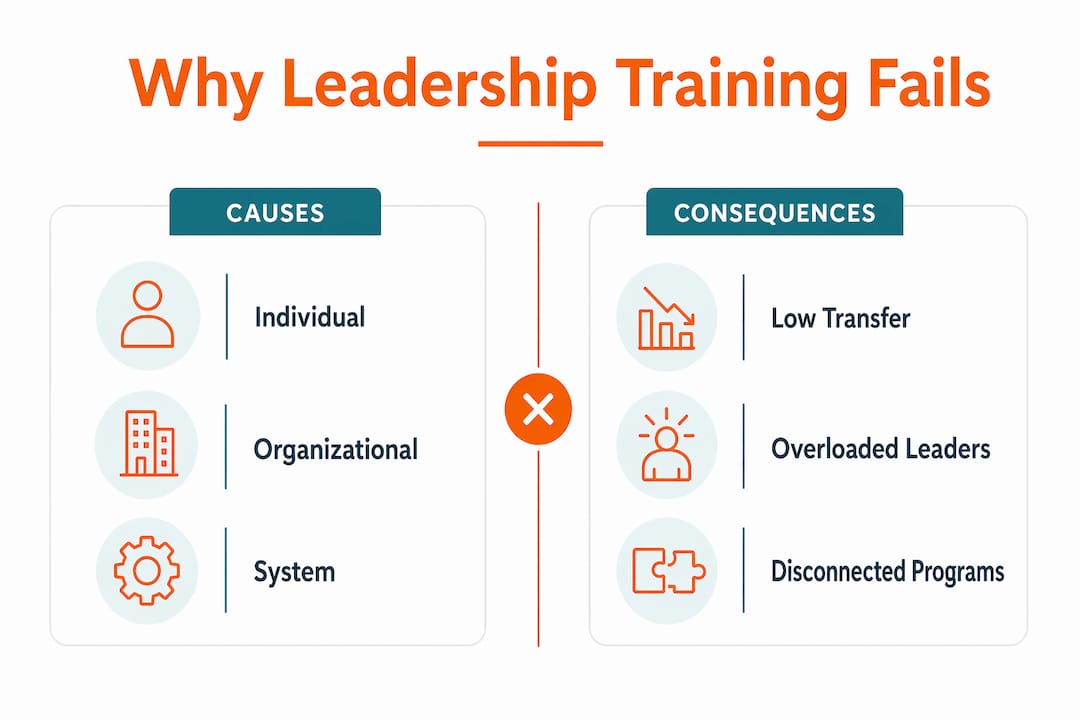
The causes of leadership training failure operate at three levels simultaneously: individual, organizational, and systemic. Most HR teams address only one of them.
Measurement stops at satisfaction scores. The most common evaluation method is the post-training survey, which captures how participants felt about the experience rather than whether they changed how they lead. Reaction scores are poor predictors of behavior transfer. A leader who rates a workshop 9 out of 10 may return to the same habits within two weeks. Without 360-degree feedback or manager assessments conducted three to six months after training, organizations have no real data on whether development actually occurred.
Leaders are overloaded before training begins. 82% of new managers receive no formal leadership preparation and learn by imitating whoever managed them before. When they do receive training, they carry it back into roles already stretched thin by competing priorities. 71% of leaders report increased stress after promotion, and 40% consider leaving people management entirely. Asking an overloaded leader to practice new coaching behaviors while managing a full team and reporting cycle is an unrealistic expectation.

Programs are disconnected from actual job demands. Many leadership programs are designed around generic competency frameworks rather than the specific challenges leaders face in their organization. When training content does not map to real decisions, real team dynamics, or real cultural pressures, it stays abstract. Leaders recognize the concepts but cannot apply them when the moment arrives.
Needs analysis is skipped or superficial. A thorough needs assessment is the foundation of any program that works. Without it, organizations invest in solutions for problems they have not clearly defined. The result is training that addresses the wrong skills, delivered to the wrong people, at the wrong time.
Pro Tip: Before designing any leadership program, conduct structured interviews with both current leaders and their direct reports. The gap between what leaders think they need and what their teams actually experience is often where the real development opportunity lives.
How does organizational culture block leadership development?
Training works in the classroom. It fades when leaders return to a culture that does not support the behaviors they just practiced. This is one of the most underestimated barriers in leadership development.
Consider the example of direct feedback. A leader attends a program on candid communication and leaves committed to giving clearer, more honest feedback. But if the organizational norm rewards harmony over honesty, that leader will face subtle social pressure to revert. Leadership is revealed in daily behavior shaped by real-world challenges, relationships, and organizational norms. No single training event overrides years of embedded culture.
The following conditions consistently block behavioral transfer after leadership programs:
- Senior leaders do not model the trained behaviors. When a manager’s own boss does not practice the skills being taught, the unspoken message is that those skills are optional. Modeling from the top is not a nice-to-have. It is the primary signal that new behaviors are expected.
- Performance management systems reward old behaviors. If the appraisal system still prizes individual output over team development, leaders will optimize for what gets measured. Training that teaches coaching and delegation loses to a system that rewards personal delivery.
- There is no psychological safety for experimentation. Applying new leadership behaviors requires trying things that may not work immediately. Organizations that punish visible failure create conditions where leaders default to what is familiar rather than what was taught.
- Peer norms reinforce the status quo. Leadership cohorts often return to teams where colleagues have not attended the same program. Without shared language and shared expectations, new behaviors feel awkward and unsupported.
Pro Tip: After any leadership program, schedule a structured debrief with each participant’s direct manager. That conversation signals organizational commitment and creates accountability for applying what was learned.
What does research say about leadership programs that actually work?
The research on effective leadership development is clear, and it challenges several assumptions that drive most corporate spending decisions.
A meta-analysis of 335 studies found that integrated training and development approaches produce significantly stronger outcomes than training alone. The distinction matters: training delivers knowledge and skills in a structured setting, while development embeds that learning through workplace application, coaching, stretch assignments, and reflection over time. Programs that combine both consistently outperform those that rely on events.
Cost is not a reliable proxy for quality. Well-designed internal programs outperform expensive external events built around lectures and motivational speakers. The design principles matter far more than the price tag or the production value of the experience.
“The workbook is not the work. Leadership is built through real decisions, real relationships, and real accountability — not through content consumption alone.”
The table below contrasts the design features of programs that fail against those that produce measurable outcomes.
| Design feature | Programs that fail | Programs that work |
|---|---|---|
| Needs assessment | Generic or skipped | Structured, role-specific |
| Delivery format | Single event or lecture series | Spaced learning with practice intervals |
| Measurement approach | Post-event satisfaction survey | 360-degree feedback at 3 to 6 months |
| Reinforcement | None after training ends | Coaching, peer accountability, manager check-ins |
| Cultural alignment | Training isolated from culture | Behaviors modeled by senior leadership |
Effective leadership development blends formal training with on-the-job elements like coaching and stretch assignments to embed learning where it actually matters. Experts like Marshall Goldsmith and Chris Roebuck have built their methodologies on exactly this principle: behavior change requires sustained accountability structures, not just compelling content.
How can companies improve leadership training outcomes?
Improving leadership development success requires changes to program design, organizational environment, and measurement practice. The following steps address the most common pitfalls in leadership training.
- Start with a genuine needs assessment. Map the specific leadership challenges your organization faces. Interview leaders, their managers, and their direct reports. Use that data to define program objectives before selecting any content or format.
- Shift from events to journeys. Replace single-day workshops with spaced learning sequences that include pre-work, skill practice, reflection periods, and follow-up coaching sessions. Spaced delivery significantly improves retention and transfer.
- Address job manageability alongside development. Improving job manageability has five times more impact on leader effectiveness than standalone development programs. If leaders are structurally overloaded, training will not compensate for that. Reduce administrative burden and clarify role scope before expecting new behaviors to take hold.
- Build in coaching and reflection post-training. Leadership training alone cannot build authentic behavior without reinforcement through coaching, reflection, and cultural support. Assign coaches or peer accountability partners for at least 90 days after any program.
- Measure at the behavioral level. Move beyond reaction surveys. Collect 360-degree feedback and manager assessments three to six months after training. Use that data to refine future programs and demonstrate ROI to senior stakeholders.
- Align senior leadership behavior with program goals. Identify two or three specific behaviors the program aims to develop and ask senior leaders to publicly commit to modeling them. That visible commitment changes the cultural signal from “training is an HR initiative” to “this is how we lead here.”
Pro Tip: Use consulting frameworks from specialists in leadership transfer to audit your current program design. An external perspective often surfaces structural barriers that internal teams have normalized and stopped seeing.
Key takeaways
Leadership training fails companies when it changes what leaders know without changing the conditions in which they lead.
| Point | Details |
|---|---|
| Transfer rate is critically low | Only 10 to 15% of leadership training produces sustained behavioral change, making design quality non-negotiable. |
| Culture overrides content | Organizational norms and senior modeling determine whether trained behaviors survive re-entry to the workplace. |
| Cost does not predict quality | Well-designed internal programs consistently outperform expensive external events in measurable outcomes. |
| Measurement must go deeper | Reaction scores tell you nothing useful. Behavioral assessments at three to six months reveal actual development. |
| Job design matters as much as training | Reducing leader overload has five times more impact on effectiveness than development programs alone. |
What most leadership teams still get wrong
From my perspective, the most persistent and costly mistake in leadership development is treating it as a content problem when it is fundamentally a systems problem. Organizations invest heavily in finding the right speaker, the right curriculum, the right venue. Then they send leaders back into the same environment that produced the behaviors they were trying to change.
The research is unambiguous: organizations that neglect environment redesign and focus solely on content delivery will see minimal lasting change. Coaching frameworks, accountability structures, and managerial modeling are not supplementary features. They are the mechanism through which training becomes behavior.
What I find most telling is how rarely organizations ask the harder question: not “what should we teach leaders?” but “what would need to change in this organization for new leadership behaviors to actually survive?” That question leads to a very different program design. It points toward culture audits, job redesign, senior leadership alignment, and measurement systems that track behavior rather than satisfaction.
The commitment to sustained leadership development is not measured in training days or budget size. It is measured in whether the organization is willing to examine and change the conditions that make good leadership difficult. That takes more courage than booking a workshop. It also produces results that compound over time in ways that no single event ever will.
— Dipti
How Rightselection helps organizations build leadership that lasts
Rightselection works with corporate leaders and HR teams who are ready to move beyond isolated training events and build leadership development programs that produce measurable, lasting change. With over 30 years of experience and a roster of 100+ global thought leaders, Rightselection curates sessions designed around your specific organizational challenges rather than generic competency frameworks.

Whether you need a world-class speaker to anchor a leadership program, a coaching framework to reinforce post-training behavior, or a full program design consultation, Rightselection brings the discernment and expertise to make it work. Explore what Mark C. Thompson and the broader Rightselection speaker network can offer your leadership development strategy. Contact Rightselection today to design a program your leaders will actually apply.
FAQ
Why does most leadership training fail to change behavior?
Most leadership training fails to change behavior because it delivers knowledge without redesigning the environment leaders return to. Without coaching, accountability, and cultural reinforcement, new skills rarely survive the transition back to daily work.
What percentage of leadership training actually transfers to the job?
Only 10 to 15% of leadership training transfers into sustained behavioral change on the job. The remaining investment is largely lost because organizations do not build the reinforcement structures needed to support application.
How does poor leadership training impact organizations?
The impact of poor leadership training includes increased leader stress, higher turnover in management roles, and wasted development budgets. Research shows 40% of leaders consider leaving people management after promotion, often because they received no meaningful preparation.
What makes a leadership development program effective?
Effective programs combine structured training with spaced delivery, post-training coaching, and behavioral measurement at three to six months. A meta-analysis of 335 studies confirms that integrated training and development approaches consistently outperform standalone training events.
How should companies measure leadership training success?
Companies should measure leadership training success using 360-degree feedback and manager assessments conducted three to six months after the program ends. Post-event satisfaction surveys are poor predictors of actual behavioral change and should not be the primary evaluation tool.