

Executive coaching is a structured advisory relationship in which a trained professional partners with senior leaders to sharpen decision quality, resolve conflict, and align organizational strategy. The role of executive coaches in partnership decisions goes well beyond personal development. Coaches act as objective facilitators at the moments that matter most: when two leaders disagree on direction, when a deal stalls over trust, or when a partnership is quietly eroding beneath the surface. Trust and confidentiality are the strongest predictors of coaching outcomes, which means the relationship itself is the foundation on which every partnership decision gets built.
How executive coaches facilitate better partnership decision-making
Most executives treat coaching as a personal growth tool. That framing misses the point entirely. In partnership contexts, coaching is decision-centric, meaning the coach’s primary function is to facilitate critical choice points rather than reshape individual behavior over months of reflection. The distinction matters because partnership decisions carry organizational consequences that cannot wait for a behavioral shift to take hold.
A coach working in this mode focuses on what practitioners call “choice point” moments. These are the junctures where a leader must decide whether to expand a partnership, renegotiate terms, bring in a third party, or exit cleanly. At each juncture, the coach does not tell the executive what to do. Instead, the conversation is structured to surface assumptions, clarify decision authority, and expose blind spots that internal advisors are often too close to see.

The practical impact is significant. Executive coaching delivers productivity gains of up to 88% and team performance lifts of approximately 50% for C-suite leaders. Those numbers reflect what happens when leaders make faster, more confident decisions with less second-guessing and fewer costly reversals.
Consider what this looks like in practice:
- A CEO and COO disagree on whether to formalize a distribution partnership. A coach facilitates a structured session that separates their personal risk tolerances from the actual business case, producing a clear, shared decision framework.
- Two co-founders stall on equity restructuring with a new investor. A coach helps each founder articulate their non-negotiables, revealing that the real disagreement is about control, not economics.
- A board-level executive hesitates to exit a failing partnership out of loyalty. A coach surfaces the organizational cost of inaction, enabling a clean and timely decision.
Pro Tip: When selecting an executive coach for partnership work, ask specifically about their experience with “choice point” facilitation. Coaches who default to behavioral frameworks alone will not serve you well when a partnership decision needs to be made this quarter.
How does executive coaching resolve partnership conflicts?
Conflict is one of the top three causes of startup and organizational partnership failure. Left unaddressed, it compounds. What begins as a disagreement over strategy becomes a values dispute, then a legal matter. The root causes of partnership conflict are almost always psychological: unmet expectations, power struggles, and misaligned values that were never surfaced during the partnership formation stage.
Structured coaching mediation addresses these root causes directly, and the results are measurable. Targeted mediation coaching saves 67% of high-conflict partnerships, while the remaining 33% achieve a clean, company-preserving exit. That second outcome is as valuable as the first. A well-coached exit protects intellectual property, preserves relationships with shared clients, and avoids litigation that can consume years of leadership bandwidth.
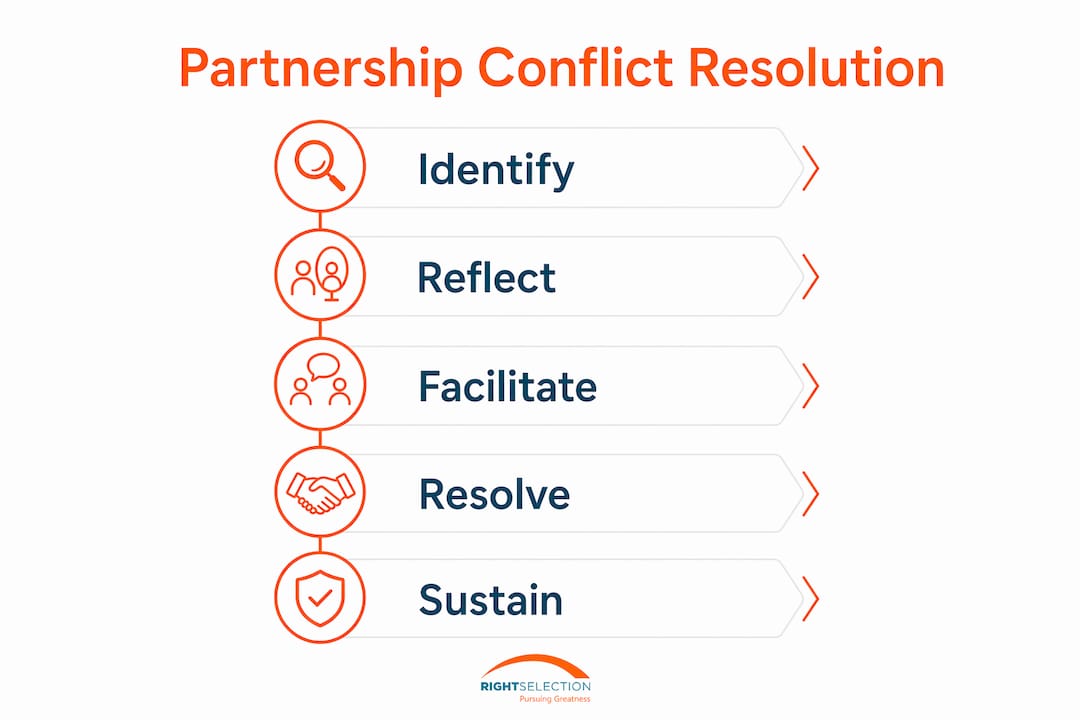
The coaching process for conflict resolution typically follows a structured sequence:
- Separate the people from the problem. The coach meets with each partner individually to map their perspective without the pressure of the other party present.
- Surface the underlying pattern. Most partnership conflicts are not about the presenting issue. A coach identifies whether the real driver is a power imbalance, a broken commitment, or a values gap.
- Facilitate a structured joint session. With root causes identified, the coach brings both parties together with a clear agenda and agreed ground rules.
- Define a decision framework. The session produces either a renewed partnership agreement with explicit expectations or a structured exit plan that both parties can execute without destroying the company.
“The coaching conversation focuses less on giving answers and more on enabling executives to reflect and choose the best partnership path at critical junctures.” — Mousaab Khaldi, entrepreneur coaching practitioner
This sequence works because it treats conflict as a decision problem, not a personality problem. The coach does not arbitrate. The coach creates the conditions in which leaders can make clear-eyed decisions about whether to repair or exit a partnership.
What impact does a coaching culture have on partnership performance?
Embedding coaching into organizational culture produces measurable gains that extend well beyond individual leader development. Organizations with strong coaching cultures see a 16.7% revenue uplift driven by improved partner alignment, reduced decision friction, and faster execution speed. That figure reflects what happens when coaching is not a one-off intervention but a systemic capability built into how the organization manages partnerships.
The mechanism is straightforward. Training programs transfer knowledge. Coaching converts that knowledge into consistent on-the-job behavior. Content-heavy enablement alone fails to turn knowledge into action because of the forgetting curve: without reinforcement, most learning fades within weeks. Coaching is the reinforcement mechanism that prevents this fade and ensures that partner management skills actually get applied in real negotiations, real conversations, and real decisions.
| Coaching culture element | Impact on partnership performance |
|---|---|
| Regular coaching check-ins with partner leads | Reduces misalignment before it becomes conflict |
| Decision-centric coaching sessions at deal milestones | Accelerates deal closure and reduces renegotiation cycles |
| Coaching-reinforced training programs | Sustains skill application beyond the initial training period |
| Trust-based coach-client relationships | Increases willingness to surface partnership risks early |
In multi-partner environments, the compound effect of coaching becomes particularly visible. When multiple partner leads within an organization are coached consistently, their shared decision frameworks begin to align. This alignment reduces the internal friction that slows deal orchestration and creates a more coherent external face to partners and clients.
Pro Tip: Build coaching touchpoints directly into your partner development calendar. Quarterly coaching sessions tied to deal review cycles produce far better outcomes than standalone coaching programs disconnected from live business activity.
Leadership behavior amplifies these effects. When senior executives model the reflective, feedback-oriented behavior that coaching develops, it signals to the entire organization that partnership decisions deserve deliberate thought. Speakers like Dr. Tasha Eurich and Stephen M. R. Covey have built significant bodies of work around exactly this dynamic: self-awareness and trust as the twin engines of organizational performance.
Executive coach vs. executive advisor: what is the difference?
The distinction between a coach and an advisor is one of the most commonly misunderstood boundaries in executive development, and confusing the two creates real frustration in partnership decision contexts. An executive coach facilitates reflection. An executive advisor provides direct strategic recommendations. Both are valuable. Neither is a substitute for the other.
| Dimension | Executive coach | Executive advisor |
|---|---|---|
| Primary function | Facilitates reflection and decision clarity | Provides strategic and operational recommendations |
| Advice-giving | Does not give direct business advice | Gives direct, experience-based recommendations |
| Partnership stage fit | Strongest during conflict, alignment, and transition phases | Strongest during deal structuring and market entry |
| Relationship dynamic | Non-directive; client drives the outcome | Directive; advisor shapes the outcome |
| Confidentiality model | High; sessions are private and protected | Variable; advisors may have board or investor relationships |
Executives who engage a coach expecting a strategic consultant will leave sessions feeling unheard. Executives who engage an advisor expecting deep personal reflection will receive recommendations they cannot fully internalize. The right question is not “which is better?” but “which does this partnership situation require right now?”
During a conflict resolution phase, a coach is the right choice. The situation calls for reflection, not prescription. During a market entry negotiation where you need someone with direct experience in that sector, an advisor is the right choice. Many senior leaders benefit from both simultaneously, with clear role boundaries established from the start.
Key takeaways
Executive coaching improves partnership decisions by acting as a structured facilitation process at critical choice points, not as a general personal development program.
| Point | Details |
|---|---|
| Coaching is decision-centric | Coaches facilitate critical choice points in partnerships, not just behavioral change over time. |
| Conflict resolution has measurable results | Structured mediation coaching saves 67% of high-conflict partnerships and enables clean exits for the rest. |
| Coaching cultures drive revenue | Organizations with embedded coaching cultures see a 16.7% revenue uplift through better partner alignment. |
| Coach and advisor roles are distinct | Coaches facilitate reflection; advisors give direct recommendations. Knowing which you need prevents costly mismatches. |
| Trust is the foundation | The quality of the coach-client relationship is the strongest predictor of coaching outcomes in partnership contexts. |
What I have learned about coaching and partnership decisions
I have seen executives invest in coaching programs that were well-designed on paper but produced little change in how partnership decisions actually got made. The pattern is consistent: the coaching was behavioral in focus, the sessions were disconnected from live deal activity, and the executive entered the engagement looking for validation rather than challenge.
The executives who get the most from coaching in partnership contexts share three qualities. They choose coaches with direct experience in organizational dynamics, not just personal development frameworks. They bring real, active decisions into the coaching conversation rather than hypothetical scenarios. And they are genuinely willing to have their assumptions challenged, including assumptions about their own partners and their own leadership behavior.
The selection of the right coach matters more than most executives acknowledge. A coach who has never sat in a room where a partnership was breaking apart will struggle to ask the right questions at the right moment. This is where discernment in the selection process pays compound dividends over time.
One more observation worth sharing: the executives who treat coaching as a one-time intervention consistently underperform those who treat it as an ongoing discipline. Partnership decisions do not happen in isolation. They accumulate. A coaching relationship that spans multiple decision cycles builds a depth of context that no single session can replicate. Commit to the process, not just the outcome.
— Dipti
How Right Selection connects executives with the right coaching professionals
Right Selection has spent over 30 years curating an elite network of global thought leaders, coaches, and corporate trainers who specialize in exactly the kind of work described in this article. For executives who need coaching support on partnership decisions, conflict resolution, or strategic alignment, the quality of the coach you choose determines the quality of the outcome you get.
Right Selection’s approach is built on tailored matching. Every engagement begins with a clear understanding of your specific partnership challenge, your leadership context, and the decision horizon you are working within. From there, the team identifies the coaching professional whose experience and methodology fit your situation precisely. Explore coaching professionals who specialize in executive decision support, or browse the full speaker and coach roster to find the right fit for your organization. Contact Right Selection directly to begin a personalized coaching engagement.
FAQ
What is the role of executive coaches in partnership decisions?
Executive coaches act as objective facilitators at critical decision points in partnerships, helping leaders clarify their thinking, resolve conflict, and align on direction. Their role is to improve decision quality, not to provide direct strategic advice.
How does executive coaching help resolve partnership conflicts?
Structured coaching mediation addresses the psychological roots of partnership conflict, including unmet expectations and power struggles. Research shows that targeted coaching saves 67% of high-conflict partnerships and supports clean exits for the remainder.
What is the difference between an executive coach and an executive advisor?
An executive coach facilitates reflection and helps leaders reach their own decisions. An executive advisor provides direct strategic recommendations based on their own experience and expertise. The two roles serve different needs at different stages of a partnership.
What are the measurable benefits of coaching for organizational partnerships?
Organizations with strong coaching cultures see a 16.7% revenue uplift through improved partner alignment and faster execution. At the individual leader level, executive coaching delivers productivity gains of up to 88% and team performance improvements of approximately 50%.
How do I know if my organization needs a coaching culture for partnerships?
If your partnership decisions are slow, frequently revisited, or driven by internal politics rather than clear frameworks, a coaching culture is likely missing. Embedding regular coaching touchpoints into partner development cycles is the most direct way to address this gap.