

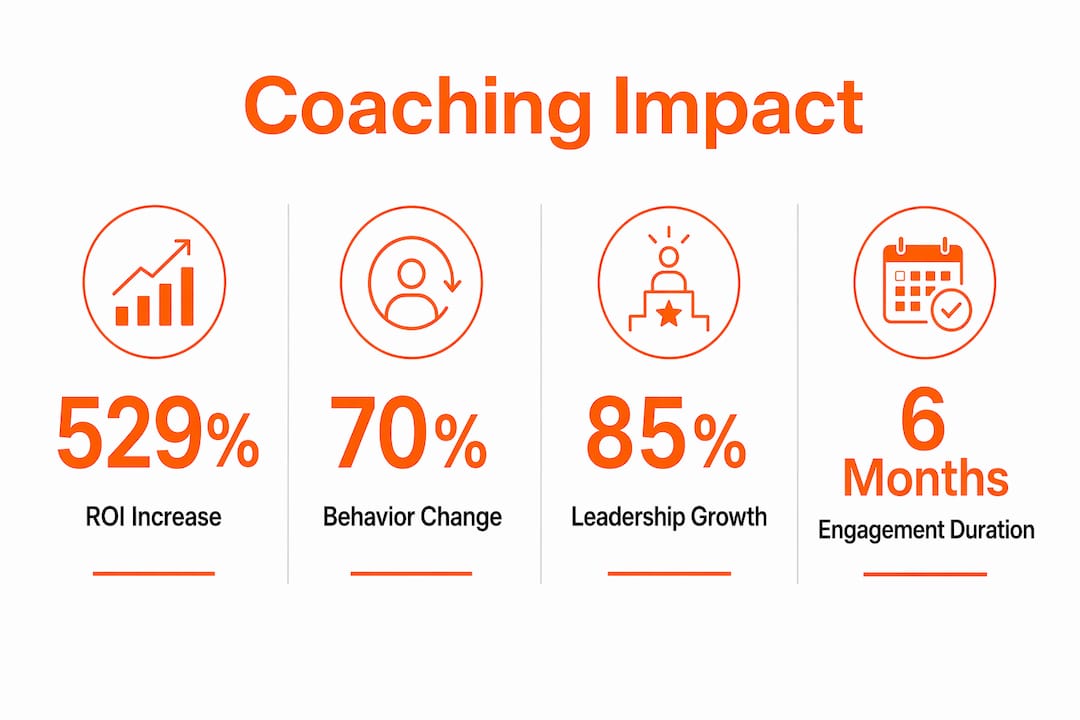
Executive coaching is a targeted developmental partnership in which a trained professional works one-on-one with a senior leader to accelerate career growth, sharpen leadership behavior, and drive measurable professional outcomes. Unlike mentoring or management training, coaching focuses entirely on the individual’s current challenges, decision patterns, and leadership presence. The role of executive coach in career growth has moved from a remedial tool to a recognized accelerator for high-potential professionals. Research from Manchester Inc. covering nearly 2,000 participants confirms an average ROI of 529% from coaching engagements, a figure that reflects real behavioral change, not just satisfaction scores. For corporate professionals navigating complex organizations, coaching is one of the most direct investments in career trajectory available.
What does an executive coach actually do for your career?
The coaching process is structured, not open-ended. A well-designed engagement follows a clear sequence that moves from diagnosis to behavioral change to measurable outcomes. Understanding this sequence helps you recognize what separates genuine career development coaching from an expensive conversation.
A typical coaching process includes these five phases:
- Intake and diagnostic assessment. The coach uses psychometric tools such as Hogan Assessments, 360-degree feedback, or the Myers-Briggs Type Indicator to establish a behavioral baseline. This phase surfaces blind spots that performance reviews rarely capture.
- Goal setting with specificity. Vague intentions produce vague results. The coach works with you to define measurable behavioral goals tied to your actual leadership context, not generic competency frameworks.
- Active behavioral work. Sessions focus on current, high-stakes challenges you are facing right now. This is where the working alliance between coach and client becomes critical. Trust and goal clarity in the coaching relationship are among the strongest predictors of positive behavioral change.
- Reflection and pattern interruption. The coach challenges cognitive patterns, not just behaviors. This is what separates coaching from training. A trainer delivers content; a coach dismantles the thinking that produces limiting behavior.
- Evaluation and reinforcement. At the close of an engagement, typically around six months, progress is measured against the original behavioral goals. The coach and client assess what has shifted and what requires continued attention.
Executive coaching is not therapy, mentoring, or consulting. Therapy addresses psychological history. Mentoring transfers experience. Consulting delivers answers. Coaching builds your capacity to generate better answers yourself. That distinction matters enormously for career advancement, because the skills you develop through coaching compound over time across every role you hold.
What does the evidence say about coaching’s impact on leadership?

The data on professional growth through coaching is more rigorous than most professionals realize. Coaching is not a soft intervention with anecdotal support. It has been studied through randomized control trials, meta-analyses, and large-scale organizational research.
Meta-analyses covering 2,528 participants confirm moderate to significant effects on leadership behaviors, goal-setting, and self-regulation. The effects are larger when leaders enter coaching with clear, specific goals. That finding has a direct implication: the quality of your preparation before a coaching engagement shapes how much you gain from it.
“Executive coaching is the undisputed champion for driving behavioral change, helping leaders move from tactical doing to intentional, strategic leadership.” — Executive Coaching Evidence and Value
The mechanism behind these results is worth understanding. Most coaching benefits come from changing the quality of a leader’s presence and behavior, not simply from increased confidence or knowledge. A leader who learns to listen differently, communicate with greater precision, or make decisions without reactive emotion creates a ripple effect across their team and organization. That behavioral shift is what drives career advancement, because organizations promote leaders who produce better outcomes through people.
Coaching also addresses a problem that rarely gets named directly. Senior leaders often operate in confidential isolation, unable to think out loud with peers or direct reports without political consequence. Coaching provides a space where leaders can stop performing and start thinking. Research shows this reduces leadership loneliness, improves nervous system regulation, and produces better team dynamics. These are not soft outcomes. They are the conditions that allow senior professionals to perform at their ceiling rather than their floor.
Pro Tip: If you are evaluating whether coaching is worth the investment, ask your organization’s HR or talent team for data on promotion rates among leaders who have completed coaching engagements versus those who have not. The pattern is almost always clear.
How to choose the right executive coach for your career
Selecting the wrong coach is expensive in time, money, and opportunity. The criteria that predict coaching success go well beyond credentials and testimonials.
- Leadership experience at or above your level. A coach who has never held a role comparable to yours cannot credibly challenge your thinking. Seven criteria predict coaching success: experience, methodology, challenge, confidentiality, track record, outcome focus, and fit. Experience at your leadership level is the non-negotiable starting point.
- The chemistry call as a diagnostic moment. Treat your first conversation as a test, not a sales meeting. Bring a real, complex leadership challenge. If the coach offers a fresh perspective within 30 minutes that you had not considered, that is a strong signal of fit. If the conversation stays surface-level, move on.
- Methodology transparency. Ask the coach to explain their process in specific terms. Vague answers about “creating space” or “unlocking potential” without a clear framework are warning signs. You want a coach who can describe exactly how they work and why.
- Confidentiality structure. In organizational coaching, understand precisely what the coach will and will not share with your employer. This boundary determines how honest you can be in sessions.
- Evidence of transformation, not just satisfaction. Ask for examples of behavioral change in past clients, not testimonials about how much clients enjoyed the process. Enjoyment and growth are not the same thing.
Pro Tip: Hourly pricing models incentivize dependency. Engagement-based pricing incentivizes your independence and success. When a coach charges by the hour, their income grows the longer you need them. When they charge by engagement, their reputation depends on your results.
One more consideration: coaches who only validate your thinking are not coaching you. Coaching efficacy depends more on the coach’s ability to challenge cognitive patterns than on their industry knowledge. If every session leaves you feeling confirmed rather than stretched, you are paying for affirmation, not development.
How coaching fits into your broader leadership development strategy
Executive coaching does not replace formal training or on-the-job experience. It multiplies them. The 70/20/10 model of leadership development, widely used by organizations including Deloitte and the Center for Creative Leadership, allocates 70% of development to on-the-job experience, 20% to social and relational learning, and 10% to formal training. Coaching sits squarely in the 20% social learning category, and it is the piece most organizations underinvest in.
The table below shows how coaching compares to other development methods across the dimensions that matter most for career advancement.
| Development method | Primary mechanism | Career impact | Durability of change |
|---|---|---|---|
| Formal training (courses, MBAs) | Knowledge transfer | Moderate | Low without reinforcement |
| On-the-job experience | Skill building through repetition | High | High, but slow |
| Mentoring | Experience transfer from senior peers | Moderate | Variable |
| Executive coaching | Behavioral change through reflection | High | High when goals are specific |
Coaching as reinforcement after formal leadership training produces the most durable behavioral changes. This is the compound effect in practice: training gives you the knowledge, experience gives you the context, and coaching converts both into consistent behavior. Without that conversion layer, most leadership training fades within 90 days of the program ending.
The most effective coaching engagements are also the most specific. Goal-driven coaching produces better progress tracking and tangible leadership improvements. “Become a better communicator” is not a coaching goal. “Reduce the frequency of interrupting direct reports in meetings, as measured by 360 feedback at 90 days” is a coaching goal. That level of specificity is what separates developmental acceleration from a pleasant but inconclusive conversation.
Coaching also works best when your organization supports it. Managers who debrief with their teams after coaching sessions, and organizations that create psychological safety for behavioral experimentation, see significantly stronger results than those who treat coaching as a private, isolated activity.
Key takeaways
Executive coaching produces measurable career advancement when it combines behavioral specificity, a challenging coach-client relationship, and integration with broader development strategy.
| Point | Details |
|---|---|
| ROI is documented and significant | Manchester Inc. research shows a 529% average return, reflecting real behavioral change across organizations. |
| Behavior change drives career growth | Coaching improves leadership presence and decision quality, the factors organizations actually promote for. |
| Coach selection determines outcomes | Choose a coach with experience at your leadership level who challenges your thinking, not one who validates it. |
| Pricing structure signals intent | Engagement-based pricing aligns the coach’s incentives with your independence and results. |
| Coaching multiplies other development | Used after formal training, coaching produces durable behavioral change that classroom learning alone cannot sustain. |
What I have learned about coaching and career growth
By Dipti
After years of working at the intersection of leadership development and talent strategy, I have come to believe that most professionals underestimate what coaching actually demands of them. The assumption is that you hire a coach and growth happens to you. The reality is that coaching is the most active form of development available, and the discomfort it creates is precisely the point.
The leaders I have seen grow most through coaching are not the ones who arrived most polished. They are the ones who arrived most honest. They brought their real problems, their real doubts, and their real patterns into the room. That willingness to be seen clearly, without the performance that senior roles often require, is what makes coaching work.
I also think the field has a credibility problem that professionals should take seriously. Not every coach produces results, and the absence of regulation means the market is uneven. The criteria for selecting a coach matter as much as the decision to engage one. A coach who challenges your thinking and holds you accountable to specific behavioral goals is worth significant investment. A coach who makes you feel good about yourself every session is not coaching you at all.
The most underrated benefit of coaching, in my experience, is the reduction of leadership isolation. Senior professionals rarely have a space where they can think without consequence. Coaching creates that space, and the clarity it produces shapes every decision that follows.
— Dipti
Ready to find the right coach for your career?
Rightselection connects corporate professionals and organizations with an elite network of global coaches, thought leaders, and leadership development specialists. With over 30 years of experience and a roster of 100+ experts, Rightselection curates coaching engagements that align with your specific leadership goals and career stage, not generic programs.
Whether you are preparing for a senior leadership transition, working through a complex organizational challenge, or accelerating your development as a high-potential professional, Rightselection’s coaching and speaker network includes specialists like Marshall Goldsmith and Mark C. Thompson, coaches whose work is grounded in measurable behavioral outcomes. Schedule a discovery conversation with Rightselection to identify the right coach for your next stage of growth.
FAQ
What is the role of an executive coach in career growth?
An executive coach accelerates career growth by facilitating behavioral change, improving leadership presence, and helping professionals navigate high-stakes transitions with greater clarity and confidence. The coach’s role is not to provide answers but to build the leader’s capacity to generate better ones.
How long does an executive coaching engagement typically last?
Most executive coaching engagements last approximately six months, which research identifies as the duration needed to produce durable behavioral change. Shorter engagements can address specific challenges but rarely produce the depth of shift that sustained career advancement requires.
How do I know if an executive coach is effective?
An effective coach challenges your cognitive patterns, holds you accountable to specific behavioral goals, and produces measurable shifts in how you lead. If sessions consistently leave you feeling validated rather than stretched, the engagement is not producing the growth you need.
Is executive coaching only for struggling leaders?
Executive coaching is primarily a developmental tool for high-potential and high-performing leaders, not a remedial intervention. Organizations increasingly use coaching as an acceleration strategy for professionals they want to prepare for greater responsibility.
What is the difference between executive coaching and mentoring?
Mentoring transfers experience and perspective from a senior professional to a less experienced one. Executive coaching builds the client’s own capacity for self-awareness, decision-making, and behavioral change. The two approaches are complementary but serve different developmental purposes.