

Cohort-based learning is defined as a structured group learning process where participants progress through a program together, creating the social and cognitive conditions that individual learning paths cannot replicate. This model is the most effective method for building a leadership bench because it produces completion rates between 80–96%, compared to just 3–15% for self-paced modules. That gap is not a minor efficiency gain. It represents the difference between leaders who finish and apply their development and those who abandon it halfway. Garrison’s Community of Inquiry framework identifies three interlocking elements, cognitive presence, social presence, and teaching presence, as the foundation of why cohort-based learning builds leadership bench strength at scale. Organizations that understand this shift their leadership development strategies from individual skill acquisition to shared organizational capability.
Why cohort-based learning builds leadership bench strength
Cohort programs work because they move leadership development from a solo activity to a collective one. When leaders learn alongside peers facing the same organizational pressures, they build shared mental models that persist long after the program ends. This is not just a social benefit. It is a structural one. The Community of Inquiry framework shows that cognitive presence, the ability to construct meaning through reflection and discussion, deepens when learners challenge each other in real time. No recorded video or self-paced module replicates that dynamic. The result is leadership skill retention that compounds over time, not just a certificate earned and forgotten.
The organizational impact extends beyond the individual leader. Cohort learning moves leadership development from individual skill-building to shared organizational capability. That shift matters because organizations do not succeed through isolated excellence. They succeed through coordinated judgment across functions and levels.
How do cohorts build peer networks that strengthen organizations?
The most undervalued benefit of cohort programs is the informal network they create. Leadership experts describe cohorts as building the “connective tissue” of an organization, the informal relationships and mutual trust that allow faster cross-functional decisions. When a VP of Marketing and a VP of Operations have learned together, debated together, and solved problems together, they resolve conflicts faster and align on strategy with less friction.

These networks do not form by accident. They require deliberate cohort design. The most effective programs mix participants from different functions while keeping them at similar organizational levels. This combination creates the peer challenge that sharpens judgment without the hierarchy that suppresses honest dialogue.
The cohort network also outlasts the program itself. Leaders who shared a cohort experience carry a common reference point into every future collaboration. That shared history accelerates trust in new working relationships and reduces the time lost to organizational politics.
- Cohorts create cross-functional relationships that improve collaboration speed.
- Shared problem-solving builds mutual trust that survives organizational change.
- A common learning experience gives leaders a shared language for conflict resolution.
- Informal networks formed in cohorts reduce political friction in future decisions.
- Peer-level consistency within the cohort encourages candid feedback and real challenge.
Pro Tip: Design cohorts with functional diversity and peer-level consistency. Mix participants from finance, operations, marketing, and HR, but keep seniority levels similar. This combination maximizes peer challenge and produces the cross-functional networks that make leadership pipelines resilient.
What does learning science say about cohort effectiveness?
The science behind cohort effectiveness is grounded in three well-established mechanisms. The Community of Inquiry model identifies cognitive presence, social presence, and teaching presence as the conditions that produce deep learning. Cohort programs activate all three simultaneously. Individual learning paths typically address only one.
“Social presence and structured peer interactions in cohorts lead to durable leadership skills and sustained engagement. The combination of accountability, peer challenge, and structured pacing creates conditions that individual learning simply cannot match.”
Cognitive presence deepens when learners must articulate their thinking to peers who will push back. Social presence, the sense of being seen and heard by others, acts as a natural commitment device. Social accountability in cohorts significantly improves learner engagement and completion because visibility through participation drives sustained motivation. Teaching presence, the structured facilitation of learning, ensures that peer discussion stays focused on leadership-relevant challenges rather than drifting into generalities.
Learning scientists also point to “desirable difficulties” as a key mechanism. Pacing, peer discussion, and accountability all introduce productive friction that forces deeper processing. That friction is what converts a learning event into a behavior change.
Optimal cohort size sits between 12 and 30 participants. This range balances social presence with enough diversity to generate genuine peer challenge. Groups smaller than 12 lose the diversity of perspective that drives critical thinking. Groups larger than 30 dilute the accountability that keeps engagement high.
| Learning dimension | Cohort-based program | Self-paced module |
|---|---|---|
| Completion rate | 80–96% | 3–15% |
| Social accountability | High (peer visibility) | None |
| Peer challenge | Structured and ongoing | Absent |
| Skill retention | Durable through behavior change | Short-term recall |
| Network formation | Cross-functional, lasting | None |
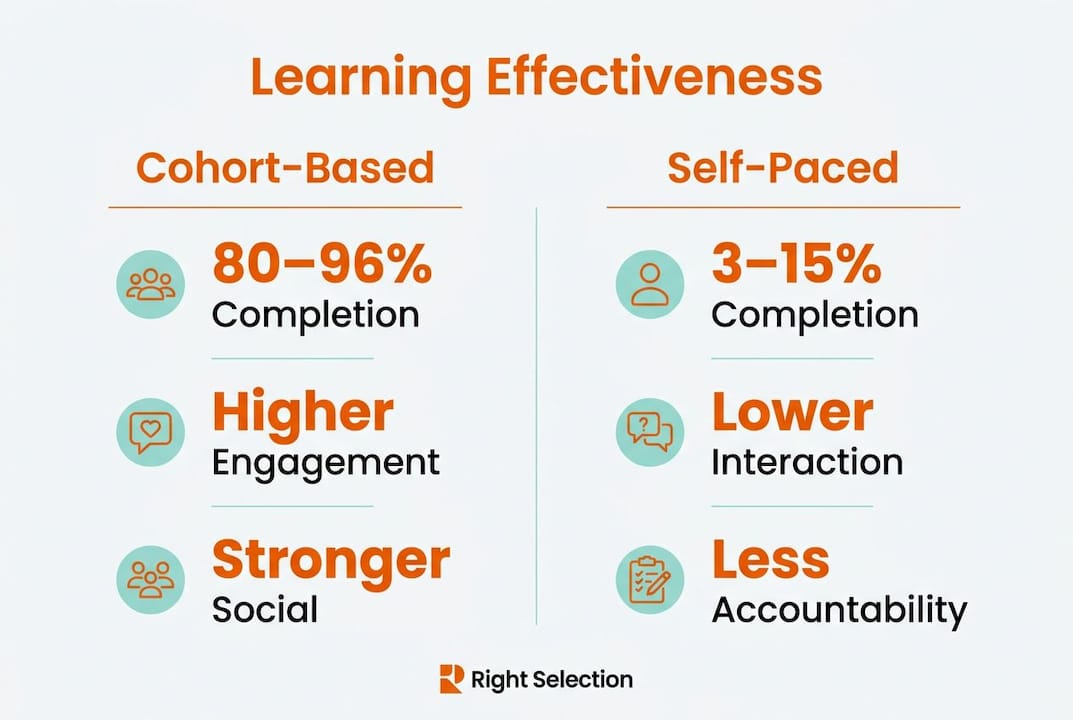
The data above reflects a consistent pattern across learning research. Cohort programs do not just outperform self-paced learning on completion. They outperform it on every dimension that matters for leadership development.
When do cohorts outperform individual learning paths?
Individual learning paths serve a purpose. Technical skill acquisition, compliance training, and knowledge updates are well-suited to self-paced formats. Leadership development is not. Peer challenge and structured discussion in cohorts develop strategic thinking and judgment in ways that solo learning paths cannot replicate.
The reason is straightforward. Leadership judgment is not a body of knowledge. It is a practiced capacity. You develop it by making decisions under pressure, receiving honest feedback, and adjusting your approach in real time. A cohort provides that environment. A self-paced course does not.
Cohort-based learning cannot be fully replaced by AI because leadership judgment and complex negotiation require human peer interaction and feedback. This is a critical point for L&D managers evaluating digital learning investments. AI tools can deliver content efficiently. They cannot replicate the experience of defending a position to a skeptical peer or navigating a group disagreement toward a productive outcome.
- Strategic thinking: Cohorts are superior. Peer debate and structured disagreement force leaders to test and refine their reasoning in ways no solo exercise can match.
- Judgment under pressure: Cohorts are superior. Group problem-solving simulates real business conditions and builds the adaptive capacity that leadership roles demand.
- Technical knowledge: Individual learning is appropriate. Self-paced formats deliver content efficiently when the goal is knowledge transfer rather than behavior change.
- Adaptive communication: Cohorts are superior. Leaders practice reading a room, adjusting their message, and managing conflict in real interactions with peers.
- Compliance and policy updates: Individual learning is appropriate. These objectives require accurate information delivery, not peer challenge.
The distinction matters because organizations that apply cohort models to every learning objective waste resources. The power of cohort-based programs lies in deploying them precisely where peer interaction is the mechanism of growth.
What is the long-term impact of cohorts on leadership pipelines?
The compound effect of cohort-based learning on leadership pipelines becomes visible over years, not weeks. Leaders who complete cohort programs enter senior roles with a ready-made network of peers they trust, a shared language for decision-making, and a cultural reference point that accelerates alignment. Cohorts build a shared language and cultural norms among leaders, which accelerates decisions and improves organizational resilience over time.
This shared language is more valuable than it sounds. When two leaders use the same frameworks to diagnose a problem, they spend less time on alignment and more time on action. That efficiency compounds across every cross-functional initiative the organization runs.
Talent retention is another measurable benefit. Cohort networks increase talent retention by creating belonging and mutual investment among participants. Leaders who feel connected to a peer group within their organization are less likely to seek that connection elsewhere. This is a direct return on the cohort investment that HR professionals can track.
- Cohort alumni share decision-making frameworks that reduce alignment time in senior roles.
- Cross-functional trust built in cohorts accelerates execution on complex initiatives.
- Shared cultural norms from cohort programs smooth leadership transitions and succession.
- Belonging formed in cohorts increases retention among high-potential leaders.
- The leadership pipeline strengthens as each cohort class builds on the networks and norms of those before it.
The cumulative effect is an organization where leadership capability is not concentrated in a few individuals. It is distributed across a connected, aligned, and mutually accountable group of leaders who reinforce each other’s growth.
Key Takeaways
Cohort-based learning builds a stronger leadership bench than individual learning paths because it combines social accountability, peer challenge, and shared mental models into a single, high-retention development experience.
| Point | Details |
|---|---|
| Completion rates are decisive | Cohort programs achieve 80–96% completion vs. 3–15% for self-paced learning. |
| Peer networks outlast the program | Cross-functional trust and shared language formed in cohorts improve collaboration for years. |
| Learning science supports cohorts | Community of Inquiry elements explain why cohorts produce durable leadership behavior change. |
| Cohorts are not universal | Deploy cohort models for judgment, strategy, and communication. Use individual formats for technical and compliance learning. |
| Retention follows belonging | Leaders who build peer networks in cohorts are more likely to stay and grow within the organization. |
The design details most organizations miss
Most organizations that invest in cohort programs focus on content selection and miss the design decisions that determine whether the program actually builds a leadership bench. The composition of the cohort matters as much as the curriculum. A group of peers from the same function will produce comfortable agreement. A cross-functional group at the same level will produce the productive friction that builds real judgment.
Facilitation quality is the second variable that separates effective cohort programs from expensive ones. Skilled facilitation does not just manage discussion. It surfaces the disagreements that participants would otherwise avoid and holds the group accountable to honest reflection. Without that, cohort programs become social events with learning content attached.
The informal network created in a cohort is the most durable asset the program produces. Organizations that fail to recognize this treat the cohort as a one-time event rather than the foundation of a long-term peer network. The leaders who graduated together three years ago are still calling each other when a cross-functional challenge arises. That is the compound effect of cohort design done well.
My strongest recommendation is to integrate cohort programs within a broader set of leadership training best practices rather than treating them as standalone events. A cohort that feeds into ongoing coaching, peer mentoring, and stretch assignments produces leaders who are genuinely ready for senior roles, not just leaders who completed a program.
— Dipti
Right Selection’s approach to cohort-based leadership development
Building a leadership bench through cohort programs requires more than good intentions. It requires deliberate design, expert facilitation, and the right thought leaders to challenge your emerging leaders at the right moments.

Right Selection has spent over 30 years connecting organizations with global thought leaders, coaches, and corporate trainers who specialize in exactly this work. The team curates cohort experiences that align with your specific business goals, not generic leadership content. Whether you are designing a first cohort program or strengthening an existing leadership development initiative, Right Selection brings the expertise and the network to make it work. Book a complimentary coaching call to discuss how a cohort-based approach can accelerate your leadership pipeline.
FAQ
What is cohort-based learning in leadership development?
Cohort-based learning is a structured group learning process where participants progress together through a shared curriculum. It builds leadership capability through peer challenge, social accountability, and cross-functional relationship building.
Why do cohort programs have higher completion rates?
Cohort programs achieve completion rates of 80–96% because social accountability and peer visibility create a natural commitment to finishing. Self-paced modules remove that accountability and see completion rates drop to 3–15%.
How does group learning for leaders differ from individual training?
Group learning for leaders develops judgment, adaptive communication, and strategic thinking through peer debate and real-time feedback. Individual training is better suited to technical knowledge and compliance objectives where peer interaction is not the mechanism of growth.
What is the ideal cohort size for leadership programs?
The optimal cohort size is 12–30 participants. This range maintains enough social presence to drive accountability while providing the diversity of perspective needed for genuine peer challenge.
Can AI replace cohort-based learning for leadership development?
AI cannot replace cohort-based learning for leadership development. Leadership judgment and complex negotiation require human peer interaction and feedback that no AI tool currently replicates.