

Measurable outcomes in leadership training are defined as quantifiable improvements in leadership competencies and business performance metrics that are directly attributable to a development program. This is the standard the industry calls outcome-based leadership development, and it separates programs that produce real change from those that simply feel productive. Companies that invest with this level of commitment see 25% better business outcomes and an average return of $7 for every $1 spent. That figure comes from a survey of 752 leadership experts, and it signals one clear truth: measurement is not a reporting exercise. It is the mechanism that makes leadership investment defensible and repeatable.
What are measurable outcomes in leadership training?
Measurable outcomes in leadership training link every program activity to a specific business goal. Without that link, training becomes an event rather than an investment. The industry term for this approach is outcome-based leadership development, and it requires defining success criteria before the first session begins.
The distinction matters because nearly 60% of first-time managers receive no formal leadership training, yet their behavior directly shapes team engagement and retention over time. That gap is not a training budget problem. It is a measurement problem. Organizations that cannot prove impact tend to deprioritize development, which compounds the gap year after year.
Outcome-based programs define three levels of impact: individual competency growth, team performance improvement, and organizational results such as reduced turnover or higher productivity. Each level requires its own metrics, its own baseline, and its own measurement timeline. Right Selection builds programs around this three-level structure, ensuring that every session connects to a named business challenge rather than a generic leadership theme.

Which business metrics effectively measure leadership training outcomes?
The most reliable metrics for measuring leadership training effectiveness fall into three categories: behavioral, team-level, and organizational.
Behavioral metrics capture changes in how leaders act day to day. These include:
- Leadership competency assessment scores, measured before and after training using validated tools
- 360-degree feedback ratings from direct reports, peers, and senior leaders
- Self-efficacy and resilience scores, particularly relevant for programs using mindfulness-based methods
- Coaching conversation frequency, tracked through manager activity logs
Team-level metrics show whether behavioral change translates into group performance. These include:
- Employee engagement survey scores, ideally from a validated instrument run quarterly
- Voluntary turnover rates within teams led by program participants
- Absenteeism rates, which correlate strongly with team trust and manager quality
- Internal promotion rates, reflecting whether leaders are developing their own people
Organizational metrics connect training to business results. Revenue per employee, customer satisfaction scores, and project delivery rates all qualify when they can be traced to leadership behavior.
Pro Tip: Establish your baseline on at least two metrics before the program launches. Without a pre-program snapshot, you cannot isolate the training effect from seasonal or market-driven changes.
Timing matters as much as metric selection. Measuring outcomes at 6 and 12 months post-program captures true behavioral and team performance changes. Immediate post-training surveys measure satisfaction, not impact. Satisfaction scores feel encouraging, but they tell you nothing about whether a manager’s team is more engaged three months later.
What training methods produce measurable impact?
The evidence on leadership training effectiveness is clear: multi-component programs outperform single-method approaches by a meaningful margin. A meta-analysis of 812 healthcare professionals found that leadership development programs produce a moderate effect size of Hedges’ g = 0.54 overall. Programs combining workshops, mentoring, and structured feedback raised that effect size to g = 0.68. That difference represents a substantial gain in real-world leadership behavior change.
The most effective program designs follow a sequence that builds on each prior element:
- Diagnostic assessment. Begin with a 360-degree feedback survey or competency assessment to identify specific development gaps. This creates personal relevance and a measurable starting point.
- Structured workshop learning. Deliver core concepts through facilitated sessions that include case studies, group discussion, and skill practice. Passive lecture formats produce the weakest outcomes.
- Simulation-based practice. Simulation-based leadership training improves behavioral scores by 2–4 points and reduces critical errors by supporting structured decision-making under pressure. Simulations work because they create consequence-free environments for practicing high-stakes behavior.
- Coaching and mentoring. Pair participants with an experienced coach or senior mentor who reinforces workshop concepts in real work situations. This is where behavior change actually takes root.
- On-the-job application. Assign structured leadership challenges between sessions. Participants who apply new skills within 72 hours of learning them retain and transfer those skills at a significantly higher rate.
- Manager reinforcement. Senior leaders acting as coaches and role models is one of the strongest predictors of sustained behavior change. When a participant’s own manager models the target behaviors, the learning environment extends far beyond the training room.
Pro Tip: Add a six-week mindfulness-based self-leadership module to programs targeting resilience. A randomized study of 128 leaders found this format significantly improves both resilience and self-efficacy compared to control groups, making it one of the most evidence-backed additions to a corporate leadership curriculum.
Right Selection’s approach to leadership training best practices reflects this multi-component model. Each program is designed around a specific business challenge, not a catalog of generic leadership topics.
How do you design a measurement framework for leadership training?
A measurement framework is the architecture that connects program activities to business results. Effective frameworks are established before curriculum design begins, not after the program ends. Most organizations get this backward, which is why so many programs cannot demonstrate impact.
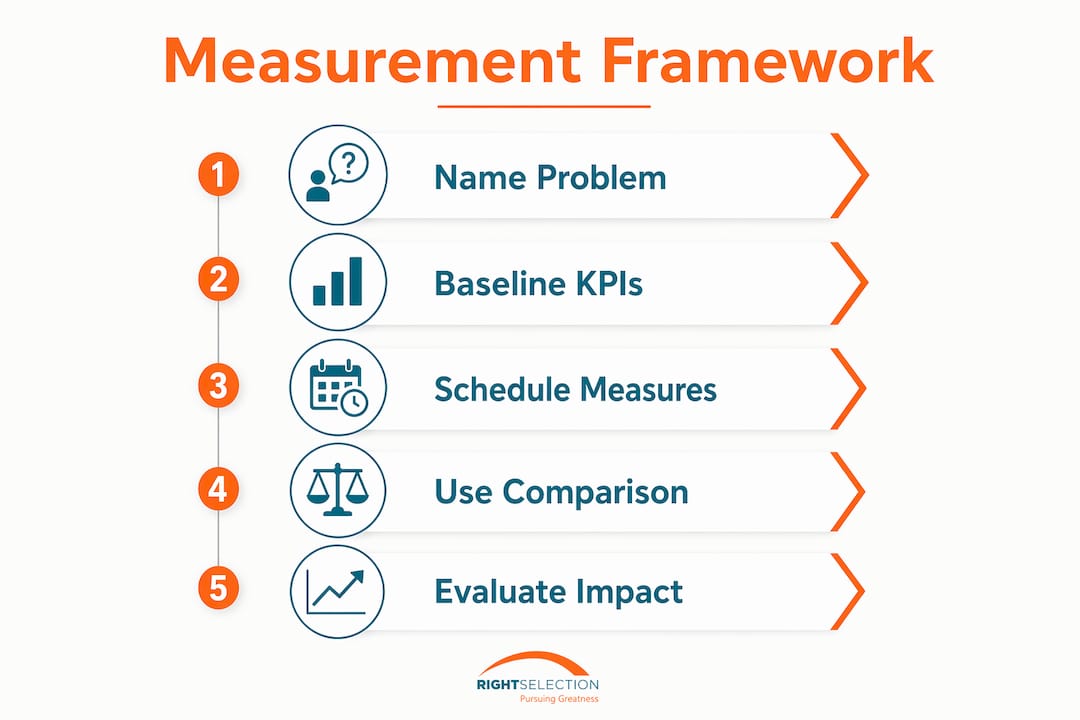
The design process follows four steps.
Step 1: Name the business problem. Every program should begin with a specific, observable challenge. “We need better leaders” is not a business problem. “Our voluntary turnover in frontline management roles increased by 18% last year” is. The business problem determines which metrics matter and what success looks like.
Step 2: Select and baseline your KPIs. Choose two to four metrics that connect directly to the business problem. Run your baseline measurement before the program launches. This is non-negotiable. Without a pre-program baseline, post-program data has no reference point.
Step 3: Schedule measurement intervals. The table below shows how measurement timing maps to the type of insight it produces.
| Measurement point | What it captures |
|---|---|
| Pre-program (week 0) | Baseline competency and team performance data |
| End of program | Participant satisfaction and immediate knowledge gain |
| 6 months post-program | Early behavioral change and team-level shifts |
| 12 months post-program | Sustained behavior change and organizational impact |
Step 4: Use a comparison group. Where possible, identify a group of leaders who did not participate in the program and track the same metrics for both groups. This isolates the training effect from external factors like market conditions or organizational restructuring.
Pro Tip: A competency evaluation system built before the program launches gives you a consistent scoring rubric across all measurement points. Changing your evaluation criteria mid-program invalidates your baseline data.
What challenges affect measuring leadership training outcomes?
The most common reason leadership programs fail to show measurable results is not poor training design. It is poor measurement design. Understanding where organizations go wrong protects your investment before it is made.
- Treating satisfaction as a proxy for impact. End-of-program surveys that ask “Did you enjoy this session?” measure experience, not behavior change. Satisfaction scores and learning outcomes are weakly correlated. A program can score 9 out of 10 on satisfaction and produce zero change in team engagement six months later.
- Measuring against the wrong metrics. Programs designed around vague goals like “developing leadership presence” cannot be measured against business results. If the training objective cannot be connected to a KPI, the objective needs to be rewritten before the program launches.
- Underestimating the time required for behavior change. Behavioral changes in leadership require months to show up in team metrics. Organizations that evaluate impact at 30 days are measuring the wrong thing at the wrong time. The 6 and 12-month intervals exist precisely because leadership behavior change has a compound effect that builds gradually.
- Ignoring the role of organizational support. A leader who returns from a development program to a culture that does not reinforce new behaviors will revert within weeks. The benefits of executive leadership training are only sustained when the broader organization, especially senior leaders, actively supports the change.
- Skipping the baseline. This is the single most damaging mistake. Without pre-program data, you cannot prove that any post-program improvement was caused by the training. You are left with anecdote instead of evidence.
Understanding why leadership training fails at the measurement stage is as important as understanding what good design looks like. Both sides of that equation protect your organization’s investment.
Key Takeaways
Outcome-based leadership development requires pre-established business metrics, multi-component program design, and measurement at 6 and 12 months post-training to produce credible, defensible results.
| Point | Details |
|---|---|
| Define metrics before design | Establish specific KPIs and baselines before the program curriculum is built. |
| Use multi-component programs | Combining workshops, mentoring, and feedback raises effect size from g = 0.54 to g = 0.68. |
| Measure at the right intervals | Collect outcome data at 6 and 12 months post-program, not immediately after training ends. |
| Involve senior leaders | Manager reinforcement and role modeling are the strongest predictors of sustained behavior change. |
| Avoid satisfaction as a metric | Post-training satisfaction scores do not predict behavioral or business impact. |
What I have learned about measuring leadership development
The most persistent mistake I see in corporate leadership programs is not a training problem. It is a sequencing problem. Organizations design the curriculum first and then ask how they will measure success. By that point, the baseline data is gone, the KPIs are vague, and the evaluation becomes a retrospective exercise in justification rather than genuine measurement.
The programs that produce real, lasting results all share one habit: they name a specific business problem before they name a single speaker or workshop topic. That discipline forces clarity. It forces the HR team and the business leaders to agree on what success looks like before anyone spends a dollar on content.
The evidence from healthcare and corporate settings reinforces this. A meta-analysis of 812 professionals showed that combined program approaches produce meaningfully stronger outcomes than any single method. That finding holds across industries because the mechanism is the same: behavior change requires repeated exposure, practice, and reinforcement, not a single event.
The other lesson I return to consistently is the role of the manager above the participant. A leader can complete an excellent program and return to a team where their own manager never asks about it, never models the target behaviors, and never creates space for application. That environment undoes the investment within weeks. Embedding leadership development into organizational culture means making the manager above the participant as accountable for the outcome as the participant themselves.
— Dipti
Right Selection’s approach to results-driven leadership programs
Corporate leaders and HR professionals who want leadership development that connects directly to business results have a clear path forward with Right Selection.

Right Selection’s network of 100+ expert speakers and coaches specializes in programs designed around specific business challenges, not generic leadership themes. Every engagement is curated to align with your organization’s goals, with session design that builds in the measurement touchpoints your team needs to demonstrate impact. Whether you are addressing first-time manager gaps, executive team alignment, or culture-level behavior change, Right Selection matches you with the right thought leader for the specific outcome you are pursuing. Book a complimentary coaching call to discuss your organization’s leadership development goals and how a measurement-first approach can protect and amplify your investment.
FAQ
What does “measurable outcomes” mean in leadership training?
Measurable outcomes in leadership training are quantifiable improvements in leadership competencies and business performance metrics that are directly linked to a development program. They include metrics like 360-degree feedback scores, team engagement rates, and retention figures tracked before and after training.
When should you measure leadership training effectiveness?
The most valid measurement points are 6 and 12 months after the program ends. Immediate post-training surveys capture satisfaction, not behavioral or business impact.
What training methods produce the strongest leadership outcomes?
Multi-component programs combining workshops, mentoring, and structured feedback produce the strongest results, with a meta-analytic effect size of Hedges’ g = 0.68 compared to g = 0.54 for single-method approaches.
How do you set a baseline for leadership training measurement?
Select two to four KPIs directly connected to your business problem and collect data on those metrics before the program launches. Without a pre-program baseline, post-program data cannot be attributed to the training.
Why do so many leadership programs fail to show measurable results?
The most common cause is poor measurement design, not poor training content. Specific failures include treating satisfaction scores as impact data, skipping baseline measurement, and evaluating outcomes too soon after the program ends.





What do you think?
Продвижение сайта: [url=https://ru.xelo.pro/xrumer/en/en/en/en/en/en/en]Прогон хрумером[/url]