

Leadership development is the strategic process of cultivating leaders’ skills to directly boost organizational performance and employee engagement. The evidence is clear: managers account for approximately 70% of the variance in employee engagement, making leadership quality the single most controllable driver of team output. Organizations that invest consistently in developing their leaders see measurable gains across productivity, retention, and culture. Understanding why leadership development drives performance is not an academic exercise. It is a business priority that HR professionals and corporate leaders can no longer afford to treat as optional.
Why leadership development drives performance: the engagement and retention link
The most direct path from leadership investment to business results runs through employee engagement. Managers with targeted coaching and development see up to 18% higher team engagement and a 20–28% improvement in performance metrics. That gap between a trained manager and an untrained one shows up in daily output, meeting quality, and how quickly teams solve problems.
Retention is the second major lever. Leadership development programs reduce employee turnover by 29 percentage points over three years. For any organization calculating the cost of replacing a skilled employee, that number represents a significant return on a training budget.
The mechanisms behind these gains are specific, not vague. Coaching skills teach managers to ask better questions instead of issuing directives. Structured feedback practices give employees clarity on expectations. Communication training reduces the ambiguity that causes disengagement. Each of these behaviors compounds over time, building a culture where people feel seen, supported, and motivated to perform.
- Coaching conversations replace one-way directives with dialogue that surfaces problems early.
- Structured feedback loops give employees clear performance signals rather than annual surprises.
- Communication clarity reduces the ambiguity that drives quiet quitting and disengagement.
- Recognition practices reinforce the behaviors that produce results, not just the results themselves.
Pro Tip: Schedule monthly one-on-one coaching conversations as a non-negotiable calendar item. Consistency in these meetings predicts engagement more reliably than any single training event.
The compound effect of leadership quality on morale is cumulative. A manager who improves their feedback skills in January creates a team that performs better by March, and that performance builds confidence that sustains itself through the year.
Which leadership skills drive the greatest performance improvements?
Not all leadership skills carry equal weight. Research shows that focusing on 5–7 empirically supported skills yields better development and evaluation results than managing broad competency frameworks. The importance of leadership skills becomes clearest when organizations stop trying to develop everything and start prioritizing what actually predicts effectiveness.
The skills with the strongest evidence base are:
- Emotional intelligence. Leaders who read emotional cues accurately make better decisions under pressure and build higher-trust teams.
- Individualized consideration. Transformational leadership’s ability to provide individualized consideration is a strong predictor of success across 39 nations, affecting both task performance and innovation.
- Decision-making under uncertainty. Leaders who use structured frameworks rather than gut instinct alone produce more consistent outcomes.
- Adaptability. The ability to shift approach when conditions change is now a baseline expectation, not a differentiator.
- Developing others. Leaders who actively grow their team members create depth that protects the organization when key people leave.
- Communication clarity. The ability to translate complex goals into clear daily priorities is the skill teams notice most.
- Accountability practices. Leaders who hold themselves and others to agreed standards create cultures where performance is the norm, not the exception.
Each of these skills translates directly into day-to-day behavior. Emotional intelligence shows up in how a manager handles a difficult conversation on a Tuesday afternoon. Individualized consideration shows up in whether a leader notices that one team member needs a challenge while another needs support.
Pro Tip: Before designing any leadership program, survey your managers on which of these seven skills they feel least confident in. That data shapes a program that people actually use.

Organizational context shapes which skills matter most. Generic competency lists miss this nuance because they treat a manufacturing floor manager and a product team lead as identical development cases. They are not.
What does research say about effective program design?
Program design quality determines whether leadership training produces lasting behavior change or simply a positive post-session survey. Leadership training effectiveness depends on needs analysis, spaced delivery, multiple methods, and on-site formats. Each of these variables moderates whether learning transfers to the job.
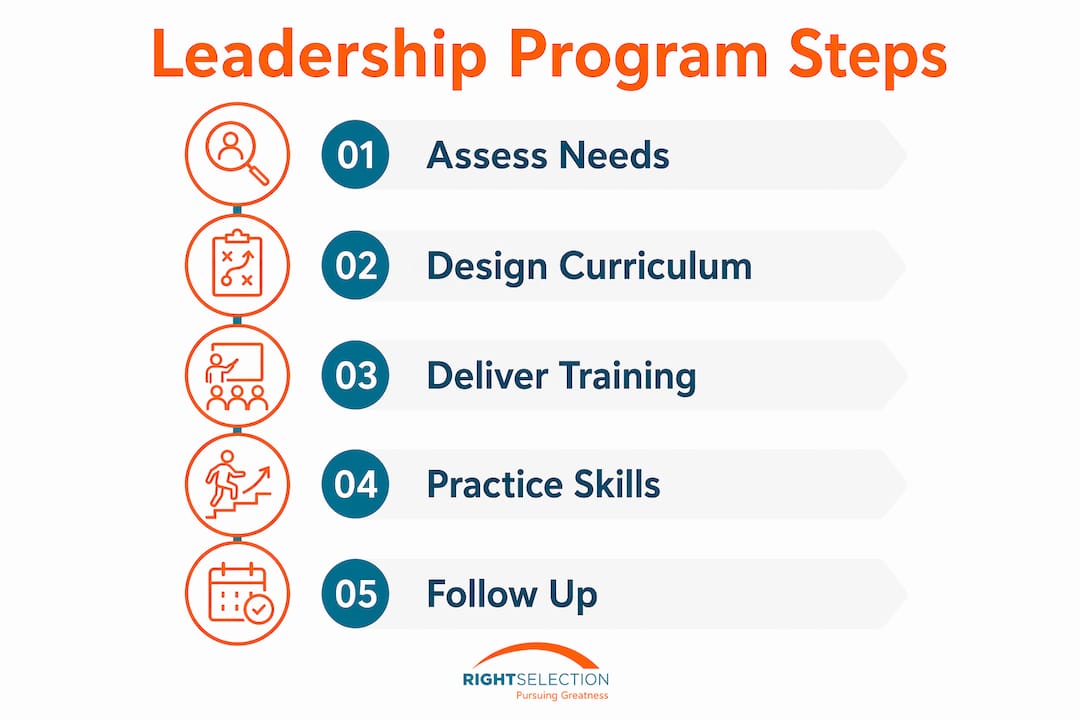
The most common design mistake is the one-day intensive. A single workshop, no matter how well facilitated, does not produce durable behavior change. Spaced leadership training with practice and feedback consistently outperforms massed, lecture-based programs regardless of cost. Spacing forces retrieval, and retrieval builds retention.
A useful way to compare design approaches:
| Design element | Lower-impact approach | Higher-impact approach |
|---|---|---|
| Delivery format | Single-day lecture | Spaced sessions over 8–12 weeks |
| Learning methods | Passive presentation | Role play, case study, peer feedback |
| Needs analysis | Generic off-the-shelf content | Tailored to organizational priorities |
| Practice opportunities | None built in | Structured on-the-job application tasks |
| Feedback mechanisms | End-of-program survey | Ongoing coaching and 360-degree input |
Program effectiveness hinges on thoughtful design and contextual tailoring far more than on production value or vendor prestige. Organizations that spend heavily on polished content but skip needs analysis consistently underperform those that invest in design rigor with simpler materials.
Face-to-face delivery still holds a measurable advantage for behavioral skill development. Simulation-based leadership training reduced missed critical actions to 6% in high-stakes team environments, demonstrating that practice in realistic conditions transfers to real performance. The principle applies equally outside clinical settings. When leaders practice difficult conversations in a safe environment, they handle them better when it counts.
The benefits of leadership development compound when programs include structured follow-up. A 90-day application plan, a peer accountability group, or monthly coaching calls each extend the learning window and improve transfer rates.
Why front-line managers are the most overlooked performance lever
Front-line managers are the most consequential and most neglected group in most leadership development strategies. Many organizations overlook frontline managers in development planning, despite their outsized influence on daily execution, engagement, and culture. Senior executives receive coaching, offsite programs, and executive education. First-level managers often receive a promotion and a handbook.
“Front-line managers often represent the largest blind spot in leadership development despite their outsized influence on engagement, culture, and performance. The gap between what they are asked to do and what they are prepared to do is where most organizational performance problems actually live.”
This gap has real consequences. A front-line manager who lacks feedback skills creates a team that does not know where it stands. A manager who cannot prioritize creates a team that works hard on the wrong things. The impact of leadership training on retention is most visible at this level, because front-line managers are the primary reason employees stay or leave.
Practical strategies for closing this gap include:
- Structured onboarding for new managers. The first 90 days in a management role shape habits that persist for years. Invest there first.
- Peer learning cohorts. Groups of managers at the same level who meet monthly to share challenges and solutions build skills through real-world application.
- Manager-specific coaching. Generic leadership programs designed for executives rarely address the daily realities of a team lead managing five people and a deadline.
- Clear performance expectations for managers as managers. Holding managers accountable for team engagement scores, not just output metrics, signals that people development is part of the job.
The role of front-line leaders in building clarity, delivering feedback, and managing performance is where organizational strategy either takes root or stalls. Developing this group is not a secondary priority. It is the primary one.
Key Takeaways
Leadership development drives performance because it directly improves the behaviors that determine engagement, retention, and daily team output at every level of an organization.
| Point | Details |
|---|---|
| Managers drive engagement | Managers account for 70% of engagement variance, making their development the highest-leverage investment. |
| Retention gains are measurable | Comprehensive programs reduce turnover by 29 percentage points over three years. |
| Focused skills outperform broad lists | Targeting 5–7 empirically validated skills produces better outcomes than managing wide competency frameworks. |
| Design quality determines transfer | Spaced delivery, needs analysis, and practice opportunities predict whether learning changes behavior. |
| Front-line managers are underdeveloped | First-level managers have the greatest daily impact on performance and receive the least development support. |
The case for specificity over scale
I have seen organizations invest significantly in leadership development and walk away with little to show for it. The pattern is almost always the same. The program was broad, the competency list was long, and the design was built around what looked impressive rather than what the business actually needed.
The research is unambiguous on this point. Thoughtful design and contextual tailoring matter far more than scale or production value. A well-designed program for 20 front-line managers will outperform a generic program rolled out to 200 leaders every time.
What I find most underappreciated is the importance of aligning leadership programs with specific business goals before a single session is designed. When a program is built around a real performance gap, participants feel the relevance immediately. That relevance drives engagement with the material, which drives application, which drives results.
The other pitfall I see consistently is treating leadership development as an event rather than a process. A two-day offsite is a starting point, not a solution. The organizations that see lasting gains build coaching, feedback, and peer accountability into the months that follow. They treat the program as the beginning of a behavior change process, not the end of a training obligation.
Emerging leaders also deserve more attention than most organizations give them. Waiting until someone reaches a senior role to invest in their development wastes years of potential and creates a pipeline problem that is expensive to fix later.
— Dipti
How Right Selection connects you to leadership expertise
Right Selection has spent over 30 years curating an elite network of global thought leaders, coaches, and corporate trainers who specialize in exactly the kind of targeted, measurable leadership development this article describes.
Whether your organization needs to develop front-line managers, build a succession pipeline, or design a program around specific performance gaps, Right Selection matches you with the right expertise. Speakers like Brian Tracy bring decades of research-backed leadership training to corporate audiences, while the broader Right Selection speaker network covers every leadership challenge from communication and emotional intelligence to executive decision-making. Every engagement is tailored to your business goals, not delivered from a generic catalog.
FAQ
What is leadership development and why does it matter?
Leadership development is the structured process of building leaders’ skills to improve organizational performance and employee engagement. It matters because managers account for approximately 70% of the variance in team engagement, making their capability the most controllable driver of business results.
How does leadership training affect employee retention?
Comprehensive leadership development programs reduce employee turnover by 29 percentage points over three years. Managers who receive coaching and feedback training create environments where employees feel supported and are less likely to leave.
Which leadership skills have the strongest impact on performance?
Emotional intelligence, individualized consideration, adaptability, and developing others are among the 5–7 empirically validated skills most strongly linked to leadership effectiveness. Focusing on this concise set produces better outcomes than broad competency frameworks.
What makes a leadership development program effective?
Effective program design includes a thorough needs analysis, spaced delivery over multiple sessions, practice-based learning, and structured feedback. These design elements predict whether learning transfers to on-the-job behavior change.
Why should organizations invest in front-line manager development?
Front-line managers have the greatest daily influence on team engagement, culture, and performance, yet they receive the least development support in most organizations. Investing in this group closes the gap between organizational strategy and daily execution.