
An executive leadership development program is a structured learning experience designed to build the strategic thinking, decision-making, and organizational influence that senior leaders need to drive lasting results. Choosing the right one is not a minor HR decision. The program you select shapes how your leaders think, act, and perform under pressure. With formats ranging from two-week on-campus intensives to year-long hybrid programs, and with coaching quality varying widely across providers, the selection process demands the same discernment you apply to any high-stakes business investment. This guide gives you the criteria, comparisons, and implementation steps to choose well.
What criteria should you use to select an executive leadership development program?
The most effective way to select an executive leadership development program is to evaluate it across six concrete dimensions: duration, format, content focus, coaching quality, participant fit, and budget.
Duration and format set the foundation. Leading executive programs range from two-week on-campus intensives to 12-month hybrid or online programs. Shorter programs suit executives who need concentrated exposure to new frameworks. Longer programs work better when behavioral change and peer cohort relationships are the goal.

Participant fit is non-negotiable. Most senior executive programs target professionals with 10 or more years of experience, drawing a clear line between mid-level managers and C-suite leaders. Placing the wrong participant in the wrong program wastes budget and produces frustration on both sides.
Content focus determines relevance. Modern executive programs now emphasize enterprise leadership, cross-functional complexity, AI-driven strategy, and organizational resilience. A program still anchored in generic management theory will not prepare your leaders for the decisions they face today.
Coaching quality separates good programs from great ones. Look for programs that include structured one-on-one coaching sessions alongside formal instruction. The coaching component is where real behavioral change happens.
Capstone projects signal practical depth. Programs that require real-world application of leadership frameworks through capstone projects produce measurable strategic impact. A program without applied work is a seminar, not a development experience.
Here is a quick checklist for your evaluation process:
- Does the program target your participants’ career stage and experience level?
- Does the content address your organization’s current leadership gaps?
- Is executive coaching included, and how many sessions are provided?
- Does the program include leadership assessments as a baseline?
- Are capstone or applied projects part of the curriculum?
- Does the total cost align with your expected return on leadership capability?
Pro Tip: Ask the program provider for alumni outcome data. Retention rates, promotion timelines, and post-program performance reviews tell you far more than a brochure.
How do different program formats compare?
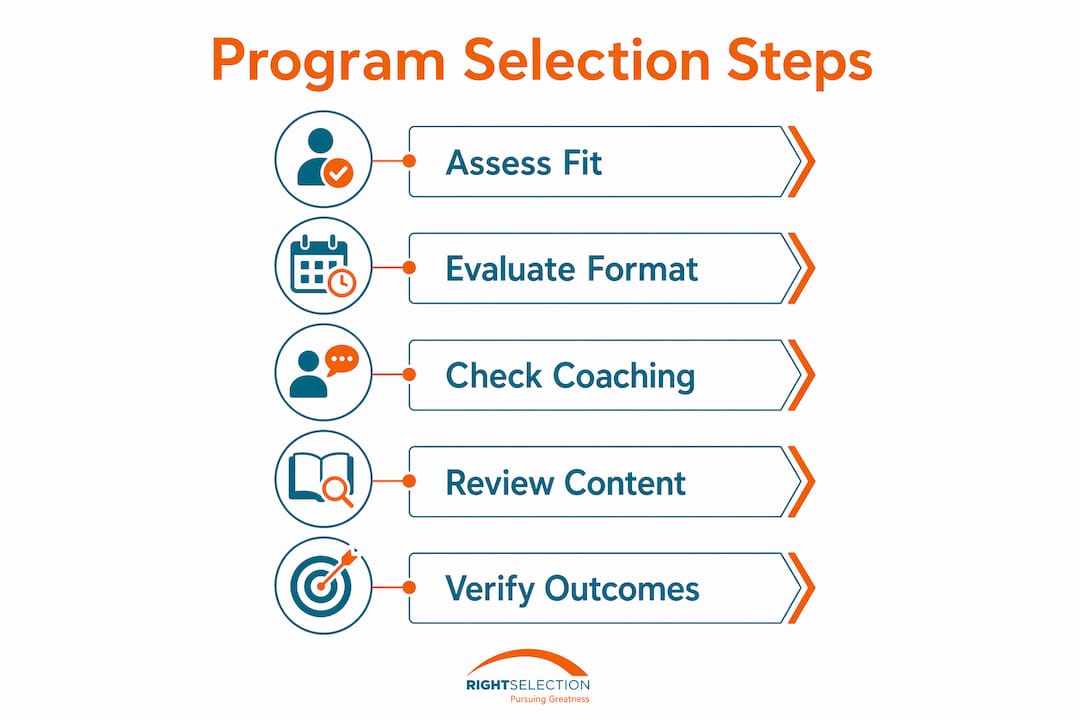
Program format is the single most practical constraint in your selection process. Your leaders’ schedules, learning preferences, and geographic locations all determine which format actually works.
| Format | Duration | Strengths | Limitations |
|---|---|---|---|
| On-campus intensive | 2–3 weeks | Deep immersion, strong peer networking | Requires full schedule commitment |
| Hybrid program | 6–12 months | Balances learning with work responsibilities | Requires self-discipline and time management |
| Fully online | 3–12 months | Maximum flexibility, lower cost | Less in-person networking and cohort bonding |
On-campus intensives create the strongest cohort bonds. Executives spend concentrated time together, which accelerates trust and peer learning. The trade-off is a complete removal from day-to-day responsibilities, which not every organization can accommodate.
Hybrid programs offer a middle path. Participants complete online modules between periodic in-person sessions. This format suits executives who need continuity in their roles while still building leadership capability over time. Understanding hybrid learning paths can help HR leaders frame this option clearly for their leadership teams.
Fully virtual programs have improved significantly in quality and depth. They work best when the organization has a distributed leadership team or when budget is a primary constraint. The networking dimension is weaker, but the content delivery can be equally rigorous.
Pro Tip: If your organization is investing in a cohort of five or more executives, negotiate for a hybrid format with at least one in-person session. The relationship capital built in person compounds over years.
What role does executive coaching play in leadership development?
Executive coaching is the mechanism through which program content becomes behavioral change. Without it, even the best curriculum produces knowledge without transformation.
Coaching focuses on identifying blind spots and strengthening judgment under pressure through honest one-on-one conversations. That is a fundamentally different activity from attending a lecture or completing a case study. It requires a qualified coach, a willing participant, and enough sessions to create real momentum.
Executive coaching packages typically cost around $3,800 USD and include leadership assessments plus approximately five personalized coaching sessions. That investment is modest relative to the cost of a poor leadership decision at the executive level.
Quality coaching within a program includes these elements:
- A validated leadership assessment, such as the Hogan, completed before coaching begins
- A personalized development plan built from assessment results
- Structured one-on-one sessions with a qualified executive coach
- Mid-program check-ins to track behavioral progress
- A closing session to anchor commitments and next steps
Coaching differs from consulting in one critical way. Consulting delivers technical advice and frameworks. Coaching develops judgment and decision-making under pressure. Both have value, but only coaching changes how a leader thinks and responds in real time.
When evaluating a program’s coaching component, ask how coaches are selected and credentialed. Ask whether coaching is personalized or delivered in group settings. Ask whether the coaching plan is tied to assessment results or applied generically. The answers reveal whether coaching is a genuine program feature or a marketing add-on.
The types of executive coaching programs available today vary widely in structure and depth. Matching the right coaching model to your leaders’ development stage is as important as selecting the program itself.
How do you implement a leadership program for maximum impact?
Selecting the program is only half the work. Implementation determines whether the investment produces lasting change or fades within six months of completion.
Complete leadership assessments before the program begins. Assessments such as Hogan establish a baseline and allow coaches to personalize development plans from day one. Without a baseline, you cannot measure progress.
Set clear development goals before enrollment. Each participant should enter the program with two or three specific leadership behaviors they intend to strengthen. Vague intentions produce vague results.
Engage actively during the program. Passive attendance is the most common reason programs fail to produce change. Participants who engage with peer discussions, coaching sessions, and capstone projects consistently report stronger outcomes.
Apply learning immediately. The compound effect of applying new frameworks to real decisions during the program is far greater than waiting until completion. Capstone projects that address live organizational challenges are the most effective mechanism for this.
Schedule post-program coaching. The period immediately after program completion is when behavioral change is most fragile. At least two to three follow-up coaching sessions within the first 90 days protect the investment and reinforce new habits.
Measure outcomes at 90 days and 12 months. Track specific leadership behaviors, team performance indicators, and business outcomes tied to the development goals set before enrollment. Leadership training best practices consistently show that measurement accountability doubles the likelihood of sustained behavioral change.
Pro Tip: Assign an internal sponsor, such as a direct manager or CHRO, to each participant. Sponsors who check in monthly during and after the program significantly increase completion rates and post-program application.
Key Takeaways
The most effective executive leadership development programs combine rigorous content, qualified coaching, and applied projects, then succeed or fail based on how deliberately organizations implement them.
| Point | Details |
|---|---|
| Match program to experience level | Target programs designed for 10+ years of experience for senior executive participants. |
| Prioritize coaching quality | Look for validated assessments, personalized plans, and qualified one-on-one coaches. |
| Choose format by schedule reality | Match on-campus, hybrid, or online format to participants’ actual availability and goals. |
| Apply learning during the program | Capstone projects tied to real challenges produce stronger outcomes than theory alone. |
| Measure outcomes at 90 days and 12 months | Set specific behavioral goals before enrollment and track them with structured follow-up. |
Why program selection is where most organizations get it wrong
I have seen organizations invest significantly in executive training programs and walk away with little to show for it. The pattern is almost always the same. The program was selected based on brand name rather than fit. The coaching component was treated as optional. And no one measured anything afterward.
The most common mistake I observe is selecting a program for its prestige rather than its alignment with the organization’s actual leadership gaps. A well-known institution’s name on a certificate does not close a specific gap in how your senior leaders handle conflict, communicate vision, or build cross-functional trust. Fit matters more than reputation.
The second mistake is underestimating coaching. Organizations that view coaching as a nice-to-have consistently see weaker outcomes than those that treat it as the core mechanism of change. The benefits of executive leadership training are real, but they materialize through behavioral practice, not passive learning.
The trend worth watching in 2026 is the integration of AI strategy into executive curricula. Programs that address how leaders manage AI-driven decision-making and organizational change are preparing executives for the next five years, not the last ten. That content distinction is now a meaningful selection criterion, not a bonus feature.
My honest recommendation: treat program selection as a strategic decision with the same rigor you apply to a major hire. Define the leadership gap first. Then find the program that closes it.
— Dipti
How Right Selection connects you with the right leadership expertise
Right Selection has spent over 30 years curating an elite network of global thought leaders, executive coaches, and corporate trainers who specialize in leadership development at the senior level.
When you work with Right Selection, you get more than a speaker or a trainer. You get a partner who designs each session around your organization’s specific leadership goals and participant needs. The roster includes 100+ specialists across leadership coaching, enterprise strategy, and organizational development. Whether you need a keynote to open a leadership summit or a sustained coaching program for your C-suite, Right Selection matches the right expertise to the right moment. Visit Right Selection to connect with a specialist and begin building a program that delivers measurable leadership growth.
FAQ
What is an executive leadership development program?
An executive leadership development program is a structured learning experience that builds strategic thinking, decision-making, and organizational influence for senior leaders. Programs typically combine formal instruction, executive coaching, and applied projects.
How long do executive leadership programs typically last?
Program duration ranges from two weeks for on-campus intensives to 12 months for hybrid or online formats. The right length depends on your participants’ schedules and the depth of behavioral change required.
What experience level do executive programs target?
Most senior executive programs target professionals with 10 or more years of experience. Programs distinguish clearly between mid-level managers and C-suite executives in both content and peer cohort composition.
How do I evaluate the coaching quality in a leadership program?
Look for programs that use validated assessments such as Hogan, provide personalized development plans, and include qualified one-on-one coaches. Group coaching sessions are less effective than individualized coaching tied to assessment results.
How do I measure the ROI of an executive leadership program?
Set specific behavioral development goals before enrollment, then track progress at 90 days and 12 months post-completion. Pair behavioral metrics with business outcomes such as team performance, retention, and decision quality to build a complete picture.