

Strategic alignment is defined as the deliberate connection between what an organization trains its leaders to do and what the business actually needs to achieve. When that connection breaks down, the cost is real. Misalignment costs Fortune 500 companies $7.5 billion annually in lost productivity and missed opportunities. For corporate leaders and HR professionals, the imperative to align leadership training with business strategy is not a best practice. It is a financial and organizational necessity. Frameworks like OKRs and SMART goals exist precisely to close this gap, and the organizations that use them consistently outperform those that treat leadership development as a standalone HR function.
What does it take to align leadership training with business strategy?
Alignment does not begin with a training calendar. Leadership training must be designed after fully understanding business strategy, industry shifts, and internal priorities. That sequence matters. Starting with training content before clarifying business direction produces programs that feel relevant but deliver little measurable impact.
Before any training program is built, four foundational conditions must be in place:
- Executive clarity: Senior leaders must articulate the organization’s strategic priorities in specific, measurable terms. Vague direction produces vague training.
- Shared ownership: HR and L&D professionals must be recognized as strategic partners, not just program administrators. This requires a seat at the strategy table.
- Accountability structures: Clear ownership of leadership development outcomes must be assigned at the business unit level, not just within HR.
- Cross-functional collaboration: Siloed departments produce disjointed alignment even when individual teams perform well. Decision rights must be clarified across functions.
| Prerequisite | Why it matters |
|---|---|
| Executive clarity on strategy | Training goals cannot be set without knowing where the business is headed |
| Shared ownership between HR and business units | Prevents L&D from operating in isolation |
| Accountability at the business unit level | Ensures training outcomes are tracked against real performance |
| Cross-functional collaboration | Reduces siloed development efforts that contradict each other |
Pro Tip: Before launching any leadership development initiative, conduct a 30-minute strategy briefing with your CFO or COO. Ask them to name the top three business outcomes they need leaders to drive in the next 12 months. Build your training framework from that conversation, not from a competency model.
Which frameworks best cascade business objectives into training goals?
Cascading goal frameworks translate high-level strategy into specific leadership development targets. The two most widely used are OKRs (Objectives and Key Results) and SMART goals. Both work, but they serve different organizational contexts.
OKRs, popularized by Google and Intel, connect company-level ambitions to team and individual objectives through a transparent, nested structure. A company OKR focused on expanding into new markets cascades into a leadership training OKR focused on building cross-cultural communication and negotiation skills. The connection is explicit and traceable. Quarterly review cadences allow leaders to adjust training priorities based on market feedback without abandoning the long-term vision.
SMART goals offer a more structured, compliance-friendly format that works well in regulated industries or organizations with lower OKR maturity. They define training outcomes with specificity, measurability, and time boundaries. The tradeoff is less flexibility and a weaker connection to company-wide strategic narratives.
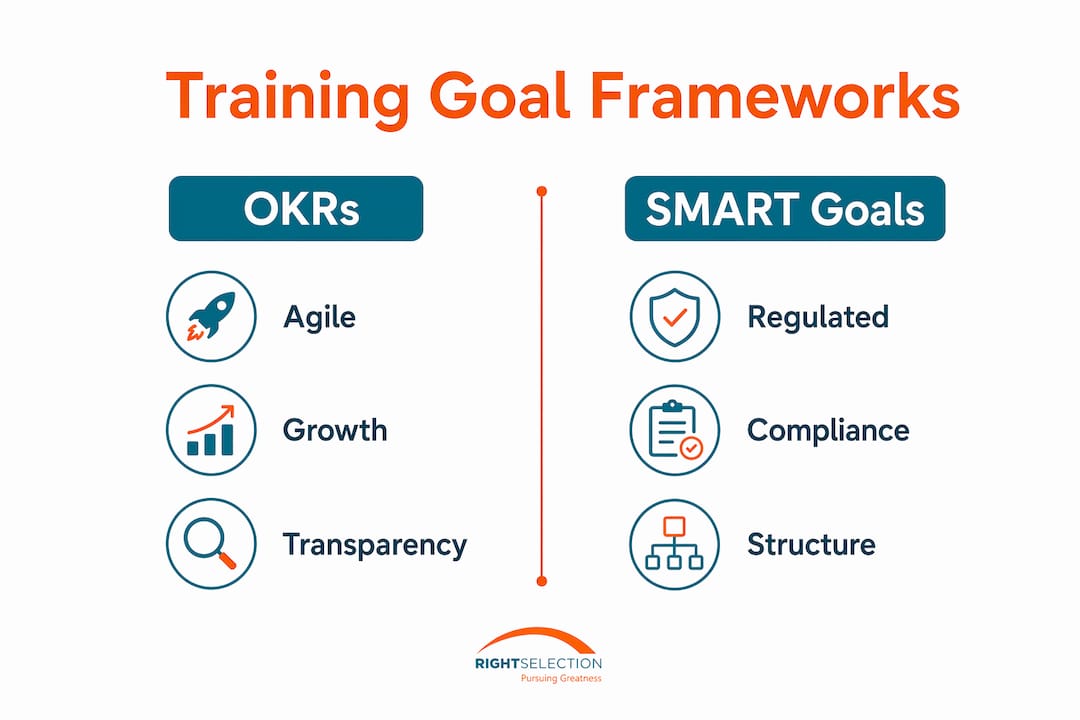
| Dimension | OKRs | SMART goals |
|---|---|---|
| Best for | Agile, growth-oriented organizations | Regulated or process-driven environments |
| Cascading ability | Strong, nested from company to individual | Moderate, requires manual linking |
| Review cadence | Quarterly | Typically annual or semi-annual |
| Flexibility | High, adjustable mid-cycle | Lower, fixed at goal-setting |
| Executive visibility | High, transparent across levels | Moderate, often siloed by department |
Cascading goal-setting frameworks like OKRs and SMART goals connect company-level strategic objectives directly to leadership training plans. That direct connection is what separates programs that move the business forward from programs that simply fill calendars.
Pro Tip: Do not force OKRs onto an organization that has never used transparent goal-setting before. Start with SMART goals to build the habit of connecting training to outcomes, then introduce OKR structure once leaders are comfortable with the accountability model.
How to map leadership training programs to measurable business outcomes
The most effective leadership training programs are built backward from business outcomes. Treating leadership training as a business product means identifying internal executive customers and linking every training module to a KPI they care about. This reframe changes how HR professionals design, pitch, and measure development programs.

Start by identifying the leadership competencies that directly support your current business priorities. If the business is focused on revenue growth, the relevant competencies are commercial acumen, client relationship management, and pipeline accountability. If the priority is talent retention, the competencies shift to coaching skills, psychological safety, and career development conversations.
Connect each competency to a specific, trackable metric:
- Revenue growth: Track deal conversion rates and average contract value among leaders who completed commercial skills training.
- Talent retention: Measure 90-day and 12-month retention rates for teams led by managers who completed coaching certification.
- Innovation: Count the number of new initiatives launched by teams whose leaders participated in design thinking workshops.
- Operational efficiency: Compare project delivery timelines before and after leadership training on prioritization and delegation.
Leadership development aligned with strategy improves decision-making, strengthens culture, and supports business transformation for growth. That outcome is not automatic. It requires that every training program be designed with a specific business problem in mind, not a generic competency framework.
Pro Tip: Present your leadership training proposal to the executive team as a business case, not a training plan. Lead with the business problem, state the expected KPI impact, and include a measurement timeline. Executives fund what they can measure.
What are best practices for maintaining alignment over time?
True alignment is fragile. It breaks quickly without clarity, ownership, accountability, and reinforcement through behavior and systems. Maintaining it requires deliberate, ongoing effort across three areas: accountability, daily practice, and periodic audits.
Accountability means that leadership development outcomes appear in performance reviews, business unit scorecards, and executive dashboards. When training results are invisible to the people who control budgets, programs lose funding and priority. Reward systems must recognize leaders who develop their teams, not just those who hit short-term numbers.
Daily practice means that alignment shows up in day-to-day priorities, conversations, and decisions. Leaders who reference training concepts in team meetings, apply coaching skills in one-on-ones, and connect their team’s work to company strategy are the visible proof that alignment is working. Without that behavioral reinforcement, training fades within weeks.
Periodic audits close the loop. Every quarter, HR and business leaders should review three questions together:
- Are the leadership competencies we are developing still connected to the business priorities that matter most right now?
- Are the metrics we are tracking actually measuring leadership impact, or just training activity?
- Have organizational changes, such as restructuring or new market entries, created gaps in our current training program?
Alignment is not a static achievement. It is a continuous system of coherence across priorities, incentives, and capabilities. Organizations that treat it as a one-time exercise will find their training programs drifting from business reality within two to three quarters.
What challenges arise when aligning training with strategy, and how do you fix them?
The most common obstacle is confusing agreement with alignment. Leadership teams often nod at a strategy document and assume everyone is pulling in the same direction. They are not. Most organizations confuse agreement on strategy with true alignment. Structural incentives, accountability systems, and operational priorities must be audited to confirm that alignment actually exists.
Four specific challenges appear repeatedly in organizations attempting to connect leadership training with business strategy:
- Siloed departments: When business units design their own leadership training without a shared framework, programs contradict each other. The fix is a central alignment committee with representation from HR, Finance, Operations, and the C-suite.
- Unclear ownership: If no one owns the outcome of a leadership program, no one measures it. Assign a named business sponsor to every major training initiative, with accountability for results.
- Gap between aspiration and execution: L&D teams often understand the strategy but lack the organizational access to translate it into training design. L&D professionals become strategic partners by adopting a view focused on business outcomes rather than training delivery. That shift requires both mindset and organizational positioning.
- Weak executive sponsorship: Training programs without a visible executive champion lose credibility with participants. Secure a named sponsor at the VP level or above before launching any company-wide leadership initiative.
Addressing these challenges requires structural changes, not just better communication. The organizations that succeed at effective leadership training treat alignment as an operational discipline, not a cultural aspiration.
Key takeaways
Aligning leadership training with business strategy requires clear goal cascading, measurable outcomes, and sustained accountability structures that connect development directly to organizational performance.
| Point | Details |
|---|---|
| Start with strategy, not training | Design leadership programs only after clarifying business priorities and executive goals. |
| Use cascading frameworks | OKRs and SMART goals connect company objectives directly to individual leadership development targets. |
| Map training to KPIs | Link every training module to a specific business metric such as retention, revenue, or innovation. |
| Sustain alignment actively | Quarterly audits, accountability systems, and daily behavioral reinforcement prevent alignment from drifting. |
| Fix structural causes first | Siloed departments and unclear ownership are organizational problems, not communication problems. |
Why alignment fails more often than it should
Most alignment failures I have observed are not caused by poor training content. They are caused by organizations that skip the structural work and jump straight to program design. A leadership workshop on strategic thinking means very little if the leaders attending it have no clarity on what the company’s actual strategy is. That gap is more common than most executives want to admit.
What I have found consistently is that the organizations with the strongest leadership development strategy treat it as a continuous business capability, not a periodic HR event. They review training priorities the same way they review financial forecasts: regularly, with data, and with a willingness to change course. The compound effect of that consistency is significant. Leaders who receive development that is directly connected to their real challenges grow faster, perform better, and stay longer.
The uncomfortable truth is that securing executive buy-in for leadership training is easier than most HR professionals believe, once you speak the language of business outcomes. Stop presenting training plans. Start presenting business cases with projected KPI impact and a measurement timeline. Executives fund what moves the needle. Show them the needle.
— Dipti
How Right Selection supports leadership and strategy alignment
Right Selection works with corporate leaders and HR professionals to design leadership development programs that connect directly to business goals and deliver measurable results.

With over 30 years of experience and a roster of 100+ global thought leaders, Right Selection curates speakers, coaches, and trainers whose expertise matches your organization’s specific priorities. Whether you need executive coaching for decision-making or a full training program tied to growth objectives, the team builds each engagement around your outcomes. Speakers like Mark C. Thompson and Doug Lipp bring direct experience connecting leadership capability to organizational performance. Visit Right Selection to explore how tailored session design can move your leadership training from activity to impact.
FAQ
What is strategic alignment in leadership training?
Strategic alignment in leadership training means designing development programs that directly support the organization’s current business objectives. It connects leadership competencies to specific outcomes like revenue growth, talent retention, or market expansion.
How do OKRs help align leadership development with business strategy?
OKRs cascade company-level objectives down to team and individual leadership goals, making the connection between training and business outcomes explicit and trackable. Quarterly reviews keep the alignment current as business conditions change.
Why does leadership training fail to align with business strategy?
Leadership training fails most often because programs are designed before business strategy is clearly defined, or because structural issues like siloed departments and unclear ownership prevent execution.
How do you measure the impact of aligned leadership training?
Measure impact by tracking KPIs directly connected to the competencies trained, such as retention rates for managers who completed coaching programs or revenue metrics for leaders who completed commercial skills development.
How often should leadership training alignment be reviewed?
A quarterly review cadence is the recognized standard. It allows organizations to adjust training priorities based on market feedback while maintaining focus on long-term strategic goals.