

Executive coaching is a structured, personalized development process that measurably improves leaders’ decision-making by building self-regulation, reflective thinking, and strategic behavior change. Where most leadership interventions stop at awareness, coaching converts insight into repeatable, high-quality choices under pressure. Industry analysis of International Coaching Federation data shows coaching ROI averages 788%, driven specifically by improvements in decision-making speed and stakeholder alignment. That number reflects something deeper than skill acquisition. It reflects a fundamental shift in how leaders think, prioritize, and act when the stakes are highest.
Why executive coaching improves decision-making at the behavioral level
The most precise answer to why executive coaching improves decision-making lies in what it targets: the cognitive and behavioral patterns that govern how leaders process information and choose a course of action. A meta-analysis published in Frontiers in Psychology in March 2026 confirmed that coaching produces its strongest effects on goal setting, self-regulation, and reflective thinking. These are not soft skills. They are the precise mechanisms that determine whether a leader makes a reactive call or a deliberate one.
Self-regulation, in particular, is what separates leaders who perform consistently from those who perform brilliantly in calm conditions and poorly under stress. Coaching builds this capacity through repeated cycles of reflection, feedback, and behavioral rehearsal. Over time, the leader develops what practitioners describe as an internal operating system: a set of tested mental habits that activate automatically in high-stakes moments.

Reflective thinking is the other critical mechanism. Most executives are trained to move fast, which means they rarely interrogate the assumptions behind their decisions. Coaching creates a structured space to do exactly that. The result is not slower decisions. It is decisions made with greater clarity about what actually matters and why.
Here is what the behavioral research shows coaching consistently improves:
- Goal clarity: Leaders learn to distinguish between urgent tasks and decisions that move the organization forward.
- Self-regulation: Emotional reactivity decreases, and deliberate reasoning increases under pressure.
- Reflective thinking: Leaders develop the habit of examining assumptions before committing to a direction.
- Behavioral follow-through: Coaching bridges knowing and doing, shifting leaders from tactical responses to strategic execution.
Pro Tip: Set specific, measurable behavioral goals at the start of every coaching engagement. Vague goals like “become a better decision-maker” produce vague results. Goals like “reduce time-to-decision on cross-functional issues by 30%” give both coach and leader a clear target to work toward.
What coaching structures actually support better decisions
Understanding the mechanics of how coaching enhances decision-making requires looking at how engagements are designed. Typical coaching programs span six to twelve months with bi-weekly sessions of sixty to ninety minutes, plus between-session access for urgent decision support. This structure matters because decision-making improvement is not a one-time event. It is a compound effect built through consistent, structured reflection over time.
The most powerful tool in a coach’s practice is the question, not the answer. Powerful coaching questions interrupt habitual, reactive thinking and prompt leaders to examine their values, priorities, and assumptions before acting. A question like “What would you decide if you were not afraid of the outcome?” does not give a leader an answer. It gives them access to their own best judgment, which is far more durable than any advice a coach could offer.
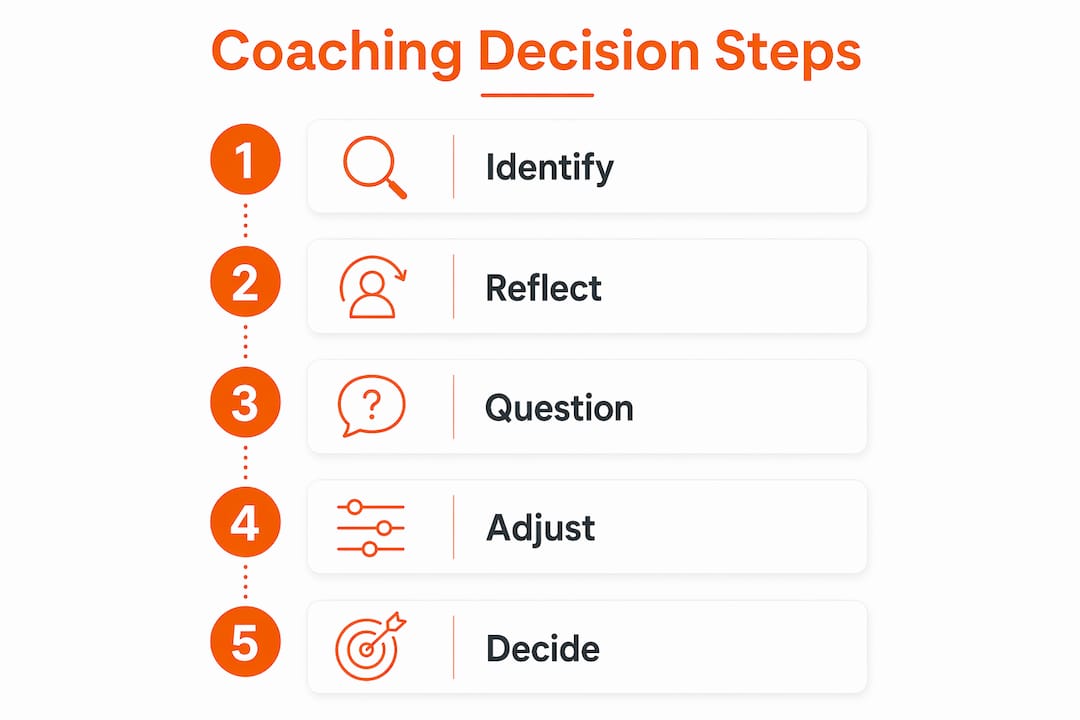
There is a paradox at the center of coaching for decision-making: slowing down to speed up. Leaders who pause to reflect before deciding consistently execute faster and with greater confidence than those who react immediately. Coaching trains this pause as a deliberate skill, not a hesitation.
The table below compares coaching to other common leadership development approaches on the dimensions most relevant to decision-making:
| Approach | Primary focus | Decision-making impact | Duration of effect |
|---|---|---|---|
| Executive coaching | Behavioral change and self-awareness | High: targets the specific habits that drive choices | Sustained over 12+ months |
| Leadership training | Knowledge and skill acquisition | Moderate: builds frameworks but not application habits | Fades without reinforcement |
| Mentoring | Experience transfer and guidance | Variable: depends on mentor’s relevance to leader’s context | Long-term but unstructured |
| 360-degree feedback | Awareness of perception gaps | Low to moderate: identifies issues but does not build new habits | One-time unless followed up |
Pro Tip: Use between-session access strategically. When a high-stakes decision surfaces between scheduled sessions, a brief check-in with your coach to surface blind spots can prevent a costly reactive call.
How coaching outperforms training alone in building decision quality
Training builds knowledge. Coaching builds the behavior that applies knowledge under real conditions. This distinction is the core of why executive coaching for leaders produces stronger decision-making outcomes than training programs alone. A leader can complete a course on cognitive bias, understand the theory perfectly, and still default to confirmation bias the next time a major acquisition is on the table. Coaching closes that gap.
Coaching combined with prior training yields stronger returns than either intervention alone because it personalizes and sustains the learning. The training provides the framework; the coaching embeds it into the leader’s actual decision process through repeated application and feedback. This is the compound effect in practice.
There are specific conditions that determine whether coaching delivers on this promise:
- Genuine motivation: Leaders who enter coaching because they want to grow outperform those who are sent by HR. Intrinsic motivation is the single strongest predictor of coaching success.
- Organizational support: When a leader’s manager and peers reinforce the behavioral changes being developed in coaching, the impact multiplies. When the organization rewards the old behavior, coaching fights an uphill battle.
- Clear goal alignment: Effective engagements require explicit agreement between the leader, the coach, and the sponsoring organization on what success looks like. Ambiguity at the contracting stage produces weak outcomes.
- Trust and confidentiality: Leaders will not surface their real decision-making challenges in a coaching session unless they trust the conversation stays private. Confidentiality is not a courtesy. It is a structural requirement for coaching to work.
The practical implication for you as a leader is straightforward. If your organization is investing in leadership training, adding a coaching component to that investment is not a luxury. It is the mechanism that converts the training spend into actual behavioral change.
How leaders can apply coaching insights to real decisions
The most direct application of coaching to decision-making is using your coach as a confidential sounding board before high-stakes choices. This is not about outsourcing the decision. It is about creating a structured space to examine your reasoning before you commit. Leaders navigating mergers, AI-driven organizational change, or cultural transformation consistently report that coaching sessions before major announcements or strategy pivots sharpen their thinking and reduce the emotional noise that distorts judgment.
Coaching also builds resilience and psychological capital, which functions as developmental insurance ahead of crises. Leaders who have worked through their decision-making patterns in coaching are better equipped to maintain performance when conditions deteriorate. They have already practiced the pause. They have already examined their default responses. When the crisis arrives, the internal operating system activates rather than collapses.
Here is a practical sequence for integrating coaching into your decision process:
- Identify the decision category. Before your next coaching session, flag the two or three decisions currently causing the most cognitive friction. These are the ones worth examining.
- Surface the assumptions. Ask your coach to help you identify what you are taking for granted in each scenario. Most poor decisions rest on an unexamined assumption.
- Map the stakeholder dynamics. Coaching is particularly effective at helping leaders see how their own behavioral patterns affect how others respond to their decisions.
- Rehearse the communication. For decisions with significant organizational impact, use coaching to rehearse how you will frame and deliver the message. Execution quality matters as much as decision quality.
- Review outcomes deliberately. After a major decision plays out, debrief with your coach. This is where the deepest learning happens and where the next decision gets better.
Coaches like Marshall Goldsmith and Chris Roebuck have built their practices on exactly this kind of structured, decision-focused engagement with senior leaders. The methodology is consistent: slow down the process enough to see it clearly, then act with full commitment.
Key takeaways
Executive coaching improves decision-making by building the behavioral habits of self-regulation, reflective thinking, and strategic clarity that leaders cannot develop through training or experience alone.
| Point | Details |
|---|---|
| Behavioral change drives better decisions | Coaching targets self-regulation and reflective thinking, the specific habits that determine decision quality under pressure. |
| Structure and cadence matter | Six to twelve month engagements with bi-weekly sessions create the compound effect needed for sustained improvement. |
| Coaching outperforms training alone | Combining coaching with prior training embeds knowledge into applied behavior, producing stronger and more durable outcomes. |
| Slowing down accelerates execution | The coached habit of strategic reflection before deciding leads to faster, more confident action, not slower decisions. |
| Conditions determine outcomes | Motivation, organizational support, and clear goal alignment are the structural requirements for coaching to deliver on its promise. |
What I have learned about coaching and the decisions that define leaders
I have worked alongside coaches and senior leaders long enough to recognize a pattern that most articles on this topic miss. The leaders who get the most from executive coaching are not the ones who arrive with the biggest problems. They are the ones who arrive with the most honest questions about their own thinking.
Coaching is not advice-giving. A coach who tells you what to decide is not coaching you. They are consulting. The real value of coaching is that it builds an internal operating system you carry into every boardroom, every crisis, and every conversation where the stakes are high. That is a fundamentally different kind of return on investment than any training program can offer.
The “slowing down to speed up” principle sounds counterintuitive to leaders who have been rewarded for decisiveness their entire careers. But the leaders I have seen make the best decisions under pressure are not the fastest. They are the most deliberate. They have practiced the pause so many times in coaching that it no longer feels like hesitation. It feels like clarity.
One more thing worth saying directly: confidentiality is not optional. If a leader cannot speak freely in a coaching session, the session produces surface-level insights at best. Organizations that sponsor coaching and then expect reporting on session content are undermining the very mechanism that makes coaching work. Protect the space, and the space will produce results.
View coaching not as a remediation tool for struggling leaders, but as an investment in the quality of every significant decision your organization makes for the next decade. The leaders who build this capacity now are the ones who will navigate complexity with discernment and consistency when it matters most.
— Dipti
Explore tailored executive coaching with Rightselection
Rightselection connects senior leaders with an elite network of coaches and thought leaders specifically selected for their ability to improve decision-making effectiveness in complex, high-pressure environments. With over 30 years of experience and a roster of 100+ global experts, Rightselection designs coaching engagements that align with your specific leadership challenges and organizational goals.

Coaches like Mark C. Thompson and Brian Tracy bring proven methodologies for strategic decision-making and leadership performance to every engagement. Whether you are preparing for a major organizational transition or building long-term decision quality across your leadership team, Rightselection’s tailored coaching programs are designed to deliver measurable outcomes. Connect with the team to explore the right fit for your goals.
FAQ
Why does executive coaching improve decision-making specifically?
Executive coaching targets the behavioral habits of self-regulation and reflective thinking that directly govern decision quality. A 2026 meta-analysis confirmed these are the areas where coaching produces its strongest, most measurable effects.
How long does it take for coaching to improve decision-making?
Typical engagements run six to twelve months with bi-weekly sessions, and most leaders report meaningful shifts in decision clarity within the first three months as new reflection habits take hold.
Is executive coaching better than leadership training for decisions?
Coaching produces stronger and more sustained behavioral change than training alone because it applies knowledge to real decisions in real time. The two work best together, with training providing frameworks and coaching embedding them into practice.
What makes a coaching engagement fail to improve decisions?
Weak outcomes arise when goal alignment is unclear, organizational support is absent, or the leader lacks genuine motivation to change. Confidentiality and trust between coach and leader are also structural requirements, not optional features.
How do powerful questions in coaching change decision-making?
Powerful questions interrupt reactive thinking and prompt leaders to examine their values and assumptions before acting. This process, developed through consistent coaching practice, reduces emotional reactivity and produces more deliberate, values-aligned choices.