

Executive coaching is defined as a structured, confidential, one-on-one professional relationship that develops a senior leader’s capacity to solve leadership challenges through behavioral change and reflection, not advice or therapy. The International Coaching Federation (ICF) recognizes it as a distinct professional practice, and meta-analyses confirm it produces measurable improvements in leadership behaviors, goal setting, and self-regulation. Unlike consulting, which delivers solutions, or mentoring, which shares experience, executive coaching builds the leader’s own problem-solving capability. Organizations like FranklinCovey and Marshall Goldsmith Stakeholder Centered Coaching have built entire methodologies around this principle. If you are a leader considering coaching or an HR professional evaluating development options, this article gives you a precise, evidence-grounded understanding of what executive coaching is and how it works in practice.
What is executive coaching explained in full?
Executive coaching is a structured confidential relationship between a trained coach and a senior leader, focused on developing the leader’s capacity rather than prescribing answers. The coach does not tell you what to do. Instead, the coach asks powerful questions, challenges assumptions, and creates space for you to develop your own clarity and direction. This distinction matters because it means the outcomes of coaching are owned by the leader, not borrowed from the coach.
The practice sits within the broader field of professional coaching, which the ICF defines as partnering with clients in a thought-provoking and creative process that inspires them to maximize their personal and professional potential. Executive coaching applies this framework specifically to leadership contexts, where the stakes are high, the decisions are complex, and honest feedback is rare. Coaches like Marshall Goldsmith have demonstrated through decades of practice that behavioral change at the senior level requires a structured, externally facilitated process.
A typical engagement is not a one-off conversation. Coaching engagements last 6 to 12 months with sessions scheduled every two to three weeks. This cadence allows enough time between sessions for the leader to experiment with new behaviors, reflect on what happened, and return with real data from their work environment. The compound effect of this cycle, repeated over months, is where genuine development occurs.
What does an executive coach do during a typical engagement?
An executive coach serves as a facilitator, sounding board, and challenger across three distinct phases of work. Understanding these phases helps you set realistic expectations before you begin.
Diagnosis and goal setting. The engagement opens with structured assessment. Coaching processes typically begin with diagnosis and goal setting, followed by ongoing coaching to translate insights into action, with progress tracked at baseline, 90, and 180 days. This phase often includes stakeholder interviews, psychometric tools, and multi-source feedback to establish a clear picture of current leadership behaviors.
Active coaching. Sessions focus on real leadership challenges the client is facing right now. The coach does not lecture. Instead, the coach uses questioning, reflection, and structured frameworks to help the leader think more clearly, decide more deliberately, and act more intentionally. Accountability is built into every session.
Progress review and integration. Near the end of the engagement, the coach and client review behavioral shifts against the original goals. This is not a performance review. It is a structured reflection on what changed, what still needs attention, and how the leader will sustain development independently.
The coach’s role is explicitly not to provide solutions. Executive coaches serve as sounding boards helping leaders with clarity, difficult conversations, transitions, self-awareness, and accountability without prescribing answers. This is the defining feature that separates coaching from consulting.
Pro Tip: Before your first coaching session, write down three leadership challenges you are currently avoiding. These are almost always the most productive starting points for coaching work.

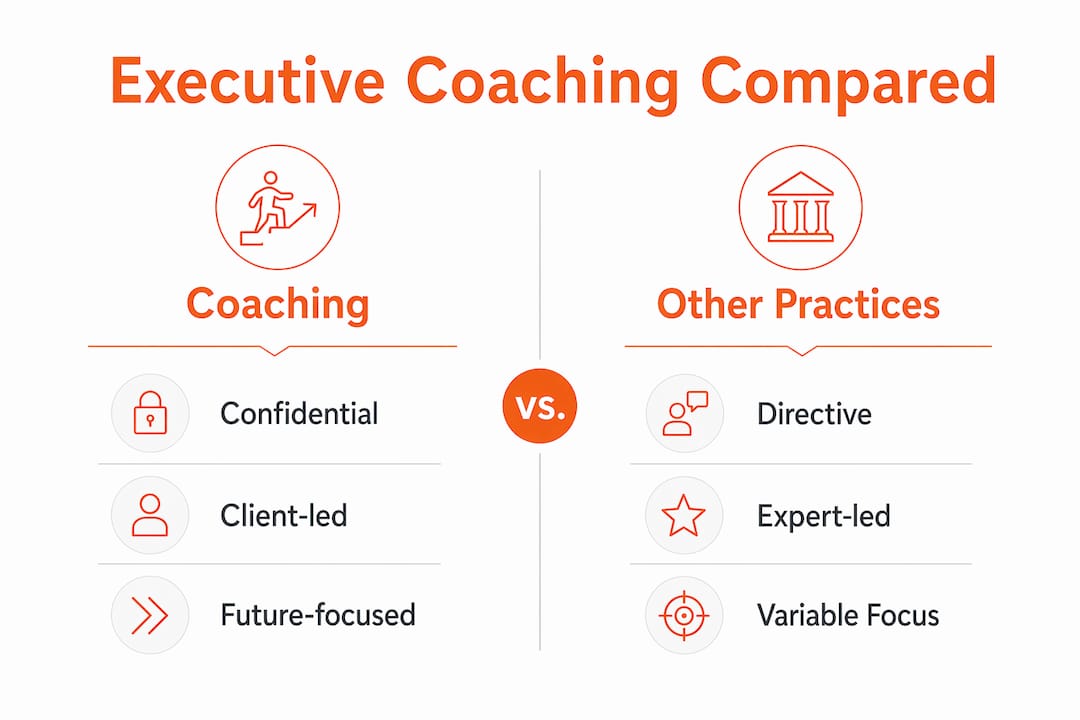
How does executive coaching differ from therapy, mentoring, and consulting?
The confusion between these four practices is common and worth resolving precisely. Each serves a different purpose, and choosing the wrong one wastes time and money.
| Practice | Primary focus | Time orientation | Who leads the solution? |
|---|---|---|---|
| Executive coaching | Behavioral change and leadership capacity | Present and future | The client, guided by the coach |
| Therapy | Emotional healing and psychological wellbeing | Past and present | The therapist and client together |
| Mentoring | Knowledge transfer and career guidance | Past experience applied to future | The mentor shares their path |
| Consulting | Problem diagnosis and solution delivery | Present problem | The consultant delivers the answer |
Therapy addresses psychological distress, trauma, or mental health conditions. Coaching assumes the client is psychologically healthy and functioning well, but wants to perform at a higher level. This is not a subtle distinction. A coach who encounters clinical issues should refer the client to a licensed therapist, not attempt to address those issues within a coaching relationship.
Mentoring transfers wisdom. A mentor who has navigated a specific career path shares what they learned so the mentee can benefit from that experience. This is genuinely valuable, but it is fundamentally different from coaching because the mentor’s experience becomes the reference point. In coaching, the client’s own experience and goals are the reference point.
Consulting delivers expertise. A consultant diagnoses a problem and recommends or implements a solution. The client pays for the consultant’s knowledge. In coaching, the client already holds the knowledge needed. The coach’s job is to help the client access and apply it more effectively. Dr. Tasha Eurich’s research on self-awareness reinforces this point: leaders who develop internal self-knowledge make better decisions than those who rely on external prescriptions.
What are the proven benefits of executive coaching?
The evidence base for executive coaching has grown substantially over the past decade, and the findings are specific enough to inform your decision.
- Improved leadership behaviors. Recent meta-analyses show executive coaching produces moderate improvements in leadership behaviors and strong effects on cognitive and performance behaviors such as goal setting and self-regulation. Strong effects on goal setting means coaching reliably changes how leaders set priorities and pursue them.
- Greater self-awareness and reduced blind spots. Utilizing 360-degree feedback increases self-awareness and reduces leader blind spots by providing multi-source data in coaching. At senior levels, where direct reports often filter feedback upward, this kind of structured honesty is difficult to obtain any other way.
- Structured space for honest reflection. Executive coaching creates a structured space for truth and reflection absent in typical organizational environments, breaking through filtered feedback common at senior levels. This is particularly valuable for C-suite leaders whose teams may hesitate to challenge them directly.
- Resilience and psychological capital. Coaching builds what researchers call psychological capital, which includes confidence, optimism, resilience, and hope. These are not soft outcomes. They directly influence how leaders respond to setbacks, manage uncertainty, and sustain performance under pressure.
- Organizational ROI. The 2023 ICF Global Coaching Study surveyed 14,591 coaches and client leaders, affirming coaching’s widespread professional legitimacy and its measurable impact on organizational outcomes. Organizations that invest in coaching report improvements in team performance, retention, and leadership pipeline strength.
The benefits compound over time. A single coaching session rarely produces transformation. Six months of consistent, structured engagement with a skilled coach produces the kind of behavioral shifts that persist long after the engagement ends.
How do executive coaching techniques apply to real leadership challenges?
Coaching techniques are most effective when anchored to the specific, high-stakes situations a leader is navigating right now. Effective executive coaching anchors conversations in real-time leadership challenges, focusing on practical interventions rather than abstract discussion. Here is how that looks in practice across common leadership scenarios.
- Role transitions. A newly promoted executive moving from individual contributor to people leader faces a fundamental identity shift. Coaching helps them identify which old behaviors to release and which new ones to build, using structured reflection and accountability between sessions.
- Stakeholder conflict. When a senior leader is struggling with a difficult peer relationship or board dynamic, coaching provides a confidential space to examine their own contribution to the conflict, develop a clear communication strategy, and practice difficult conversations before having them.
- High-stakes decision-making. Coaching does not make decisions for leaders. It slows the decision process down enough for the leader to examine their assumptions, consider second-order consequences, and decide with greater clarity and confidence.
- Accountability and behavior change. Research confirms that more coaching sessions do not automatically mean better outcomes. Quality of engagement and alignment with real challenges matter most. A leader who brings genuine problems to each session and commits to experimenting between sessions will outperform one who treats coaching as a scheduled obligation.
Multi-source feedback tools, particularly 360-degree assessments, are a standard technique in executive coaching. 360-degree feedback is integrated confidentially to inform coaching priorities and support honest self-assessment. The data from these tools gives both coach and client a shared, evidence-based starting point rather than relying on the leader’s self-perception alone.
Pro Tip: Ask your coach to anchor at least 70% of your sessions to a specific, current leadership challenge. Abstract discussions about leadership philosophy are interesting but rarely produce behavioral change.
Key takeaways
Executive coaching is the most evidence-backed method for producing sustained behavioral change in senior leaders, and its impact depends on structured engagement with real challenges, not session volume alone.
| Point | Details |
|---|---|
| Clear definition matters | Executive coaching builds leadership capacity through behavioral change, not advice, therapy, or consulting. |
| Structure drives outcomes | Engagements of 6 to 12 months with sessions every 2 to 3 weeks produce the sustained reflection needed for change. |
| Evidence supports the investment | Meta-analyses confirm strong effects on goal setting, self-regulation, and leadership behavior across multiple studies. |
| 360 feedback is a core tool | Multi-source feedback reduces blind spots and creates a shared, honest baseline for development work. |
| Quality beats quantity | Coaching success depends on engagement quality and alignment with real leadership challenges, not the number of sessions. |
Why honest feedback is the real reason executive coaching works
From where I sit, having worked alongside thought leaders and coaches across industries for years, the most underappreciated aspect of executive coaching is not the methodology. It is the honesty.
Senior leaders operate in environments where almost everyone around them has a reason to soften the truth. Direct reports want to protect their careers. Peers want to maintain relationships. Boards want to project confidence. The result is that many high-performing executives are making consequential decisions with incomplete or filtered information about how their behavior lands on others.
Coaching breaks that pattern. A skilled coach has no organizational agenda. They are not competing for budget, protecting a relationship, or managing upward. That independence creates a rare kind of candor that most leaders have not experienced since early in their careers, if ever.
What I have observed is that leaders who engage with coaching seriously, meaning they bring real problems, accept honest feedback, and commit to experimenting with new behaviors, tend to describe it as one of the most significant development experiences of their careers. Not because the coach gave them answers, but because the coach helped them see what they already knew but had been avoiding.
The leaders who get the least from coaching are those who treat it as a box to check or a benefit to consume passively. Coaching requires commitment. It requires the willingness to sit with discomfort, examine your own patterns, and try something different. That is not easy at any level of seniority. But the leaders who do it consistently report that the compound effect on their clarity, confidence, and impact is worth every session.
— Dipti
Explore expert coaching through Rightselection
Rightselection connects professionals and organizations with an elite network of global coaches, thought leaders, and corporate trainers who deliver measurable leadership development outcomes. With over 30 years of experience and a roster of 100+ speakers and coaches, Rightselection specializes in curating coaching engagements that align precisely with your leadership goals and organizational context.
Whether you are a senior leader preparing for a role transition, an HR director building a leadership pipeline, or an executive seeking structured accountability, Rightselection’s expert coaching network offers tailored programs designed to produce real behavioral change. Coaches like Phil Bedford and May Sayed Ali bring proven frameworks and genuine discernment to every engagement. Explore your options and find the right coach for your specific leadership context.
FAQ
What is the executive coaching definition in professional practice?
Executive coaching is a structured, confidential, one-on-one relationship between a trained coach and a senior leader, focused on developing the leader’s capacity through behavioral change and reflection rather than providing advice or solutions.
How long does an executive coaching engagement typically last?
A typical executive coaching engagement lasts 6 to 12 months, with sessions scheduled every two to three weeks to allow time for reflection and behavioral experimentation between meetings.
What is the difference between executive coaching and mentoring?
Mentoring transfers the mentor’s experience and knowledge to guide the mentee’s career path. Executive coaching builds the client’s own problem-solving capacity through structured questioning and reflection, without the coach prescribing a direction based on personal experience.
What does an executive coach actually do in sessions?
An executive coach asks powerful questions, provides structured feedback, uses tools like 360-degree assessments, and holds the leader accountable to behavioral commitments made between sessions. The coach facilitates clarity without delivering solutions.
Does executive coaching produce measurable results?
Yes. Meta-analyses confirm executive coaching produces moderate to strong improvements in leadership behaviors, goal setting, and self-regulation. The ICF Global Coaching Study surveyed nearly 15,000 coaches and leaders, affirming coaching’s measurable impact on both individual and organizational performance.