

Peer coaching in organizations is defined as a structured group process where colleagues of comparable status meet regularly to support each other’s professional development. Known formally as peer coaching groups (PCGs), this method offers a low-cost alternative to one-to-one coaching without sacrificing depth or accountability. PCGs typically involve 4–6 members meeting on a consistent schedule, working through real work challenges rather than theoretical exercises. The result is a development model that scales across an organization, reaches employees outside formal coaching budgets, and builds lasting behavioral change. Understanding what peer coaching in organizations actually looks like, and how to run it well, is what separates programs that transform culture from ones that quietly fade out.
How does peer coaching work in organizations?
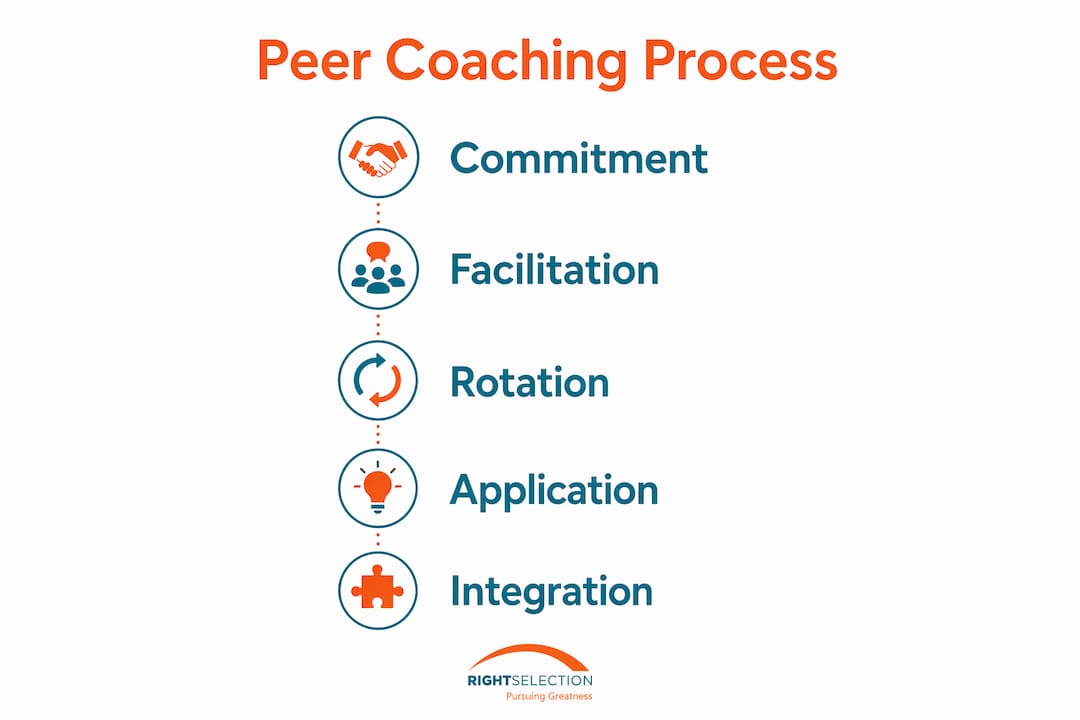
Peer coaching operates through a repeating cycle of structured group sessions, not open-ended conversations. PCGs typically involve 4–6 members who meet regularly over a defined period, guided by structured materials rather than improvised discussion. Each session focuses on real challenges participants face in their current roles, not hypothetical scenarios or past case studies.
The session structure follows a clear sequence:
- Check-in. Each participant briefly shares progress on commitments made in the previous session.
- Topic engagement. The group works through a structured discussion guide covering a specific leadership or professional skill.
- Application. Participants connect the topic directly to a challenge they are currently facing at work.
- Commitment. Each person states a specific next step they will take before the next meeting, in front of the group.
- Reflection. The group closes with brief observations on what shifted in their thinking during the session.
The commitment step is the most underrated part of the process. Research shows participants demonstrate a higher likelihood to act on goals when commitments are made publicly in a peer setting. Accountability to colleagues, not a manager or coach, creates a different kind of follow-through.
Facilitation is peer-led by design. Expert facilitators often undermine peer expertise and engagement, so the role rotates among group members. One person manages time and keeps the conversation on track. The others participate as equals.
Pro Tip: Rotate the facilitator role every session. This builds facilitation skills across the group and prevents any one person from dominating the dynamic.
Sessions work best when the group treats the time as a working meeting, not a support circle. The goal is to wrestle with real problems and leave with a concrete commitment, not to vent or commiserate.

What are the benefits of peer coaching for employees and organizations?
Peer coaching delivers benefits at both the individual and organizational level, and the two reinforce each other over time.
For individual employees, the most direct benefits include:
- Stronger leadership behaviors. Peer coaching circles build the habit of asking better questions and challenging assumptions, which are core leadership skills that traditional training rarely instills.
- Higher accountability. Public commitments made in front of peers create follow-through that self-directed learning cannot replicate.
- Expanded networks. Peer coaches benefit by growing their internal networks and developing communication and leadership skills simultaneously.
- Reduced burnout risk. Peer coaching strengthens relationships and builds a sense of community, which supports engagement and reduces turnover.
- Broader perspective. PCGs break hierarchical barriers, giving employees access to diverse viewpoints they would not encounter in one-to-one coaching.
For organizations, the compound effect of peer coaching across teams is significant. When peer coaching becomes part of how leaders work, not just a program they attend, it changes the culture.
Peer coaching groups built on compassion stimulate neural engagement that maximizes openness to feedback and long-term behavioral change. At scale, this shifts organizational habits beyond isolated development programs, embedding coaching behaviors into everyday leadership interactions.
Cost-effectiveness is another clear advantage. PCGs reach employees who fall outside formal coaching budgets, making leadership development accessible across levels and functions without proportional increases in cost. A single well-designed peer coaching program can run across dozens of groups simultaneously.
What differentiates peer coaching from mentoring and training?
Peer coaching occupies a distinct space in the learning and development ecosystem. Understanding where it differs from mentoring, formal training, and informal peer learning helps organizations choose the right method for the right goal.
| Method | Who leads | Focus | Structure | Mindset |
|---|---|---|---|---|
| Peer coaching | Peers (rotating) | Real work challenges | High, with guides | Practitioner |
| Mentoring | Senior mentor | Career guidance | Low to moderate | Student |
| Formal training | Expert instructor | Skill content delivery | High | Student |
| Informal peer learning | Unstructured | Ad hoc knowledge sharing | None | Varies |
The practitioner mindset is the defining feature of peer coaching. Treating participants as practitioners rather than students differentiates successful peer coaching from traditional management training. Participants bring expertise to the table. They are not there to receive information. They are there to apply it.
Mentoring, by contrast, positions one person as the expert and the other as the learner. That dynamic is valuable for career navigation but limits the range of perspectives available. Formal training delivers content efficiently but rarely produces behavioral change on its own, because application is left to the individual after the session ends.
Peer learning in organizations, when it is informal, lacks the structure that makes peer coaching effective. Casual knowledge sharing between colleagues is useful, but it does not produce the accountability, commitment, or consistent reflection that structured peer coaching delivers. Peer learning is most effective when embedded into regular work interactions with clear structure, not left to chance.
The other key distinction is embeddedness. Peer coaching is not an event. It runs alongside daily work, session after session, building cumulative impact over months. That consistency is what produces behavioral change rather than temporary awareness.
How can organizations successfully implement peer coaching programs?
Successful peer coaching programs share four non-negotiable elements. Lacking any one of them results in meetings that drift into social hours or unproductive venting sessions.
- Small groups. Keep groups at 4–6 members. Larger groups dilute accountability and reduce airtime for each participant.
- Structured materials. High-quality discussion guides with substantive content, application prompts, and commitment steps are non-negotiable. Even talented peers cannot compensate for weak materials.
- Regular meeting cadence. Consistency builds trust and momentum. Groups that meet sporadically lose the thread between sessions.
- Peer-led facilitation. Rotating facilitation among members keeps engagement high and prevents dependence on an external expert.
Beyond structure, the selection of topics matters. The best peer coaching programs connect session content directly to the organization’s current priorities, whether that is managing through change, building team trust, or developing executive coaching practices at the manager level. Generic content produces generic conversations.
Pitfalls are predictable and avoidable. Without proper facilitation, groups risk devolving into complaint sessions rather than constructive development. Training peer facilitators to redirect conversations toward specific, actionable next steps is the single most important safeguard. Organizations scaling peer coaching across team management structures find that a brief facilitator orientation before launch prevents most common failures.
Pro Tip: Build a short facilitator guide that includes three redirect phrases for when conversations drift. Phrases like “What would you do differently next time?” or “What is one thing you can control here?” keep sessions productive without requiring formal coaching skills.
Integration into existing workflows is the final step. Peer coaching groups work best when they meet during established work hours, not as an add-on to already full schedules. Positioning sessions as working meetings rather than development programs increases attendance and long-term commitment.
Key Takeaways
Peer coaching in organizations works because structured group accountability, real-work application, and peer-led facilitation combine to produce behavioral change that traditional training and one-to-one coaching cannot replicate at scale.
| Point | Details |
|---|---|
| Core definition | PCGs are structured groups of 4–6 peers meeting regularly to develop professionally through real work challenges. |
| Accountability drives results | Public commitments made in peer settings increase follow-through on goals more than self-directed learning. |
| Four elements are required | Small groups, structured materials, consistent cadence, and peer-led facilitation are all necessary for success. |
| Distinct from mentoring and training | Peer coaching treats participants as practitioners, not students, and embeds learning into daily work. |
| Cultural impact at scale | When adopted broadly, peer coaching shifts organizational habits and makes coaching a leadership behavior, not a program. |
What I have seen peer coaching do that nothing else can
I have worked with organizations that have invested heavily in leadership training, executive coaching, and formal mentoring programs. All of those methods have real value. But peer coaching does something different, and I think it is underestimated precisely because it looks simple on the surface.
The moment that changed my perspective was watching a group of mid-level managers in their third peer coaching session. They were not performing for a facilitator or trying to impress a senior leader. They were genuinely wrestling with real problems, holding each other accountable, and asking questions that cut through the noise. That quality of conversation is rare in most organizations. Peer coaching creates the conditions for it consistently.
What I have also observed is that the cultural shift takes time. The first few sessions often feel awkward. Participants are not used to being treated as practitioners rather than learners. They wait for someone to give them the answer. The breakthrough comes when the group realizes the answer is already in the room. That shift in mindset, once it happens, tends to be permanent.
The biggest mistake organizations make is under-investing in the setup and over-trusting the process to run itself. Structure is not a constraint on peer coaching. It is what makes the peer dynamic productive rather than pleasant but directionless. Get the materials right, train the facilitators briefly, and then get out of the way.
— Dipti
Right Selection’s approach to peer coaching in your organization
Right Selection brings over 30 years of experience connecting organizations with coaches, thought leaders, and corporate trainers who know how to design development that actually sticks.

If you are considering building a peer coaching program or want to strengthen an existing one, Right Selection can help you match the right structure, content, and facilitation approach to your organization’s specific goals. The work begins with a conversation about where your teams are now and where you want them to go. Book a complimentary coaching call with Right Selection to get a clear picture of what peer coaching could look like inside your organization. You can also explore the full range of coaching and leadership resources available to corporate teams.
FAQ
What is the peer coaching definition in a workplace context?
Peer coaching in organizations is a structured group process where colleagues of similar status meet regularly to support each other’s professional development using real work challenges and accountability commitments.
How many people should be in a peer coaching group?
PCGs work best with 4–6 members. This size maintains accountability for each participant while allowing enough diversity of perspective to make sessions productive.
How does peer coaching differ from peer learning?
Peer coaching is a formal, structured subset of peer learning. It uses defined session formats, rotating facilitation, and public commitments, while general peer learning can be informal and unstructured.
What makes peer coaching programs fail?
Programs fail when they lack structured materials, consistent meeting schedules, or trained peer facilitators. Without these elements, sessions drift into venting or socializing rather than focused development.
Can peer coaching replace one-to-one coaching?
Peer coaching is a complement to one-to-one coaching, not a replacement. It reaches more employees at lower cost and builds a coaching culture, while individual coaching addresses personal development needs that require privacy and depth.