

Leadership capability building is defined as a structured, long-term process of developing the specific mix of knowledge, skills, behaviors, and cognitive patterns required to lead effectively across organizational levels. The industry term for this practice is “leadership capacity building,” though both phrases describe the same systematic approach. Organizations that commit to this process see measurable gains in employee engagement, retention, and strategic execution. 94% of employees are more likely to stay with a company that offers professional development, including leadership programs. That figure alone signals why building leadership skills is no longer optional for competitive organizations.
What is leadership capability building, and why does it matter?
Leadership capability building is a comprehensive, structured process of developing the knowledge, skills, behaviors, and cognitive patterns necessary to lead effectively at various levels of responsibility. It integrates skill-building, real-world practice, and ongoing feedback into a long-term organizational strategy. This separates it from one-off leadership training events, which rarely produce lasting behavior change.
The importance of leadership skills extends beyond individual performance. When leaders lack capability, organizations experience lower employee engagement, slower decision-making, and reduced capacity for innovation. Leadership effectiveness training addresses these gaps systematically rather than reactively.

Three forces make this process especially relevant in 2026. First, organizational complexity has increased, requiring leaders to manage distributed teams and ambiguous priorities. Second, the pace of change demands leaders who can make sound decisions with incomplete information. Third, leadership development strategies now face greater scrutiny for measurable ROI, pushing organizations toward evidence-based approaches over generic training catalogs.
Leadership capability building also connects directly to succession planning. Organizations that develop leaders internally reduce dependency on external hiring and build institutional knowledge that compounds over time.
What are the key components and stages of leadership capability building?
Leadership capability building follows a repeatable structure. A structured program typically moves through six stages, each building on the last to produce durable behavior change.
- Identify needs and gaps. Conduct a leadership capability assessment using surveys, 360-degree feedback, and performance data to map current skill levels against future organizational requirements.
- Define critical skills. Select a focused set of high-impact competencies aligned to business priorities. Avoid broad lists of 20 or more traits that dilute development focus.
- Design learning pathways. Build a curriculum that combines formal instruction, coaching, peer learning, and on-the-job application. Single-format programs consistently underperform.
- Deliver practice-based learning. Use spaced learning over weeks or months rather than concentrated single-day sessions. Leaders need time to practice skills in their actual roles before feedback is meaningful.
- Measure behavior-change impact. Track observable behavior shifts, not just course completion rates. Measuring behavior change links directly to better program ROI.
- Scale across the workforce. Once a program proves effective at one level, adapt it for other leadership tiers and business units.
Each stage requires deliberate design. Skipping the assessment phase, for example, produces programs that address the wrong skills. Skipping measurement produces programs that cannot demonstrate value to senior stakeholders.
Pro Tip: Integrate feedback at every stage, not just at the end. Leaders who receive feedback during practice, rather than after a course concludes, apply new behaviors more consistently and retain them longer.
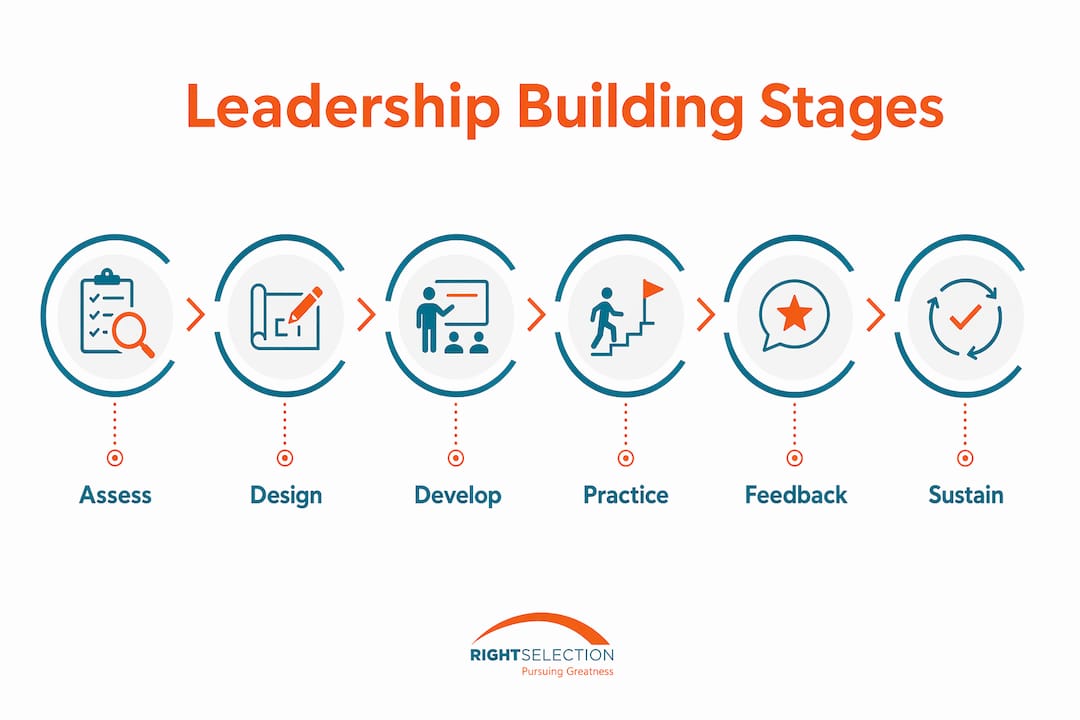
The compound effect of this process is significant. Organizations that run structured, multi-stage programs build a pipeline of capable leaders who are ready to step into expanded roles without extended ramp-up periods.
Which leadership skills have the strongest research support for effectiveness?
Not all leadership skills carry equal weight. Research supports focusing on a lean set of 5–7 high-impact skills rather than sprawling competency frameworks with 20–30 traits. That focus produces clearer measurement and more targeted development.
The five skills with the strongest evidence base for leadership effectiveness are:
- Communication. The ability to convey direction clearly, listen actively, and adapt messaging to different audiences.
- Decision-making. Sound judgment under uncertainty, including the ability to act with incomplete information and course-correct quickly.
- Emotional intelligence. Self-awareness, empathy, and the ability to regulate one’s own responses while reading the emotional state of a team.
- Trust-building. Consistency between words and actions that creates psychological safety and team cohesion over time.
- Coaching and development orientation. The habit of growing others through feedback, delegation, and deliberate stretch assignments.
These five skills appear repeatedly in meta-analytic research as predictors of team performance, employee engagement, and organizational outcomes. Broad competency lists that include traits like “strategic vision” or “executive presence” often lack the same empirical grounding and are harder to measure or develop.
Pro Tip: When designing a leadership effectiveness training program, select no more than seven skills to develop in any given cycle. Fewer targets mean clearer feedback, faster progress, and stronger accountability from both leaders and their managers.
Enhancing leadership abilities in these specific areas produces a measurable compound effect. A leader who improves communication and trust-building simultaneously creates a team environment where decision-making accelerates and innovation becomes more likely.
How can organizations design effective leadership development programs?
Program design is where most organizations lose momentum. The critical distinction is between leadership training and leadership development. Training is an event. Development is a process. Capability building belongs firmly in the second category.
Co-ownership between HR and leadership teams is the single most important structural decision in program design. When HR owns the program alone, it risks becoming disconnected from real business priorities. When line leaders own it alone, it lacks consistency and rigor. Shared accountability increases both the relevance and the engagement of participants.
Effective program design follows four principles:
- Anchor skills to business outcomes. Define what leadership behaviors will directly support the organization’s top three priorities for the next 12–18 months. This prevents programs from becoming generic.
- Build in coaching. One-off training fails to produce lasting behavior change. Pairing formal learning with executive coaching or peer coaching creates the reflection loops that embed new habits.
- Measure behavior, not attendance. Track whether leaders are applying new skills in their roles, not whether they completed a module. Behavioral observation, manager feedback, and 360-degree reviews are the right instruments.
- Integrate on-the-job learning. Stretch assignments, cross-functional projects, and real-time problem-solving are among the most effective vehicles for building leadership capacity. Classroom learning alone cannot replicate them.
MBA-level consulting frameworks increasingly inform how organizations structure leadership development, particularly in linking individual skill growth to organizational strategy. That connection between personal development and business impact is what separates programs that earn continued investment from those that get cut in the next budget cycle.
What are practical strategies for sustaining leadership capability building?
Sustaining leadership development over time requires embedding it into the daily rhythm of work. Learning embedded in the flow of work through on-the-job training, knowledge management systems, and peer learning creates continuous feedback loops that outlast any single program.
| Common pitfall | Recommended practice |
|---|---|
| Relying on annual training events | Use spaced, ongoing learning spread across the year |
| Bloated competency frameworks | Focus on 5–7 validated, measurable skills |
| HR-only program ownership | Build shared accountability with line leadership |
| Measuring course completion | Track observable behavior change over time |
| Treating development as a cost | Position it as a retention and performance investment |
Peer learning is underused in most organizations. Structured peer cohorts, where leaders at similar levels share challenges and solutions, accelerate development faster than solo learning because they create real accountability and diverse perspectives.
Leadership engagement is non-negotiable. When senior leaders visibly participate in development programs, whether as learners, coaches, or sponsors, participation rates and behavior change both increase. When senior leaders treat development as something that happens to others, the signal to the organization is clear and damaging.
Scaling leadership development requires a modular approach. Programs designed in discrete, adaptable units can be deployed across business units, geographies, and leadership levels without rebuilding from scratch each time. That modularity also makes it easier to update content as organizational priorities shift.
Key Takeaways
Leadership capability building produces lasting results only when it combines structured assessment, focused skill development, and continuous feedback embedded in daily work.
| Point | Details |
|---|---|
| Define capability building clearly | It is a structured, long-term process, not a one-time training event. |
| Focus on 5–7 high-impact skills | Communication, decision-making, and emotional intelligence have the strongest research support. |
| Co-own program design | HR and line leadership must share accountability for relevance and rigor. |
| Measure behavior change | Track observable skill application, not course completion rates. |
| Embed learning in daily work | On-the-job practice, peer learning, and coaching sustain gains over time. |
Where leadership development gets personal
I have worked with enough organizations to recognize a pattern that rarely gets named directly. The leaders who struggle most are not the ones who lack intelligence or ambition. They are the ones who were promoted because they excelled as individual contributors and then received no structured support for the entirely different skill set that leadership demands.
Power skills like trust-building, engagement, and fostering innovation are the most critical and most neglected capabilities in modern organizations. What looks like a personality flaw in a struggling leader is almost always a remediable skill gap. That reframing matters enormously, because it shifts the response from writing someone off to investing in their development.
The organizations I respect most treat leadership capability building as a continuous discipline, not a remediation program. They assess regularly, develop deliberately, and measure honestly. They also understand that the types of leadership development programs that produce the best outcomes are those designed around specific business needs rather than off-the-shelf content.
The competitive advantage of consistent leadership development compounds over years. Organizations that start now build a leadership bench that is genuinely difficult for competitors to replicate.
— Dipti
Right Selection’s approach to leadership capability building
Right Selection has spent over 30 years curating an elite network of global thought leaders, coaches, and corporate trainers who specialize in building leadership capability at every organizational level. The focus is always on measurable outcomes, not generic content delivery.

Each program is designed around your organization’s specific priorities, with session design and speaker curation aligned to the leadership skills that matter most for your context. Whether you need a leadership coaching engagement with a recognized expert or a full capability-building program for your leadership pipeline, Right Selection matches the right expertise to your goals. Explore Right Selection’s full suite of leadership development solutions, or book a complimentary coaching call to discuss your organization’s specific needs.
FAQ
What is leadership capability building?
Leadership capability building is a structured, long-term process of developing the knowledge, skills, behaviors, and cognitive patterns leaders need to perform effectively at various organizational levels. It combines formal learning, coaching, practice, and ongoing feedback rather than relying on single training events.
How is leadership capability building different from leadership training?
Leadership training is a discrete event, while leadership capability building is an ongoing development process. Programs that rely on one-off training fail to produce lasting behavior change, whereas capability building integrates practice, reflection, and coaching measured over time.
Which leadership skills should organizations prioritize?
Research supports focusing on 5–7 high-impact skills, including communication, decision-making, emotional intelligence, trust-building, and coaching orientation. Bloated competency frameworks with 20–30 traits dilute development focus and make measurement harder.
How do you measure the success of a leadership development program?
Measure observable behavior change in leaders’ actual roles, not course completion rates. Tools like 360-degree feedback, manager observation, and performance data tied to business outcomes provide the most reliable indicators of program effectiveness.
Why do leadership capability programs fail?
Most programs fail because they rely on one-off training, lack co-ownership between HR and line leadership, or measure attendance instead of behavior change. Sustainable programs embed learning in daily work and maintain continuous feedback loops across the development cycle.