
Coaching is defined as an ongoing, personalized process that creates a motivating climate by improving clarity, support, feedback, and recognition to align actual performance with expectations, as established by MIT Human Resources. The role of coaching in employee development goes well beyond motivation. It directly closes performance gaps, builds emotional competence, and increases the probability that employees achieve meaningful goals. For corporate leaders and HR professionals, understanding how coaching works, what the research proves, and how to implement it effectively is no longer optional. It is the difference between a workforce that grows and one that stagnates.
What does research say about coaching’s impact on employee development?
The evidence for coaching’s effectiveness is now statistically precise. A January 2026 meta-review of 15,278 participants found that coaching interventions produce a moderate-to-strong positive effect (Hedges’ g ≈ 0.58) across professional performance, goal attainment, emotional competence, and self-awareness. That effect size places coaching in the same performance tier as other well-validated organizational interventions, which means you can defend coaching investment with hard numbers.
The impact extends directly to engagement. A February 2026 study of 9,341 employees found that leader coaching behavior significantly strengthens the relationship between goal-focused leadership and employee person-job fit, which in turn drives higher work engagement. When a manager coaches with intention, employees feel more aligned with their roles. That alignment is not a soft outcome. It reduces turnover risk and increases discretionary effort.
Executive coaching produces particularly strong results at the leadership level. A meta-analysis of 37 randomized controlled trials confirmed statistically significant improvements in leader behavior, with the strongest gains in cognitive behaviors such as complex goal-setting and developmental planning. The same analysis found that executive coaching reliably decreases burnout symptoms while increasing vigor, self-efficacy, and resilience. That combination of performance gain and wellbeing improvement makes coaching one of the highest-return development investments available.
“Coaching changes not only confidence but specific leadership behaviors and complex cognitive skills — the exact capabilities organizations need most in uncertain environments.”
| Outcome Area | Effect / Finding | Source |
|---|---|---|
| Professional performance | Hedges’ g ≈ 0.58 (moderate-to-strong) | 2026 meta-review, 15,278 participants |
| Work engagement | Significantly increased via leader coaching behavior | 2026 study, 9,341 employees |
| Cognitive leader behaviors | Statistically significant improvement | Meta-analysis, 37 RCTs |
| Burnout reduction | Reliably decreased with increased vigor | Frontiers in Psychology, 2023 |
How does coaching differ from traditional training?
Training and coaching are not interchangeable. Training delivers knowledge and skills in a structured, time-bound format. Coaching translates that knowledge into sustained, personalized behavior change over time. The distinction matters because most organizations invest heavily in training seminars and see limited long-term behavior change. Coaching fills that gap.

A systematic review of leadership development program outcomes confirmed that coaching and training serve complementary functions, with coaching most effective when it follows training. Training provides the conceptual framework. Coaching converts that framework into observable habits through repeated application, feedback, and accountability.
| Dimension | Traditional Training | Coaching |
|---|---|---|
| Format | Group, time-bound sessions | One-on-one, ongoing |
| Focus | Knowledge and skill transfer | Behavior change and application |
| Accountability | Low (self-directed post-session) | High (coach holds coachee accountable) |
| Personalization | Generic curriculum | Tailored to individual goals |
| Sustainability | Fades without reinforcement | Builds through iterative practice |
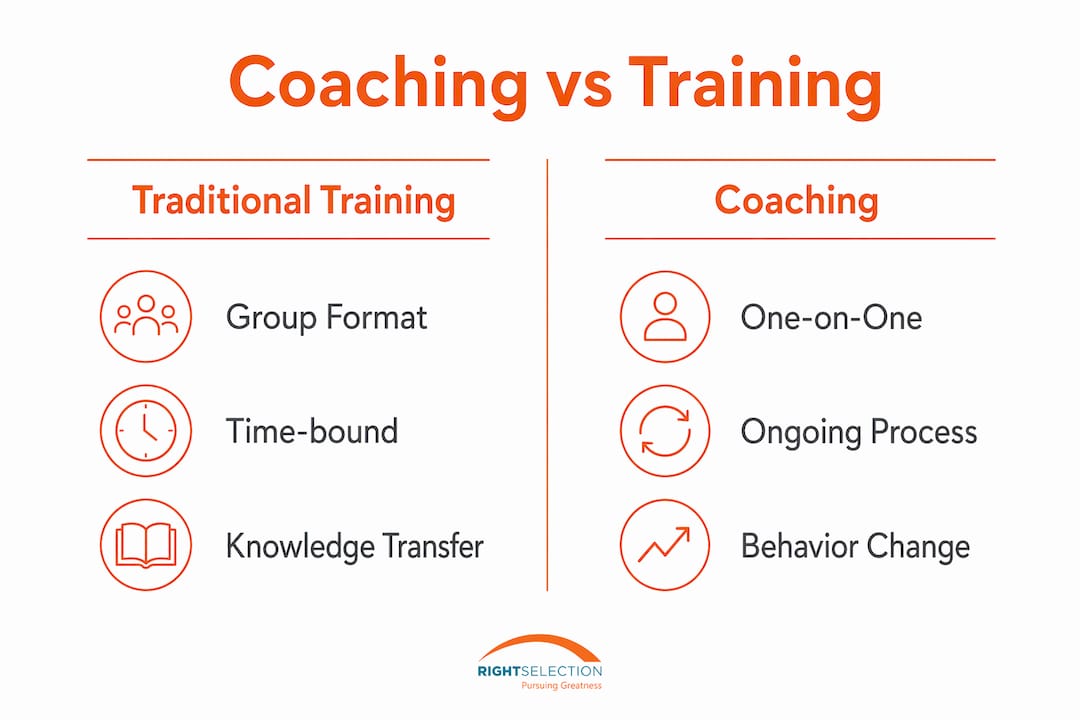
The research on executive coaching confirms that cognitive behavior improvements such as goal-setting, habit adoption, and developmental planning are areas where coaching outperforms seminars. Training can introduce these concepts, but coaching is what makes them stick. Organizations that treat coaching as a standalone replacement for training miss the compound effect of combining both within a coherent development architecture.
Pro Tip: Schedule coaching sessions within two weeks of any major training event. That timing window is when new knowledge is most available for conversion into behavioral practice.
What factors determine whether coaching actually works?
Coaching does not automatically produce results. Three factors consistently determine whether a coaching engagement succeeds or fails.
- Trust and relationship quality. The coach-coachee relationship is the primary vehicle for change. Without psychological safety, coachees withhold honest reflection, and the coaching process becomes performative. Selecting coaches with strong interpersonal credibility is not a preference. It is a prerequisite.
- Goal specificity. Vague goals produce vague outcomes. Coaching goals must be behavioral, measurable, and tied to real work contexts. “Become a better communicator” is not a coaching goal. “Deliver structured feedback to direct reports within 48 hours of a performance event” is.
- Internal motivation. Coaching changes observable behaviors and complex cognitive habits, not just self-confidence. That level of change requires the coachee to want it. Coaching assigned as a corrective measure without genuine buy-in from the employee rarely produces lasting results.
Organizational support is the fourth, often overlooked factor. When managers and senior leaders actively reinforce coaching goals in day-to-day work, behavior change compounds. When the organization ignores coaching outcomes, even motivated coachees revert to old patterns. HR professionals who design coaching programs must build reinforcement mechanisms into the broader performance management system.
Pro Tip: Before launching a coaching engagement, ask the coachee to write down three specific behaviors they want to change and why those changes matter to them personally. That exercise surfaces motivation levels and sets a behavioral baseline.
How do you integrate coaching into employee development programs?
Effective integration requires deliberate design, not ad hoc deployment. The following steps reflect employee coaching best practices drawn from organizational research and practitioner experience.
Align coaching goals with organizational priorities. Every coaching engagement should connect to a business outcome. Leadership pipeline development, succession planning, and engagement improvement are all legitimate anchors. Coaching without organizational alignment becomes a personal development benefit rather than a strategic investment.
Select coaches based on fit, not just credentials. A coach’s technical background matters less than their ability to build trust, ask precise questions, and hold coachees accountable. For leadership development specifically, coaches with direct experience in the coachee’s industry or functional area tend to accelerate the trust-building phase.
Sequence coaching after training. As the systematic review evidence confirms, coaching is most effective when it follows structured learning. Build your development calendar so that coaching engagements begin within weeks of relevant training programs, not months later.
Define measurement criteria upfront. Decide before the engagement begins how you will assess progress. Behavioral observation, 360-degree feedback tools, and goal completion rates are all valid measures. Waiting until the end of a coaching cycle to think about measurement produces anecdotal evidence, not organizational learning.
Build coaching into leadership pipelines. Transformational coaching, which guides individuals toward personal and professional transformation by enhancing critical thinking and leadership qualities, is particularly effective for high-potential employees moving into expanded roles. Organizations that reserve coaching only for remediation miss its highest-value application.
Review and adjust regularly. Coaching is iterative. Mid-cycle check-ins between HR, the coach, and the coachee allow for goal recalibration when business priorities shift. Rigid coaching contracts that ignore changing organizational context produce outdated outcomes.
The importance of coaching for employees becomes most visible when these steps are executed with consistency. Organizations that treat coaching as a structured program rather than an informal perk see measurably better retention, engagement, and leadership readiness. For leaders looking to strengthen the broader development architecture, executive leadership training paired with coaching creates the most durable results.
Key takeaways
Coaching produces measurable, research-backed improvements in performance, engagement, and leadership behavior when it is structured around clear goals, strong relationships, and organizational reinforcement.
| Point | Details |
|---|---|
| Coaching effect size is proven | A 2026 meta-review of 15,278 participants shows a moderate-to-strong effect (g ≈ 0.58) on performance and goal attainment. |
| Coaching and training are complementary | Coaching is most effective when it follows training, converting knowledge into sustained behavioral change. |
| Three factors drive success | Trust, goal specificity, and internal motivation determine whether a coaching engagement produces lasting results. |
| Cognitive behaviors change most | Executive coaching produces the strongest gains in complex goal-setting, developmental planning, and habit adoption. |
| Integration requires deliberate design | Aligning coaching goals with business priorities and measuring outcomes upfront separates strategic programs from informal perks. |
Why coaching is the development investment leaders keep underestimating
I have spent years working alongside organizations that invest generously in training calendars and then wonder why behavior does not change. The answer is almost always the same. Training without coaching is like reading a manual and never practicing the skill. The knowledge exists. The application does not.
What the 2026 research confirms is something practitioners have observed for a long time. Coaching works at the cognitive level, not just the motivational one. It changes how people think about goal-setting, how they plan development conversations, and how they respond under pressure. Those are not soft skills. They are the exact capabilities that determine whether a leader scales with the organization or becomes a bottleneck.
The trend I find most significant right now is the integration of transformational coaching into leadership pipelines. Organizations are no longer asking coaches to fix underperformers. They are asking coaches to accelerate high-potential employees who are already performing well. That shift in application reflects a more mature understanding of what coaching actually does. It does not repair people. It compounds their existing strengths.
My honest advice to any HR leader reading this: stop treating coaching as a remediation tool and start treating it as a growth accelerator. The organizations that make that shift consistently report stronger leadership bench depth, higher engagement scores, and better retention of top talent. The research supports it. The compound effect of consistent, well-designed coaching over 12 to 24 months is substantial. The only question is whether you are willing to commit to the timeline.
— Dipti
Explore coaching solutions built for organizational impact
Right Selection connects corporate leaders and HR professionals with an elite network of coaches and thought leaders who specialize in measurable performance improvement. With over 30 years of experience and a roster of 100+ speakers and coaches, Right Selection designs tailored coaching programs aligned with your specific business goals.
Coaches like Phil Bedford and Nour Zougheib bring deep expertise in leadership development and executive performance, working directly with organizations to produce outcomes you can measure. Whether you are building a leadership pipeline or addressing specific performance gaps, Right Selection curates the right coaching match for your context. Explore the full range of coaching and development programs available through Right Selection today.
FAQ
What is the role of coaching in employee development?
Coaching is a personalized, ongoing process that improves performance, emotional competence, and goal attainment by creating a motivating climate of clarity, feedback, and support. A 2026 meta-review of 15,278 participants confirmed a moderate-to-strong positive effect across all four of those outcome areas.
How does coaching improve performance differently than training?
Training transfers knowledge in group settings, while coaching converts that knowledge into sustained behavioral change through one-on-one accountability and iterative practice. Research confirms coaching is most effective when it follows structured training rather than replacing it.
What makes a coaching engagement succeed or fail?
Coaching success depends on three factors: the quality of the coach-coachee relationship, the specificity of behavioral goals, and the coachee’s internal motivation to change. Organizations that also reinforce coaching goals through day-to-day management see significantly stronger outcomes.
Does executive coaching reduce burnout?
Yes. A meta-analysis of 37 randomized controlled trials found that executive coaching reliably decreases burnout symptoms while increasing vigor, self-efficacy, and resilience in leaders. That combination makes coaching one of the few development interventions with both performance and wellbeing benefits.
How should HR professionals measure coaching outcomes?
Define measurement criteria before the engagement begins, using behavioral observation, 360-degree feedback, and goal completion rates as primary indicators. Mid-cycle reviews allow for goal recalibration and produce organizational learning rather than anecdotal end-of-program impressions.